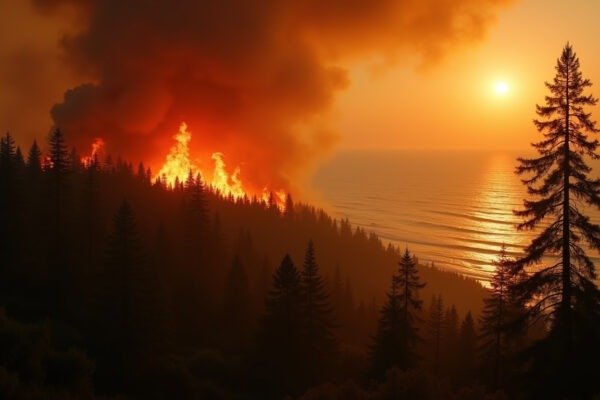
The Ontario wildfires 2026 season erupted in mid-July as nearly 200 forest fires burned across northern Ontario. The blazes forced wildfire evacuations Ontario in at least 15 communities and sent hazardous Canadian wildfire smoke across 19 U.S. states.
Toronto air quality briefly ranked as the worst in the world. In Milwaukee, the Air Quality Index hit 644 on July 16, a level so far beyond the EPA’s Hazardous threshold that the scale had no category for it.
What Happened: The Ontario Wildfires 2026 Outbreak
More than 135 wildfires were burning across northwestern Ontario by July 16, with at least 60 listed as out of control. The fires concentrated near Thunder Bay, a city on Lake Superior roughly an hour from the Minnesota border. New fires continued to start throughout the week as hot, dry conditions refused to let up.
Provincial officials ordered evacuations in communities home to more than 1,500 people. Several First Nations and rural communities were evacuated south to Thunder Bay.
Highways across the region closed entirely, cutting off ground access to multiple towns. Evacuees described scenes of trees vanishing in seconds as flames tore through the boreal forest (NYT, CP24).
By July 16, air quality alerts covered 18 states from the Great Lakes through the Northeast and down into the Mid-Atlantic. New York Governor Kathy Hochul warned of hazy skies and poor air quality.
Toronto’s skies turned an eerie orange, and GO Transit reported schedule delays from reduced visibility (ABC News, Yahoo News).
This is part of a broader pattern. Wildfire smoke now routinely crosses continents, affecting air quality thousands of miles from the flames.
Why the Ontario Wildfires 2026 Are So Severe
The fires were triggered primarily by lightning strikes across a landscape primed to burn. Drought conditions across much of Canada combined with persistent heat to create what scientists call a fire weather pattern. Dan Westervelt, an associate professor at Columbia University’s Climate School, described it as a perfect storm of dry conditions providing abundant fuel for the fires (AOL / Columbia Climate School).
The science is straightforward. When temperatures stay high for weeks and rain stays away, forests dry out. The professional term is fuel availability: the amount of dry organic material ready to ignite.
Lightning provides the spark. In Ontario, dozens of new fire starts were attributed to lightning (northjersey.com).
British Columbia cited drought conditions and forecast lightning activity as its primary concerns. Across Canada, 859 active fires were burning by July 16, and nearly 5.9 million acres had burned so far in 2026. The national fire season was running well above average, driven by the same heat dome pattern that pushed temperatures above 110 degrees Fahrenheit across the American West and Europe in the same week.
The western United States is burning earlier and hotter this year for the same reasons. The Aspen Acres Fire in Colorado has already burned 100,000 acres, destroyed 851 structures, and become the state’s eighth-largest wildfire on record. This is not a one-province problem. It is a continental one.
How the Smoke Affects People
The health impact was immediate and severe. In Milwaukee, the Air Quality Index reached 644 on July 16. For context, the EPA’s Hazardous category starts at 301, and anything above 500 is considered beyond the scale (Medical Daily).
Emergency rooms across the Great Lakes region reported increases in asthma-related visits. Schools canceled outdoor activities. The smoke carried fine particulate matter known as PM2.5, particles small enough to enter the bloodstream through the lungs. Wildfire smoke health risks now affect millions of people far from any active fire.
For the 1,500 people evacuated from their homes, the impact was far more personal. Entire communities emptied out as flames approached. First Nations communities, many accessible only by seasonal roads or air, faced particular challenges getting residents to safety.
Evacuations disrupted work, separated families, and left people uncertain about what they would return to.
The economic toll spread across multiple sectors. Transportation slowed as highways closed and visibility dropped. Outdoor workers from construction crews to delivery drivers lost workdays.
The tourism industry in Ontario faced cancellations as images of orange skies circulated globally. Forestry communities that depend on timber resources braced for losses that could take years to recover.
Why the Ontario Wildfires 2026 Matter Now
The Ontario fires are not an isolated incident. They are part of a global pattern that has made 2026 another extreme fire year. Canada’s 2023 wildfire season burned 45 million acres and sent smoke across the Atlantic to Europe. The 2024 and 2025 seasons were also above average.
Scientists have warned that a warming climate extends the fire season earlier into spring and later into fall. The Fire Year concept, where large wildfires burn somewhere on the continent in every month, has become a documented reality.
The cross-border smoke crisis highlights a growing challenge. Wildfire smoke travels farther than it used to, and more people are breathing it.
A study published in 2025 found that wildfire smoke PM2.5 exposure has undone decades of air quality improvement in the western United States. The Ontario fires extended that pattern eastward, reminding millions of Americans that they are not insulated from disasters burning hundreds of miles away.
What We Can Learn
The Ontario wildfires 2026 reinforce a lesson that fires in places like California and Australia, and across the Mediterranean, have repeated for years: preparation saves lives. Communities with evacuation plans in place moved faster.
People who owned N95 masks from previous smoke seasons used them. Air quality alerts worked when people paid attention.
The practical takeaway is not complicated. Know your Air Quality Index. Keep masks accessible. Have a go-bag ready if you live in a fire-prone region.
Beyond individual preparedness, the fires underscore the need for investment in early detection systems, fire-resilient community design, and climate adaptation strategies. Canada has expanded its firefighting budget significantly since 2023.
Ontario’s Aviation, Forest Fire and Emergency Services now deploys faster than ever. The speed of response is improving. The question is whether it can keep pace with the speed of the fires themselves.
Key Facts: Nearly 200 fires in northern Ontario, 60+ out of control. At least 15 communities evacuated, 1,500+ people displaced. 859 active fires across Canada, 5.9 million acres burned nationwide. Smoke triggered alerts in 18 to 19 U.S. states. Milwaukee AQI hit 644 (Hazardous threshold: 301). Toronto air quality briefly ranked worst in the world. Primary cause: lightning on drought-stressed forests.
Design Notes
Featured Image: Aerial photograph of wildfire smoke plumes rising from boreal forest in northern Ontario, with orange-tinted sky. Use existing featured image (ID 4644).
Body Image 1, Evacuations: Photo of evacuees at Thunder Bay reception center or highway closure with smoke in distance. Placement: After “What Happened” section, before “This is part of a broader pattern” paragraph. Alt text: “Evacuated residents register at a Thunder Bay reception center as wildfire smoke fills the sky behind them, Ontario, July 2026.”
Body Image 2, Air Quality Map: Map or infographic showing PM2.5 levels across Great Lakes and Northeast U.S. on July 16, 2026, with Milwaukee AQI 644 highlighted. Placement: After “How the Smoke Affects People” section intro paragraph. Alt text: “Air quality map showing hazardous PM2.5 levels across the Great Lakes region on July 16, 2026, with Milwaukee AQI reaching 644.”
NWH Editorial Standards: This article follows the NWH Editorial Standards for source attribution, fact-checking, and science communication. All external claims are linked to their original sources.