Record-Breaking June Heat Wave Sweeps Across Southern Europe: What Communities Are Facing
What’s Happening
In the final days of June 2025, Southern and Western Europe baked under two successive heat waves that shattered national temperature records, strained power grids, and ignited wildfires from Portugal to Turkey. The western half of the continent registered its warmest June since records began, with an average temperature of 20.49°C, a full 2.81°C above the 1991-2020 baseline. [SOURCE: https://climate.copernicus.eu/heatwaves-contribute-warmest-june-record-western-europe]
Portugal recorded 46.6°C (115.9°F) in Mora, roughly 100 kilometers east of Lisbon, on June 29. It was a new national record for June, eclipsing the previous mark of 44.9°C set in 2017. [SOURCE: https://en.wikipedia.org/wiki/2025_European_heatwaves] Spain followed close behind. The town of El Granado in Huelva province hit 46.0°C (114.8°F) on June 28, breaking a national June record that had stood since 1965. [SOURCE: https://en.wikipedia.org/wiki/2025_European_heatwaves]
Italy placed 21 cities under its highest-level red alert, including Rome, Milan, and Naples. France saw 84 departments placed under orange heatwave alerts, a record number, and Cadenet reached 41.4°C. [SOURCE: https://en.wikipedia.org/wiki/2025_European_heatwaves] Greece sweltered through its second-hottest June on record, with Skala in Messenia touching 43.2°C. [SOURCE: https://en.wikipedia.org/wiki/2025_European_heatwaves] Even the United Kingdom felt the heat: England experienced its hottest June since 1884, and London recorded 35°C on the hottest opening day of Wimbledon ever observed. [SOURCE: https://www.euronews.com/2025/06/30/southern-europe-sizzles-under-severe-heatwave-sparking-wildfire-warnings]
Beneath the surface, the western Mediterranean was simmering too. Sea surface temperatures reached 27.0°C on June 30, the highest June value ever recorded, with an anomaly of +3.7°C, the largest daily departure from normal for any month in the basin’s recorded history. [SOURCE: https://climate.copernicus.eu/heatwaves-contribute-warmest-june-record-western-europe]
Why It’s Happening
A persistent high-pressure system, a heat dome, parked itself over Western Europe and acted as a lid. It drew Saharan air northward, compressed it downward, and blocked cooler Atlantic weather systems from breaking through. [SOURCE: https://theconversation.com/2025s-first-summer-heatwave-was-early-and-deadly-for-all-of-western-europe-261043] The timing, around the summer solstice on June 21, meant the sun was at its peak, and cloudless skies allowed maximum solar radiation to strike the surface. The result was a self-reinforcing furnace.
But the intensity of the heat carries a deeper fingerprint. A rapid attribution study by Imperial College London and the London School of Hygiene and Tropical Medicine concluded that human-caused climate change made the June-July 2025 heat wave 1 to 4°C hotter than it would have been in a pre-industrial world. [SOURCE: https://www.lshtm.ac.uk/newsevents/news/2025/first-analysis-estimate-number-heatwave-deaths-linked-climate-change] The researchers found that roughly 1,500 of the approximately 2,300 heat-related deaths during a 10-day period were directly attributable to climate change. Without global warming, the death toll would have been roughly one-third of the observed figure. [SOURCE: https://www.lshtm.ac.uk/newsevents/news/2025/first-analysis-estimate-number-heatwave-deaths-linked-climate-change]
Europe is the fastest-warming continent on Earth, heating at 0.53°C per decade since the mid-1990s, roughly twice the global average. [SOURCE: https://www.aljazeera.com/news/2025/7/16/why-is-europe-facing-record-breaking-heatwaves] More than two-thirds of the most severe European heat waves since 1950 have occurred since the year 2000. [SOURCE: https://wmo.int/media/news/extreme-heat-grips-europe]
“Climate change has made it significantly hotter than it would have been, which in turn makes it a lot more dangerous.”
Dr. Ben Clarke, Imperial College London [SOURCE: https://www.aljazeera.com/news/2025/7/16/why-is-europe-facing-record-breaking-heatwaves]
Human Impact
Health: The Quiet Toll
Heat is often called the silent killer, and the June 2025 heat wave bore that out. Approximately 2,300 excess deaths were documented across 12 European cities during a 10-day window from June 23 to July 2. Milan recorded 317 deaths attributable to climate change; Barcelona, 286; Paris, 235; London, 171; Rome, 164; and Madrid, 108. [SOURCE: https://www.lshtm.ac.uk/newsevents/news/2025/first-analysis-estimate-number-heatwave-deaths-linked-climate-change] Over 80 percent of excess deaths occurred among people older than 65. [SOURCE: https://www.aljazeera.com/news/2025/7/16/why-is-europe-facing-record-breaking-heatwaves]
The true toll is almost certainly higher. Most victims die at home or in hospitals from pre-existing conditions worsened by heat, and heat is rarely listed as a contributing cause on death certificates. Official mortality data typically takes about six months to publish. [SOURCE: https://www.lshtm.ac.uk/newsevents/news/2025/first-analysis-estimate-number-heatwave-deaths-linked-climate-change] By summer’s end, an estimated 16,500 people had died from heat across 854 European cities. Spain’s environment ministry alone recorded 1,180 heat-related deaths in just two months. [SOURCE: https://en.wikipedia.org/wiki/2025_European_heatwaves] [SOURCE: https://www.aljazeera.com/news/2025/7/16/why-is-europe-facing-record-breaking-heatwaves]
Infrastructure Under Strain
The heat pushed energy systems to their limits. France’s Golfech nuclear plant on the Garonne River shut down completely when water temperatures rose too high to cool the reactors safely. At least 7 gigawatts of French nuclear capacity went offline on July 1 and 2, affecting up to 15 percent of the national fleet. Switzerland’s Beznau plant halved its output and shut one reactor. [SOURCE: https://www.reuters.com/sustainability/climate-energy/two-die-spain-wildfire-two-deaths-france-european-heatwave-2025-07-02/]
Electricity demand surged: 14 percent in Spain, 9 percent in France, and 6 percent in Germany. Wholesale power prices nearly tripled in Germany and more than doubled in France and Poland. [SOURCE: https://ember-energy.org/latest-insights/heat-and-power-impacts-of-the-2025-heatwave-in-europe/] Record solar generation, 45 terawatt-hours across the EU in June, up 22 percent year-on-year, helped prevent blackouts, but the margin was thin. [SOURCE: https://ember-energy.org/latest-insights/heat-and-power-impacts-of-the-2025-heatwave-in-europe/]
Wildfires and Displacement
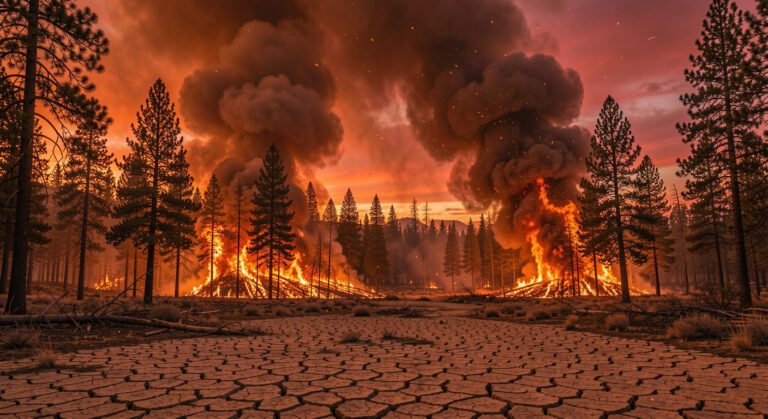
Active wildfires burned in Greece, Spain, Portugal, France, Turkey, and Germany. A large blaze south of Athens near the Temple of Poseidon forced the evacuation of 40 people from five areas. Authorities deployed 130 firefighters, 12 planes, and 12 helicopters to contain it. [SOURCE: https://www.euronews.com/2025/06/30/southern-europe-sizzles-under-severe-heatwave-sparking-wildfire-warnings] In Turkey, forest fires fanned by strong winds damaged holiday homes in Izmir’s Doğanbey region. Izmir airport was temporarily closed and four villages were evacuated. Earlier blazes forced the temporary evacuation of roughly 50,000 people. [SOURCE: https://www.reuters.com/sustainability/climate-energy/two-die-spain-wildfire-two-deaths-france-european-heatwave-2025-07-02/]
In France, roughly 300 firefighters and water-dumping planes battled the season’s first significant forest fires, which consumed 400 hectares in the Aude region and forced tourist evacuations from a campground. [SOURCE: https://www.euronews.com/2025/06/30/southern-europe-sizzles-under-severe-heatwave-sparking-wildfire-warnings]
Why It Matters Now
The June 2025 heat wave was not an outlier. It was the latest chapter in an accelerating pattern. June 2025 was the third-warmest June globally since instrumental records began in 1850. Human-induced warming is now increasing at 0.27°C per decade, the highest rate ever recorded. [SOURCE: https://www.aljazeera.com/news/2025/7/16/why-is-europe-facing-record-breaking-heatwaves]
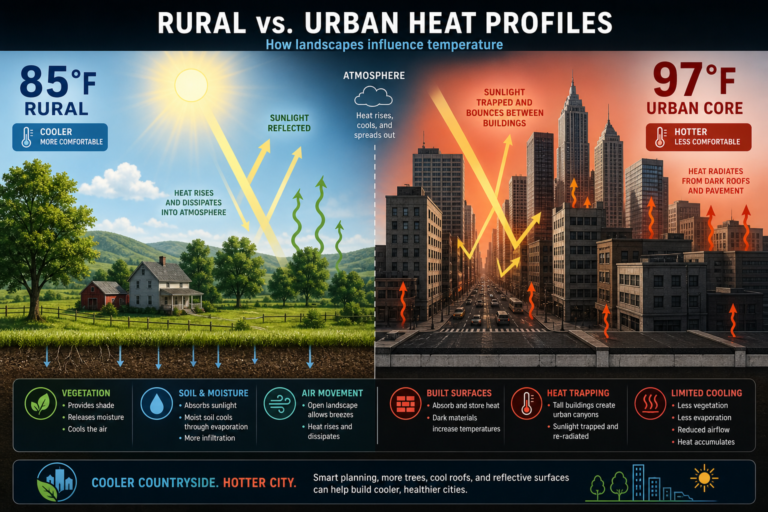
What happened in Southern Europe is a preview of what much of the world will face in the coming decades, and the region is not ready. Central and northern European countries, less accustomed to extreme heat, face significant adaptation deficits. Most homes and public spaces in these regions lack air conditioning, and lifestyles are not yet suited to withstanding temperatures that would have been unthinkable a generation ago. [SOURCE: https://theconversation.com/2025s-first-summer-heatwave-was-early-and-deadly-for-all-of-western-europe-261043]
The Lancet Public Health warned in 2024 that heat-related deaths in Europe could more than quadruple by mid-century under current climate policies. [SOURCE: https://www.euronews.com/2025/06/30/southern-europe-sizzles-under-severe-heatwave-sparking-wildfire-warnings] The marine heat wave that accompanied the June event, with local extremes above 28°C in the Gulf of Lion, more than 5°C above normal, is a reminder that the crisis extends beyond land. Warmer seas reduce nighttime coastal cooling, amplify humidity, and stress marine ecosystems. [SOURCE: https://climate.copernicus.eu/heatwaves-contribute-warmest-june-record-western-europe]
What Communities Are Doing
Across Southern Europe, the response mixed emergency measures with longer-term adaptation.
Italy’s Health Ministry placed 21 cities under level-3 red alert, the highest category, indicating emergency conditions that posed risks even to healthy individuals. [SOURCE: https://www.euronews.com/2025/06/30/southern-europe-sizzles-under-severe-heatwave-sparking-wildfire-warnings] Seven regions, including Lazio, Tuscany, and Sicily, imposed bans on outdoor labor during peak heat hours. [SOURCE: https://www.pennlive.com/nation-world/2025/06/severe-heat-waves-hit-southern-europe-as-local-authorities-warn-against-wildfire-risks.html] Bologna designated seven “climate refuges,” public spaces equipped with air conditioning, water, and seating for vulnerable residents. Rome offered free swimming pool access for seniors. Naples implemented hospital heatstroke treatment protocols. Florence assigned medical staff to check on isolated and at-risk residents. [SOURCE: https://responsibleus.com/southern-europe-heat-wave-2025-high-alerts-across-spain-italy-france-and-portugal]
France closed 2,213 schools on July 1. Misting stations appeared along the Seine in Paris. Health and Families Minister Catherine Vautrin enacted special care measures for homeless people, outdoor workers, and the elderly. [SOURCE: https://www.euronews.com/2025/06/30/southern-europe-sizzles-under-severe-heatwave-sparking-wildfire-warnings] Germany’s national weather service issued over 200 warnings through its hazard portal, a twentyfold increase from just 10 warnings on June 20. Some towns imposed water usage limits from rivers and lakes. [SOURCE: https://wmo.int/media/news/extreme-heat-grips-europe]
At the international level, the World Meteorological Organization activated its Coordination Mechanism to provide expert advice and curated data to national agencies. The EU’s Copernicus Climate Change Service supplied real-time monitoring of temperatures, heat stress, ozone pollution, and wildfire risk. [SOURCE: https://wmo.int/media/news/extreme-heat-grips-europe]
Yet experts caution that these measures, while necessary, are reactive. The countries that suffered most, Portugal, Spain, Italy, Greece, are the ones with the most experience managing extreme heat. As heat waves grow more frequent and more severe, the adaptation gap in northern and central Europe widens. The infrastructure, the building stock, and the public health systems of cities like London, Paris, and Berlin were not designed for sustained 40°C days. Changing that will take decades and trillions of euros. [SOURCE: https://theconversation.com/2025s-first-summer-heatwave-was-early-and-deadly-for-all-of-western-europe-261043]