How Coral Bleaching Events Are Accelerating in 2026 and Why It Matters
What’s Happening Beneath the Surface
The world’s coral reefs are in the grip of the most extensive bleaching event ever recorded. Since January 2023, bleaching-level heat stress has reached 84 percent of the planet’s coral reef areas, according to NOAA’s Coral Reef Watch. At least 83 countries and territories have documented mass bleaching within their waters. The numbers dwarf every previous global event.
The fourth global coral bleaching event was declared in April 2024 by NOAA and the International Coral Reef Initiative. It followed three earlier events, each larger than the last. The first, in 1998, affected 21 percent of reefs. The second, in 2010, reached 37 percent. The third, spanning 2014 to 2017, hit 68 percent. Now the fourth has surpassed them all, crossing 84 percent and still counting.
Scientists describe the pace as unprecedented. The gaps between global events are shrinking. What was once a once-a-decade crisis now threatens to become a near-annual reality. NOAA researchers have warned that mass coral bleaching could occur every year on the majority of reefs worldwide by 2050 if emissions continue on their current path.
The Great Barrier Reef tells the story in sharp relief. In 2025, the reef suffered its sixth mass bleaching event since 2016. It marked the second instance of back-to-back summer bleaching, with events in both 2024 and 2025. For the first time, both of Australia’s World Heritage reefs, the Great Barrier Reef and Ningaloo, bleached simultaneously.
“We know coral bleaching is accelerating as our oceans warm, driven by the world’s continued reliance on fossil fuels.”
President Surangel Whipps Jr., President of Palau
Why Reefs Turn White
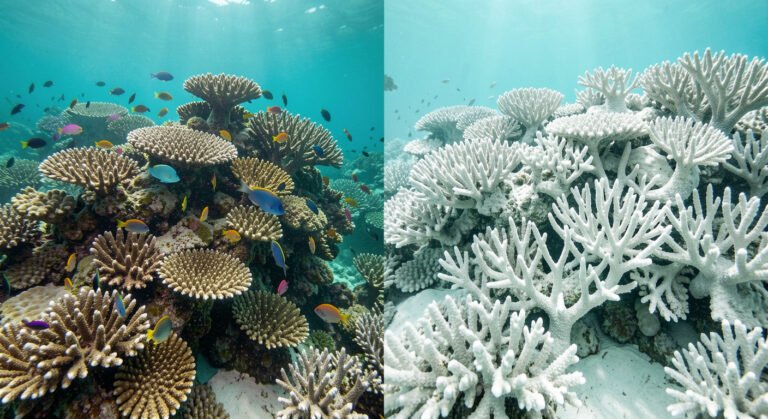
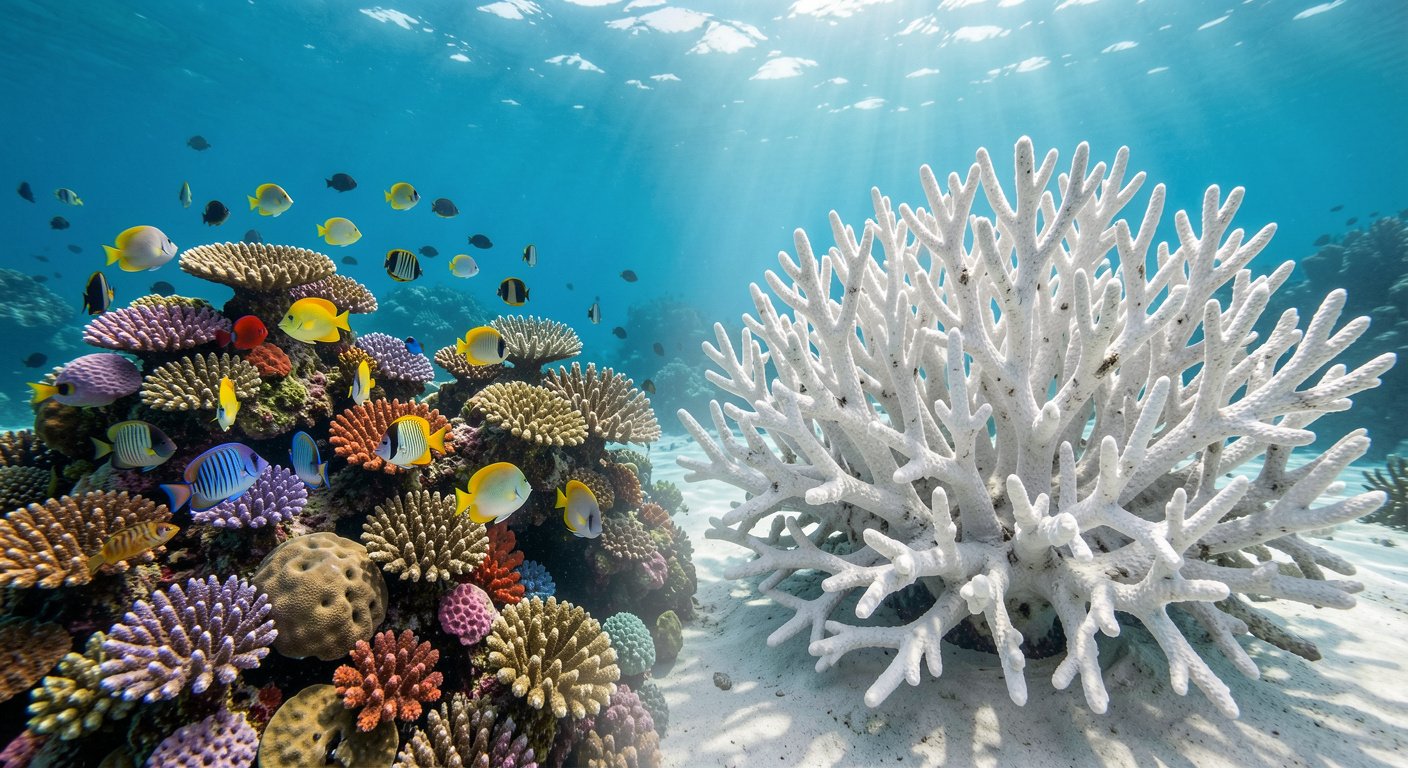
Coral bleaching is a stress response. When water temperatures rise too high for too long, corals expel the microscopic algae living inside their tissues. These algae, called zooxanthellae, give corals their color and supply up to 90 percent of their energy through photosynthesis. Without them, the coral’s transparent tissue reveals the white calcium carbonate skeleton beneath.
The temperature threshold is alarmingly low. A rise of just one degree Celsius sustained over four weeks can trigger bleaching. In many tropical waters, that margin has already been crossed repeatedly. Bleached corals are not dead, not yet. They can recover if waters cool quickly enough. But if the heat persists, they starve, become vulnerable to disease, and eventually die.
“Corals are bleaching and dying primarily because the Ocean is warming at an alarming rate. The Ocean is warming primarily because of accumulating greenhouse gases emitted by humankind’s ongoing burning of fossil fuels.”
Ambassador Peter Thomson, UN Secretary-General’s Special Envoy for the Ocean
Marine heatwaves have become both more frequent and more intense. In 2024, the world’s oceans experienced triple the previous record number of marine heatwaves. Ocean temperatures reached record-breaking highs. The year 2024 was officially the hottest on record and the first to exceed 1.5 degrees Celsius above pre-industrial levels. That number carries weight: it is the threshold the Paris Agreement aimed not to cross.
The link to climate change is direct. Greenhouse gas emissions trap heat in the atmosphere, and the ocean absorbs more than 90 percent of that excess heat. As the atmosphere warms, so does the sea. Coral reefs sit at the front line of that warming, with no ability to move to cooler water.
A New Scale for an Escalating Crisis
In early 2024, NOAA’s Coral Reef Watch revised its heat stress category system for the first time. The agency added three new Bleaching Alert Levels, 3, 4, and 5, to capture extreme heat stress that the old two-level system could no longer describe. Alert Level 5 signals a risk of more than 80 percent coral death on an affected reef.
The new levels reflect a grim reality: the old ceiling of Alert Level 2 was no longer sufficient to warn communities and managers about what was coming. Heat stress now routinely exceeds what was once considered the maximum.
One Billion People and a $10 Trillion Economy
Coral reefs are not just beautiful. They are essential. Roughly one-third of all known marine species depend on reefs at some point in their life cycle. An estimated one billion people benefit directly or indirectly from the food, jobs, and coastal protection that reefs provide. The economic value of these services has been calculated at $10 trillion per year.
Reefs act as natural breakwaters, absorbing wave energy and protecting coastlines from storms and erosion. They support fisheries that feed coastal communities across the tropics. They underpin tourism industries that sustain island and coastal economies. When reefs collapse, those protections and livelihoods collapse with them.
The cost of inaction is staggering. Research suggests that climate-driven coral loss could cost the global economy $500 billion annually by the end of this century. Coral coverage has already halved since the 1950s. The Global Coral Reef Monitoring Network documented a 14 percent decline in live coral cover between 2009 and 2018 alone.
“Coral reefs are humanity’s canary in the coal mine for much more than just climate change. What we choose to do to save them will determine their future and affect all life on earth.”
Dr. David Obura, Founding Director of CORDIO East Africa
Why 2026 Is a Critical Year
The fourth global bleaching event may have technically ended in late 2025, but its consequences are unfolding in 2026. Scientists are now assessing mortality rates, tracking which reefs survived, and measuring how much coral cover was lost across the tropics. Early field surveys suggest severe damage in multiple regions, including parts of the Caribbean, the Maldives, and the western Pacific.
The trajectory is clear and concerning. Each global bleaching event has been larger than the last. The intervals between them are getting shorter. The Great Barrier Reef, once considered resilient due to its size and protected status, has now bleached six times in nine years. The reef’s capacity to recover between events is eroding.
Current national climate policies put the world on a path toward roughly 2.7 degrees Celsius of warming by the end of the century. At that level, scientists project that 99 percent of tropical coral reefs would be lost. Even under more optimistic scenarios, the window to preserve functioning reef ecosystems is narrowing fast.
What Can Still Be Done
The situation is severe, but not hopeless. Conservationists and scientists are pursuing multiple strategies to give reefs a fighting chance. Coral restoration projects are expanding globally, with underwater nurseries growing fragments that can be transplanted onto damaged reefs. Researchers are selectively breeding heat-tolerant corals that can withstand warmer water. Efforts to reduce local pollution, stop overfishing, and improve water quality all help reduce the non-climate stress that weakens reefs.
These local actions matter. Healthy reefs under less local pressure can recover faster after bleaching events. But they are not a substitute for addressing the root cause. Without rapid and deep cuts to greenhouse gas emissions, even the most carefully restored reefs will face temperatures they cannot survive.
The economics of protection are compelling. Safeguarding the entire ocean, not just coral reefs, would cost less than two percent of the $10 trillion in annual value that the ocean provides to humanity. Spending on coral conservation needs to increase sevenfold to match the scale of the challenge, according to the International Coral Reef Initiative.
The message from scientists, island leaders, and international organizations is consistent: cutting emissions is the single most important action for coral survival. Every fraction of a degree of warming avoided means more reefs have a chance. Conservation can buy time, but only climate action can secure a future.
Reefs have survived for hundreds of millions of years through ice ages and mass extinctions. Whether they survive the Anthropocene depends on choices being made now.