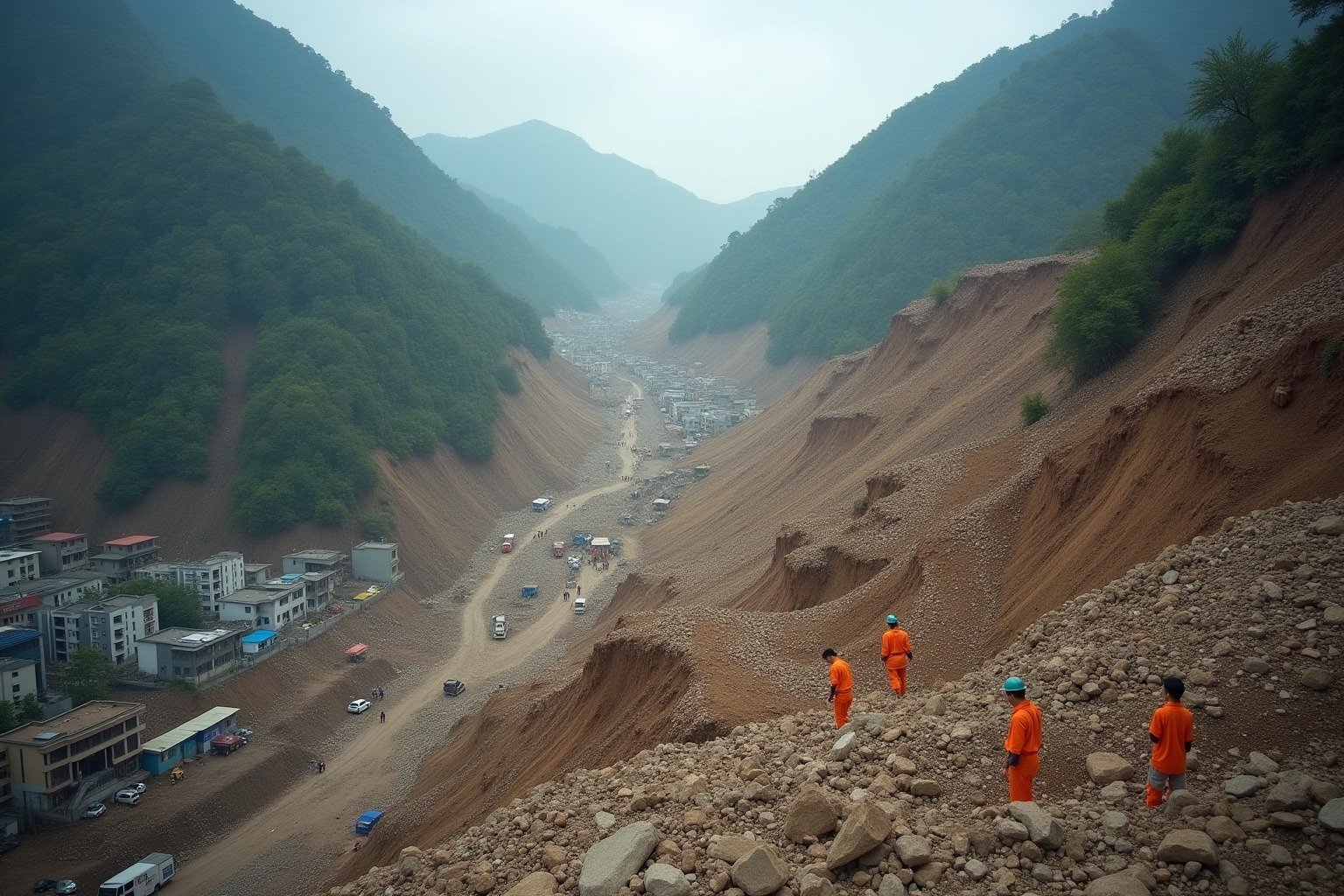
A wall of earth and rock collapsed onto residential buildings in southwestern China on the morning of July 17, 2026, burying homes, destroying a roadway, and trapping an unknown number of people beneath the rubble. Within hours, China activated a Level-II national emergency response, the second-highest disaster alert level. As of Friday afternoon, eight people are confirmed dead, at least 34 remain missing, and more than 1,100 residents have been evacuated from the danger zone.
The landslide struck Hanjia subdistrict in Pengshui Miao and Tujia autonomous county, part of the sprawling Chongqing municipality where the Wujiang River cuts through steep, erosion-prone terrain. Rescue teams pulled 10 survivors from the debris by 2 p.m. local time, according to China’s state-run Xinhua news agency. The search for dozens of missing residents continued into the night as emergency crews navigated unstable slopes and the constant threat of further collapse.
What Happened in Chongqing
The landslide occurred along a section of the Wujiang River in Pengshui county, a mountainous region in southeast Chongqing known for its dramatic karst landscape, deep river gorges, and heavy summer monsoon rainfall. Witnesses described a sudden collapse that swept away hillside homes and severed a major roadway. State media images showed rescue workers in orange uniforms digging through shattered concrete and splintered wood, surrounded by steep, scoured slopes where the earth had simply given way.
China’s Ministry of Emergency Management dispatched specialized geological disaster rescue teams to the site. The Level-II designation, issued within hours, unlocks national coordination of rescue assets, medical teams, and relief supplies. It is the same emergency tier activated for major earthquakes and typhoon landfalls. More than 1,100 people were evacuated from surrounding neighborhoods as geologists assessed whether additional slope failures were imminent.
Why the Chongqing Landslide Happened
The landslide was triggered by rainfall, but the conditions for disaster were set long before the rain began to fall.
The simple explanation: When heavy rain saturates soil on a steep slope, the water fills the spaces between soil particles and reduces the friction that holds the slope in place. At a certain threshold, gravity wins. Geologists call this rainfall-induced slope failure. The Wujiang River valley in Chongqing is particularly vulnerable because its terrain combines three dangerous ingredients: steep slopes carved by river erosion, a thick layer of weathered rock and soil accumulated over millennia, and intense summer monsoon rainfall that can deliver a month’s worth of precipitation in a few days. When all three converge, the slope fails catastrophically, as it did on Friday morning.
Southern China enters its monsoon flood season every summer, and 2026 has been especially active. Intense rainfall across the upper Yangtze River basin, which includes Chongqing, has saturated hillsides across multiple provinces. The China Meteorological Administration has issued repeated heavy rain warnings for the region throughout July.
How the Chongqing Landslide Affected People
Loss of Life and the Missing. Eight people are confirmed dead as of Friday afternoon. Thirty-four more are unaccounted for, their families waiting at the edges of the rescue zone. Each hour that passes without their recovery shifts hope toward grief. The psychological toll on a community watching rescue workers dig through what used to be their neighbors’ homes is immeasurable.
Displacement and Shelter. More than 1,100 residents were evacuated from the Pengshui area, forced to leave their homes with little notice. Emergency shelters and temporary housing have been established, but for families whose homes were destroyed, the displacement will last months or longer. In rural Chongqing, where many residents depend on agriculture and local trade, losing a home also means losing a livelihood.
Infrastructure Damage. The landslide destroyed a roadway and collapsed multiple residential buildings. In mountainous Pengshui county, where roads are the sole connection between villages perched on steep hillsides, losing a major road cuts off communities from food, medical care, and rescue access. Repairing slope-stabilized roads in this terrain is slow and expensive.
Economic Impact. Chongqing is one of China’s largest and fastest-growing municipalities, but its rural counties like Pengshui remain poor by comparison. Landslides in these areas destroy assets that families spent lifetimes building. For farmers whose terraced fields are buried or whose livestock are lost, the financial recovery timeline is measured in years, not weeks.
Why Landslides Like Chongqing Are Becoming More Common
China has always experienced landslides during its summer monsoon. The geological conditions of the mountainous southwest, from Sichuan to Yunnan to Chongqing, make slope failures a recurring feature of life. But the frequency and intensity are changing.
Warmer air holds more moisture. A warmer climate means monsoon rainfall events are delivering more water in shorter periods than the historical record shows. The same atmospheric physics that is driving more extreme rainfall in Texas is at work in the Yangtze River basin. When slopes that have held for centuries suddenly fail, it is often because they are confronting rainfall volumes they were never shaped to withstand. The slope that collapsed in Pengshui on July 17 may have been stable for a thousand years. The rain that broke it was something new.
What Happens Next
Rescue operations in Pengshui will continue through the weekend, though the window for finding survivors narrows with each passing hour. Geological survey teams are mapping the surrounding slopes for instability, and more evacuations are possible if additional weak points are identified. China’s emergency management system, hardened by years of responding to earthquakes, floods, and landslides across the southwest, will shift from rescue to recovery in the coming days.
The slope that failed on July 17 will eventually be stabilized. The road will be rebuilt. The question, for Chongqing and for every mountainous region facing more intense rainfall, is how many slopes are waiting their turn.
- How Flash Floods Work: The Science Behind Nature’s Fastest Killer
- How Climate Change Rewrote the Rules of Rain
- How Barometric Pressure Affects Your Body: The Science of Weather Sensitivity
Sources: China Ministry of Emergency Management, Xinhua News Agency, China Daily, Al Jazeera, ABC News (Australia).