Quick Summary
- The Great Barrier Reef’s annual mass coral spawning occurs Oct-Dec 2026, triggered by the November full moon.
- Back-to-back bleaching in 2024 and 2025 caused the worst recorded coral decline , Northern GBR lost 24.8% of hard coral in one year.
- CSIRO’s larval seedbox technology boosts coral settlement up to 56-fold, giving restoration efforts a fighting chance.
- The reef contributes $9 billion/year to Australia’s economy and supports 77,000 jobs. Over 6,000 First Nations custodians lead 102 reef protection projects.
# The Great Barrier Reef’s 2026 Spawning Event: Hope Amid a Bleaching Crisis
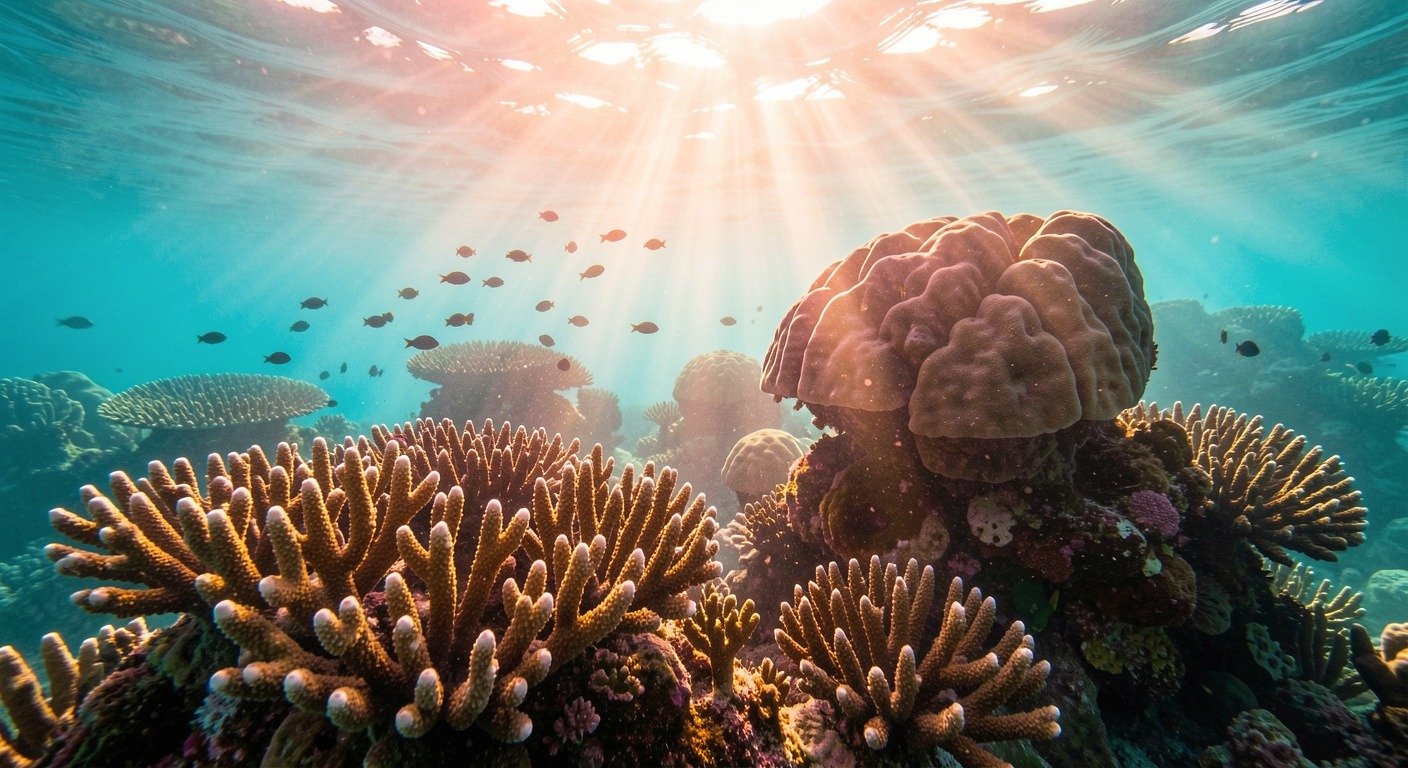
Most people never see a coral reef reproduce. It happens at night, once a year, across a vast stretch of ocean. Billions of tiny pink and white bundles rise from the reef like an upside-down snowstorm, drifting toward the surface to begin new life. The Great Barrier Reef spawning 2026 event is approaching, and this year, it carries more weight than any in recent memory.
In late 2026, the world’s largest living structure will perform the same ancient ritual it has repeated for millennia.
But the reef that releases those eggs and sperm is not the reef of even two years ago. Back-to-back bleaching events have stripped color and life from vast stretches of coral.
The question now is not whether the spawning will happen. It will. The question is whether the larvae that result can survive long enough to help the reef recover.
What Coral Spawning Is
Every year between late October and early December, something extraordinary happens beneath the surface of the Coral Sea. On a handful of nights triggered by the November full moon, rising water temperatures, and lengthening daylight hours, more than a hundred species of coral release their eggs and sperm into the water at the same time.
Scientists call this synchronized mass reproduction a mass coral spawning event. The Great Barrier Reef hosts the largest display of it anywhere on Earth.
The timing is precise. Most spawning happens after dark, peaking a few nights after the full moon.
The water fills with millimeter-sized bundles, each containing both eggs and sperm, that float upward like a slow-motion blizzard in reverse. On the surface, the bundles break apart. Eggs and sperm from different colonies mix, fertilize, and within days become free-swimming larvae.
The simple explanation: corals are animals that cannot move to find mates. So every colony in a region releases its reproductive material at exactly the same moment to maximize the odds of fertilization.
The scientific term is broadcast spawning, a strategy used by many marine invertebrates. Think of it like every tree in an entire forest releasing its seeds on the same night so the wind can carry them farther and mix them more effectively.
Beyond the spectacle, coral spawning Great Barrier Reef events are the single most important mechanism the reef has to heal itself after damage.
The Bleaching Crisis: What the Reef Has Endured
The reef that releases its spawn in 2026 is a wounded one. The Great Barrier Reef bleaching 2025 event marked the sixth mass bleaching since 2016, and it broke a grim record: it was the first time in recorded history that the reef bleached in consecutive years.
This is part of a broader pattern of warming oceans. A related marine heatwave, covered in our earlier reporting on the Pacific Blob, shows how these temperature anomalies are reshaping ocean ecosystems globally.
When ocean water stays too warm for too long, corals expel the microscopic algae living in their tissues. These algae provide both color and most of the coral’s energy.
Without them, the coral turns white. A bleached coral is not dead, but it is starving. If temperatures drop quickly enough, the algae return. If the heat persists, the coral dies.
The numbers from the Australian Institute of Marine Science tell a stark story. In the Northern Great Barrier Reef, hard coral cover dropped from approximately 39.8 percent in 2024 to 30.0 percent in 2025. That is a 24.8 percent decline in a single year.
The Central section fell from 33.2 percent to 28.6 percent, a 13.9 percent decrease. The 2024 summer bleaching reversed five years of recovery that scientists had watched with cautious optimism.
For more on why these events are intensifying, see our explainer on how coral bleaching events are accelerating in 2026.
Sea surface temperatures across the Great Barrier Reef Marine Park have warmed by 0.94 degrees Celsius since 1900. That number may sound small, but for corals that live within one to two degrees of their thermal maximum, it is the difference between survival and collapse.
As of June 2026, the Great Barrier Reef Marine Park Authority reported coral disease on 20 reefs across the Marine Park. Eight reefs recorded low to moderate bleaching prevalence. Heat stress had eased since April, but the reef remains under persistent pressure from a warming climate.
How the Spawning Matters More Than Ever
If bleaching is the reef’s biggest threat, spawning is its strongest natural defense. After a severe bleaching event, the only way dead coral patches recover is through new larvae settling, attaching to the reef structure, and growing into juvenile polyps.
The 2026 spawning window is not just another seasonal event. It is a critical recovery opportunity, meaning the Great Barrier Reef spawning 2026 season will be one of the most closely watched in decades.
Natural spawning works, but it has limits. Many larvae drift away from the reef, eaten by predators or swept into open ocean. Survival rates from egg to settled polyp are extraordinarily low, often well under one percent.
After back-to-back bleaching, the reef needs every larva it can get. This is where coral reef restoration Australia programs enter the picture. Scientists are no longer just watching the reef spawn. They are intervening to give every larva a fighting chance.
The most promising technology is the larval seedbox, developed by CSIRO, Australia’s national science agency.
The simple explanation: scientists collect coral spawn during a mass spawning event, rear the larvae in floating nursery pools, and release them over damaged reef sections inside mesh enclosures called seedboxes. The professional term is larval enhancement, a form of coral IVF that captures the natural spawn and concentrates it where it is most needed.
In trials published in November 2025, CSIRO’s seedbox technology boosted coral larval settlement by up to 56-fold compared to unassisted natural settlement.
To understand what a 56-fold improvement means: imagine planting a field where only one seed in a hundred normally grows. Now imagine a method where 56 seeds in a hundred grow instead. That is the difference between a reef patch that stays bare and one that begins to regenerate.
The Australian Institute of Marine Science has been tracking reef health through its Long-Term Monitoring Program since 1986, surveying 124 reefs across the Marine Park. Their data provides the baseline against which every restoration effort is measured.
The People Who Depend on the Reef
The Great Barrier Reef is not just an ecosystem. It is an economic engine and a cultural anchor for hundreds of thousands of people. The human stakes of the reef’s decline are measured in dollars, jobs, and lost ways of life.
Tourism. The reef contributes approximately 9 billion dollars per year to the Australian economy and supports 77,000 full-time jobs, according to a Deloitte Access Economics valuation published in October 2025. Its total asset value stands at 95 billion dollars. When bleaching closes dive sites and turns coral gardens into bone-white graveyards, tourists choose other destinations. Coastal towns from Cairns to Airlie Beach depend on the reef for survival.
Coastal protection. The reef itself absorbs a significant portion of wave energy before it reaches the shoreline. Without a living, growing reef, storm surges hit coastal communities harder. Property damage rises. Insurance costs climb. The reef is, in the most literal sense, a breakwater that nature built and maintains for free. The ocean-climate connection runs deeper than most realize: healthy oceans drive the weather patterns that shape life far beyond the coastline.
Fishing. Commercial and recreational fishing in the Great Barrier Reef Marine Park generates hundreds of millions annually. Bleaching disrupts the entire food web. When coral dies, the small fish that live in its branches disappear. The larger fish that eat them move on. A degraded reef is an emptier, quieter, less productive ecosystem, and fishing communities feel that loss directly.
Indigenous communities. For more than 60,000 years, First Nations peoples have managed the Sea Country that includes the Great Barrier Reef. Today, over 6,000 First Nations custodians are leading 102 reef protection projects through Traditional Owner programs, according to the Great Barrier Reef Foundation. Their knowledge of reef cycles, spawning seasons, and sustainable harvesting practices predates Western science by tens of thousands of years. The Great Barrier Reef traditional owners are not passive stakeholders. They are active partners in every major restoration effort now underway.
A 2025 survey by the Great Barrier Reef Foundation found that 98 percent of Australians fear losing the reef. That is not a statistic about coral. It is a statistic about identity.
“The reef is not just a place we visit. It is a living bank account, a 60,000-year-old library of Indigenous knowledge, and a storm wall that 77,000 Australian families count on for their next paycheck.”
What Is Being Done, and What We Can Learn
The science of coral restoration is advancing fast. Coral IVF seedbox technology, the 56-fold settlement booster developed by CSIRO, is moving from research trials to field deployment. The Great Barrier Reef Marine Park Authority issues regular reef health updates tracking heat stress, bleaching prevalence, and coral disease across the Marine Park.
But technology can only buy time. The root cause of mass bleaching is rising ocean temperatures driven by climate change. Scientists at the ARC Centre of Excellence for Coral Reef Studies emphasize that keeping global warming to 1.5 degrees Celsius above pre-industrial levels is the single most important variable for the reef’s long-term survival.
There are reasons for cautious hope. Recent research has identified triple the number of climate-resilient coral reefs than previously known, expanding the pool of reefs that might survive even under moderate warming scenarios.
What can someone who lives thousands of miles from Queensland do? Three things.
First, support reef-safe tourism. Every tourist dollar spent on operators certified by the Great Barrier Reef Marine Park Authority funds conservation levies and supports coastal communities with a direct economic incentive to protect the reef.
Second, reduce your carbon footprint in whatever ways are practical for your life. The reef’s fate is tied to global emissions. Individual actions matter less than collective pressure, but collective pressure is made of individual choices.
Third, follow and support reef conservation organizations. The Great Barrier Reef Foundation, AIMS, and the ARC Centre of Excellence all publish accessible updates on reef health and restoration progress.
The 2026 spawning will happen. Billions of coral larvae will drift through dark water, and a tiny fraction of them will find a place to settle, attach, and begin building something new. Whether those larvae grow into a reef that future generations can still recognize depends on decisions being made right now, not just in Australia but everywhere.
Frequently Asked Questions
When does the Great Barrier Reef spawning happen in 2026?
The main spawning window runs from late October through early December 2026, with peak activity occurring on nights following the November full moon. The exact dates vary by location along the reef, but the event is highly predictable because it is triggered by the lunar cycle, water temperature, and day length.
What is coral IVF and how does it differ from natural spawning?
Coral IVF, formally called larval enhancement, is a restoration technique where scientists collect naturally released coral spawn, rear the larvae in protected floating pools, and then release them over damaged reef sections inside mesh enclosures called seedboxes. Natural spawning leaves larvae to drift and settle wherever currents carry them, most never making it. Coral IVF concentrates the larvae where they are needed most.
How bad was the 2025 bleaching compared to previous years?
The 2025 bleaching was the sixth mass bleaching event since 2016 and the first time bleaching occurred in consecutive years. Northern Great Barrier Reef hard coral cover declined by 24.8 percent in a single year, from 39.8 percent to 30.0 percent. The back-to-back nature of the 2024 and 2025 bleaching events is unprecedented.
Can the Great Barrier Reef recover from this level of bleaching?
Partial recovery is possible, but it depends on several factors: the success of the Great Barrier Reef spawning 2026 and 2027 seasons, continued deployment of restoration technologies like seedboxes, and whether global ocean temperatures stabilize. The concern is the rising frequency of bleaching events, which gives the reef less time to heal between impacts.
How do First Nations communities contribute to reef protection?
Over 6,000 First Nations custodians are leading 102 reef protection projects through Traditional Owner programs. These projects range from water quality monitoring to traditional fire management that reduces sediment runoff, to direct participation in coral restoration trials. First Nations knowledge of reef cycles spans more than 60,000 years.