She was seven years old, standing ankle-deep in the Atlantic off the coast of North Carolina, when she asked the question every parent dreads. “If the ocean is made of water, and water is clear, then why is the ocean blue?”
Her father gave the answer most of us heard growing up. “It reflects the sky,” he said.
It is a beautiful idea. On a cloudless afternoon the sky above is blue and the sea below is blue, and the two feel connected, as though the ocean is a mirror the planet holds up to the heavens. You can almost believe it.
But it is also wrong. The ocean is not blue because it reflects the sky. It is blue because water itself is blue. A pale, almost invisible blue that only reveals itself when there is enough of it. The question of why is the ocean blue leads somewhere much stranger and more beautiful than the reflection story ever could.
The Myth That Would Not Stand
The reflection theory has been repeated for centuries. According to the Woods Hole Oceanographic Institution, it remains one of the most common misconceptions about the sea. You have probably said it yourself. On a gray overcast day, however, the ocean does not turn gray. It stays stubbornly blue. If reflection were the whole story, the sea would dim with every passing cloud. It does not.
This is the first clue that something else is going on, something the water itself is doing. The question of why is the ocean blue but water clear points directly to the physics. A glass of water on your table has no color you can see. Fill a bathtub and the water still looks clear. So how does the same substance turn a deep, vivid blue when you pour enough of it into the ocean?
The answer began to emerge in the early twentieth century. Physicists started pointing instruments at large volumes of water and measuring what happened to sunlight when it entered. They found something that overturned a folk belief. When light travels through water, the water molecules selectively remove certain colors from it. Not the salt. Not the floating particles. The H₂O molecules themselves.
C. V. Raman, the Indian physicist who won the Nobel Prize for his work on light scattering, demonstrated this with pure distilled water in a long tube. The water glowed faintly blue. No sky required. No salt. No impurities. Just water being itself.
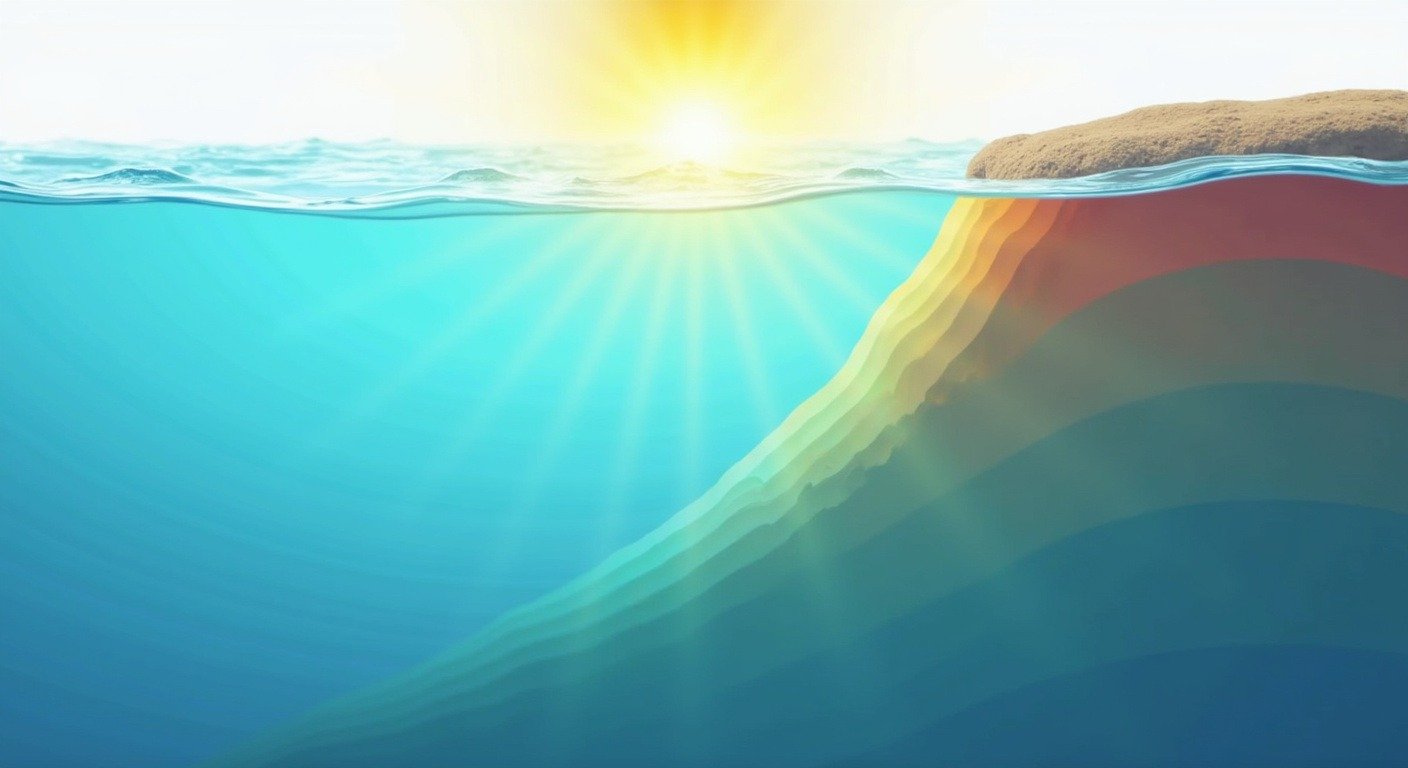
Sunlight entering the ocean loses colors one by one as it travels deeper. Red vanishes first, then orange, yellow, and green. Only blue survives the longest journey. Image: NWH / AI-generated
The Real Reason Why Is the Ocean Blue
Sunlight arrives at the ocean surface carrying every color humans can see: red, orange, yellow, green, blue, violet. White light, in other words. But as that light travels downward through the water, the molecules start removing colors from the parade.
They do this through a process called selective absorption. Water molecules stretch and vibrate at frequencies that happen to match the energy of red light. When a red photon strikes a water molecule, the molecule absorbs it and converts the energy into heat. The photon is gone. Orange photons meet the same fate. Yellow follows. Green lingers longer but is absorbed too.
Blue photons are the wrong frequency. The water molecules cannot grab them efficiently. The blue light keeps traveling downward, and some of it scatters sideways and back upward, escaping the surface and reaching your eyes. What you see when you look at the ocean is the light that survived.
This is not how the sky works. The National Oceanic and Atmospheric Administration explains that the sky is blue because of Rayleigh scattering: tiny air molecules bounce short-wavelength blue light in all directions while letting red light pass straight through. The ocean is blue because water absorbs the red end of the spectrum and leaves blue behind. Two completely different physical mechanisms. The sky scatters. The ocean absorbs. If you want to understand why the sky is blue, the mechanism is elegantly explained by why the sky is blue. The ocean tells a different story entirely.
A simple experiment makes this visible. Fill a white plastic bucket with tap water and look straight down into it from above. The water appears faintly blue, even indoors, even with no blue sky above you. The water is showing you its own color. A drinking glass looks clear because light passes through too little water for absorption to register. The bucket gives the light a longer path. The ocean gives it miles.
This is why why does water look blue only when it is deep. Every meter of water strips away more red light. By 30 meters down, almost all the red is gone. The light that remains is a cold, pure blue. Deeper water means a longer journey for the light, and a longer journey means more chances for red photons to be absorbed. The deep open ocean, where ocean currents carry water thousands of miles from any coast, reaches a shade of blue so intense it barely looks real.
The Colors the Ocean Hides
If the ocean were only ever blue, the story would end here. But look at a satellite photograph of Earth and you see a painter’s palette. The ocean color science reveals that every shade carries information about what is happening inside the water.
Green oceans are living oceans. That emerald hue comes from phytoplankton, microscopic plants drifting in the surface waters. Their chlorophyll absorbs blue and red light for photosynthesis and reflects green back, exactly the way leaves on land do. A single liter of seawater can hold millions of these organisms. When they bloom, they paint the ocean green across thousands of square miles. These blooms feed the entire marine food web. The sardines, anchovies, and krill that sustain the world’s commercial fisheries all depend on phytoplankton. When blooms shift, fish follow. When blooms collapse, fishing communities feel it at the dock and you feel it at the grocery store.
Brown oceans carry the land into the sea. The Amazon River dumps billions of tons of sediment into the Atlantic every year, creating a plume of brown water so large that sailors in the age of exploration reported finding fresh water hundreds of miles from the South American coast. Suspended particles of soil and clay scatter light in every direction. The blue never gets a chance. Coastal communities that depend on clear water for tourism watch those brown plumes spread after every heavy rain. Their livelihoods shift with the sediment.
Turquoise shallows are the color of the seafloor. In places like the Bahamas, the water is shallow enough for sunlight to reach the bottom and bounce back. White carbonate sand reflects the full spectrum upward through a thin layer of blue-tinted water, producing the electric aquamarine that fills travel photographs. The same physics works in a Caribbean swimming pool lined with white plaster. Tourism economies across the tropics are built on the color of that water.
Black water is the deep ocean. Below 200 meters, sunlight cannot reach at all. Every photon has been absorbed. The abyssal plain is a world illuminated only by the bioluminescence of its own creatures. This is where the journey of light through water finally ends, in absolute darkness.
These colors are not permanent. Researchers at MIT and the National Oceanography Centre, writing in the Library of Congress and other scientific outlets, have documented that climate change is shifting entire ocean basins toward greener hues as warming waters alter phytoplankton distributions. A 2023 study found that more than half of the world’s ocean surface has measurably changed color in just the last two decades. The ocean is rewriting its own palette in real time.
What the Water Remembers
Light that enters the ocean does not simply leave. Most of it dies there, absorbed photon by photon across the long descent to darkness. The blue light you see at the surface is the fraction that escaped.
That light traveled from the sun through 93 million miles of space. It hit the surface at the right angle. It passed through a gauntlet of water molecules that stripped away every color but one. Then, against all odds, it scattered back upward into your eyes. What you are seeing is a survivor.
The ocean has been doing this for three and a half billion years. Long before there was a sky to reflect, long before eyes existed to perceive color, the water absorbed red light and scattered blue. It is not mirroring anything. It is revealing its own nature, one photon at a time.
Stand at the edge of the sea knowing this. You are not looking at a borrowed sky. You are looking at the water itself, refusing to let go of the only color it cannot swallow. The same physics that paints cloud types across the sky with scattered light works differently down here, where the color comes from what gets taken away, not what gets scattered.
Woods Hole Oceanographic Institution, “Why Is the Ocean Blue?,” whoi.edu
Contains information related to marketing campaigns of the user. These are shared with Google AdWords / Google Ads when the Google Ads and Google Analytics accounts are linked together.
90 days
__utma
ID used to identify users and sessions
2 years after last activity
__utmt
Used to monitor number of Google Analytics server requests
10 minutes
__utmb
Used to distinguish new sessions and visits. This cookie is set when the GA.js javascript library is loaded and there is no existing __utmb cookie. The cookie is updated every time data is sent to the Google Analytics server.
30 minutes after last activity
__utmc
Used only with old Urchin versions of Google Analytics and not with GA.js. Was used to distinguish between new sessions and visits at the end of a session.
End of session (browser)
__utmz
Contains information about the traffic source or campaign that directed user to the website. The cookie is set when the GA.js javascript is loaded and updated when data is sent to the Google Anaytics server
6 months after last activity
__utmv
Contains custom information set by the web developer via the _setCustomVar method in Google Analytics. This cookie is updated every time new data is sent to the Google Analytics server.
2 years after last activity
__utmx
Used to determine whether a user is included in an A / B or Multivariate test.
18 months
_ga
ID used to identify users
2 years
_gali
Used by Google Analytics to determine which links on a page are being clicked
30 seconds
_ga_
ID used to identify users
2 years
_gid
ID used to identify users for 24 hours after last activity
24 hours
_gat
Used to monitor number of Google Analytics server requests when using Google Tag Manager