Best Places to See the Midnight Sun: Norway, Alaska, and Iceland Summer Guide
What Is the Midnight Sun
Above the Arctic Circle, at 66.5 degrees north, the laws of day and night break down each summer. The Earth tilts on its axis by about 23.5 degrees, and during the weeks around the June solstice, the North Pole leans toward the sun. (This is the same axial tilt that drives the seasonal patterns we cover in our weather versus climate explainer.) The result is a stretch of time when the sun never sinks below the horizon.
At the solstice itself, June 21, the effect reaches its peak. The farther north you travel, the longer the continuous daylight lasts. A day above the Arctic Circle can feel like a week of ordinary summer afternoons, the light cycling from gold to rose without ever fading to black.
Norway, Iceland, and Alaska each offer a different version of this phenomenon. In one country you watch the sun skim across a fjord at 1 a.m. In another you hike a mountain pass under light that reads 11:30 p.m. on your watch but looks like 7 p.m. The midnight sun is three distinct places, each with its own rhythm.
Norway: Where the Sun Forgets to Set
Tromso
Tromso sits at nearly 70 degrees north, and the sun stays above the horizon from roughly May 20 to July 24. That is two full months without a sunset. On clear summer nights, the waterfront fills with people who have abandoned any concept of a bedtime.
The Midnight Sun Marathon runs here on June 20, 2026. Thousands of runners start in the evening and finish under a sky that never darkens.
The Lofoten Islands
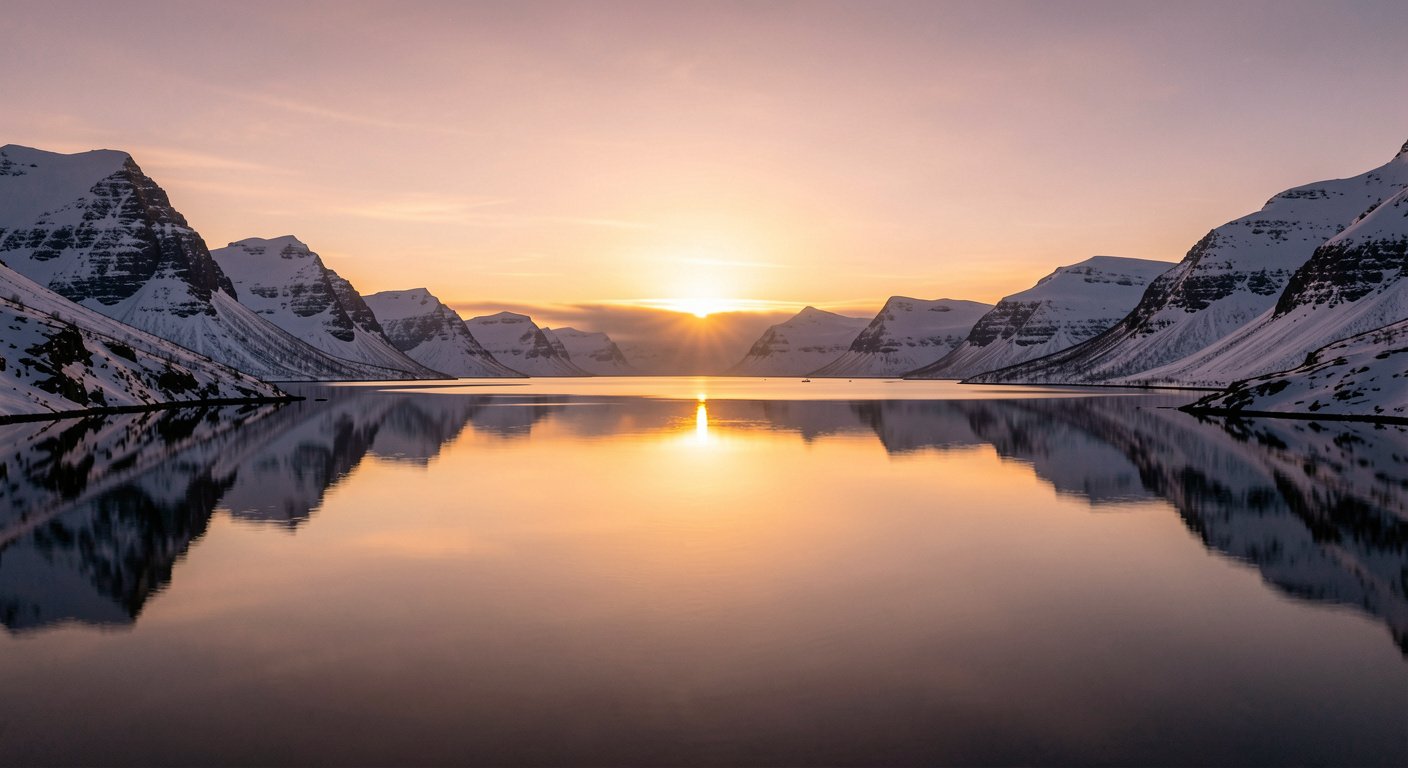
If there is a single image that defines the Norwegian midnight sun, it might be the Lofoten Islands. Jagged peaks rise straight from the sea, and red fishing villages cling to narrow strips of land. Between late May and mid-July, the low-angle light turns the mountains amber and the water to glass.
Hiking here at midnight feels like walking through a painting. Reinebringen, a steep climb above the village of Reine, offers one of the most photographed views in northern Europe. At midnight in June, you may share the trail with only a handful of others.
North Cape and Svalbard
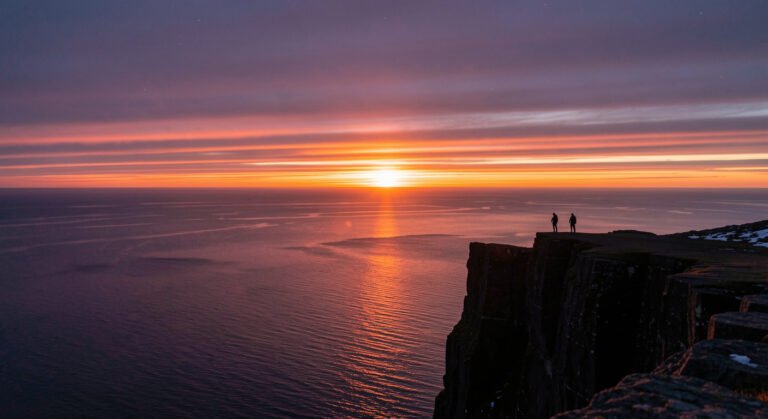
The North Cape, a cliff rising 307 meters from the Barents Sea, is the northernmost point in continental Europe reachable by car. Between mid-May and late July, the sun circles the sky in a continuous loop above the plateau.
Further north, the Svalbard archipelago has midnight sun from late April through late August, roughly four months. Polar bears outnumber people here, and any trip beyond Longyearbyen requires an armed guide. The reward is Arctic light in its purest form: cold, clean, and relentless.
Iceland: Near-Constant Light on a Volcanic Island
Reykjavik and the Solstice Glow
Iceland sits just below the Arctic Circle, but at nearly 65 degrees north, Reykjavik comes remarkably close to true midnight sun. Around the solstice, the sun dips below the horizon for less than an hour, and the sky never fully darkens. Photographers call it the golden hour, except it lasts for four or five.
Locals swim at Nautholsvik geothermal beach past 10 p.m., the warm water a contrast to the cool air and pale sky. The harbor path from Harpa Concert Hall to the old port becomes the city’s evening promenade. Reykjavik in June does not sleep so much as it pauses and carries on.
Grimsey Island: True Arctic Circle
For the real thing, head north. Grimsey Island, about 40 kilometers off Iceland’s northern coast, sits directly on the Arctic Circle. Here the sun does not set for several weeks around the solstice. The island is home to about 60 people and roughly a million seabirds, including puffins along the cliffs.
A ferry runs from Dalvik three times a week in summer. You can walk across the Arctic Circle marker, watch the sun trace a full loop around the sky, and fly back the same day. The stillness there at midnight, broken only by waves and the cries of Arctic terns, stays with you.
Jokulsarlon and the North
Jokulsarlon Glacier Lagoon, on the south coast, is worth the 380-kilometer drive from Reykjavik. Icebergs calved from Breidamerkurjokull glacier drift toward the sea, glowing amber in the permanent twilight. The light at midnight makes the lagoon look like another planet.
The north coast around Husavik offers evening whale-watching tours in Skjalfandi Bay through June and July. Humpback whales feed under full midnight daylight. A surfacing whale 30 meters from the boat, lit by Arctic light, justifies the trip north.
Alaska: Endless Days in the Last Frontier
Fairbanks
Fairbanks, in Alaska’s interior, enjoys 70 straight days of functional midnight sun from roughly May 17 to July 27. On June 21, sunrise is 2:57 a.m. and sunset comes at 12:47 a.m. the following day. The sky never gets darker than civil twilight, bright enough to read a book outside at any hour.
The Midnight Sun Festival takes over downtown on June 20, 2026. The Alaska Goldpanners host their annual Midnight Sun Baseball Game starting at 10:30 p.m., played entirely without artificial lights, a tradition dating back to 1906.
Utqiagvik and Denali
Utqiagvik, formerly Barrow, is the northernmost settlement in the United States. The sun rises on May 10 and does not set again until August 2, roughly 82 days of continuous daylight. In June the tundra briefly blooms while the sun circles overhead. Alaska Airlines flies from Fairbanks and Anchorage.
Denali National Park stays open 24 hours during summer, and the long daylight means you can hike without racing the clock. The boreal forest and tundra here echo the patterns we described in our piece on how forests shape weather. On clear June nights, the alpenglow on Denali’s snow-covered summit, North America’s tallest peak at 20,310 feet, can last for hours.
Practical Tips for Your Midnight Sun Trip
Traveling under 24-hour daylight sounds freeing, and it is. But it also creates problems that ordinary vacations do not.
Book early. The solstice period, roughly June 15 to June 25, is peak season across all three destinations. Hotels in Tromso, Reykjavik, and Fairbanks fill up six months or more in advance. The same goes for rental cars in Iceland and camper vans in Norway.
Pack a sleep mask. Most hotels have blackout curtains, but light finds its way through every gap. A good sleep mask and consistent bedtime routine help your body understand when to shut down. Some travelers bring portable blackout blinds that suction-cup to windows.
Dress in layers. Temperatures still drop to 4 to 10 degrees Celsius (40 to 50 Fahrenheit) even in June. Bring a waterproof outer layer, a fleece or wool midlayer, and sturdy shoes. Being cold at 1 a.m. ruins the experience.
For photography, the golden hour lasts several hours instead of minutes. You can shoot in soft directional light much longer than usual. A tripod helps, but at f/4 and ISO 400, modern cameras can handhold at midnight in June.
Stay safe. Constant daylight can trick you into ignoring fatigue. Set a schedule for meals and rest. In remote areas like Svalbard and Denali, carry bear protection and know local safety protocols. In Utqiagvik, the Arctic Ocean is dangerously cold year-round.
The midnight sun is not something you check off a list. It is something you sit with, at 1 a.m., on a dock in Lofoten or a lava field in Iceland or a riverbank in Alaska, watching the world stay bright when your body says it should be dark.
“The sun just dipped into the sea and rose again, red, refreshed, as if it had been down to drink.” – Knut Hamsun, Pan (1894)
“At 11 p.m. in Reykjavik, the sky holds the color of 7 p.m. everywhere else, and nobody seems in a hurry to go home.”