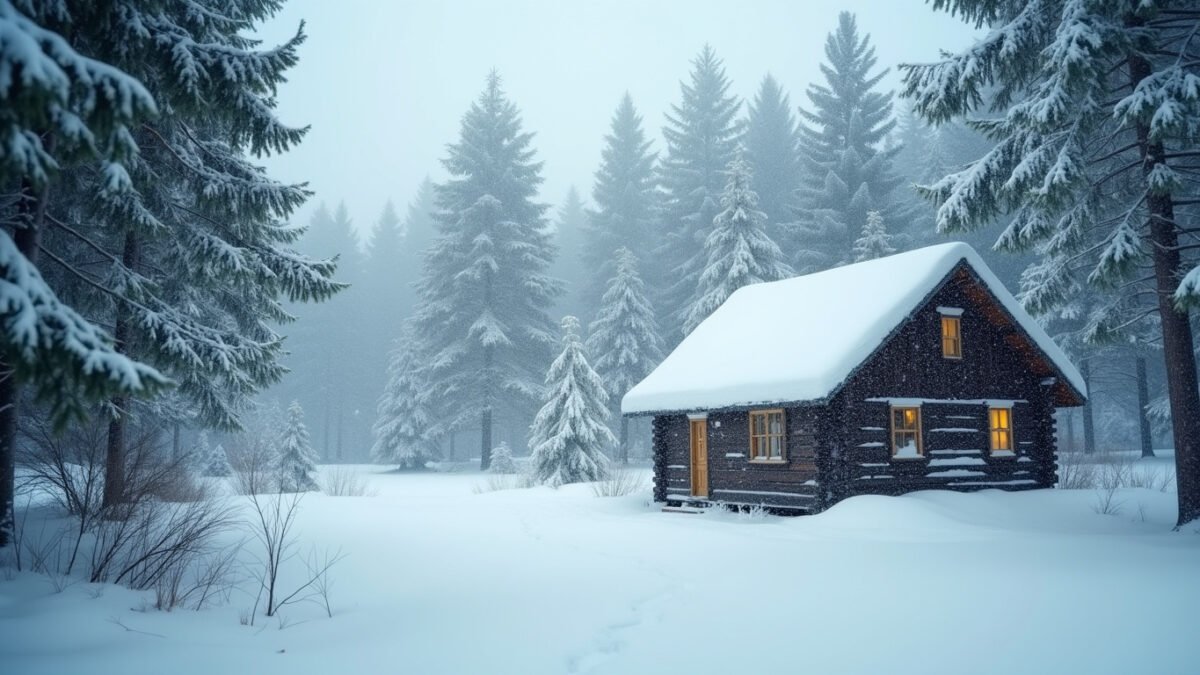
Peaceful winter landscape with snow-blanketed pine trees and fresh snowfall — serene cold weather scene
Why Snow Forms of a Crystal
The shape of a snow crystal depends almost entirely on the temperature and humidity inside the cloud where it forms. At 23 degrees Fahrenheit, ice crystals grow into long, thin needles. At 5 degrees Fahrenheit, they become flat hexagonal plates. The familiar six-pointed stellar dendrite, the snowflake of holiday cards and children’s drawings, develops in the dendritic growth zone when humidity is high.
Why do crystals take these specific forms? The answer comes down to how water molecules arrange themselves when they freeze. Water molecules lock into a hexagonal lattice, which is why every snow crystal has six sides at its core. The temperature then determines how fast new molecules attach to each face of the crystal. At some temperatures, growth happens fastest on the flat faces, producing plates. At other temperatures, growth concentrates on the edges and corners, producing needles or the branching arms of dendrites.
Humidity adds another layer of complexity. In drier air, crystals grow slowly and stay simple. In moist air, they grow quickly and develop more elaborate branching. A crystal drifting through different temperature and humidity zones inside a cloud can change its growth pattern mid-flight, which is why no two snowflakes are exactly alike. Each one carries a record of the microclimate it traveled through.
Scientists classify the types of snow into several broad categories. Stellar dendrites are the classic six-armed stars. Plates are flat, thin hexagons. Columns and needles are long, pencil-like crystals with flat or pointed ends. Capped columns look like spools of thread, with plates growing at either end of a column. Spatial dendrites form when individual crystals collide and freeze together, creating irregular clusters. The mix of shapes in any snowfall can tell a meteorologist a great deal about conditions inside the storm cloud.
How Snow Affects People: Travel, Water, Daily Life
Snow shapes human life in ways that go far beyond a canceled school day. Its effects ripple through transportation systems, water supplies, and the economy.
Travel is the most immediate impact. A major winter storm can shut down highways, ground hundreds of flights, and paralyze rail freight across entire regions. The National Oceanic and Atmospheric Administration (NOAA) reports that winter storms cause billions of dollars in economic losses each year when factoring in infrastructure damage, supply chain delays, and lost business. A single severe snowstorm can strand thousands of vehicles on interstate highways, as happened during the January 2022 I-95 shutdown in Virginia, where drivers spent more than 24 hours trapped on the road.
Infrastructure bears the physical weight of snow directly. Wet, heavy snow can collapse roofs not designed for the load, particularly on flat-roofed commercial buildings. Power lines snap under the combined weight of ice and snow, leaving communities without heat or electricity in freezing conditions. The cost of clearing snow from roads and public walkways runs into hundreds of millions of dollars each winter across northern states.
Water supply is the quieter but deeper impact. In the western United States, mountain snowpack acts as a natural reservoir. Snow accumulates through the winter months, then melts slowly in spring and summer, feeding rivers, reservoirs, irrigation systems. According to the U.S. Department of Agriculture’s Natural Resources Conservation Service, snowmelt provides up to 75 percent of the West’s annual water supply. When snowpack is thin, as it was during the 2026 snow drought across the West, farms face tight irrigation limits, reservoirs draw down, and wildfire risk rises with the dry soil left behind.
Farmers who rely on snowmelt to irrigate crops must adjust planting decisions months in advance based on snowpack surveys. Cities from Denver to Los Angeles depend on snow-fed rivers for drinking water. A poor snow year reshapes water policy debates and household water budgets simultaneously.
The economy absorbs these shocks across multiple sectors. The winter recreation industry, from ski resorts to snowmobile outfitters, depends on reliable snowfall for its seasonal revenue. A snow drought in the Sierra Nevada, for example, cost California’s ski industry an estimated $2 billion during the 2014-2015 season. Meanwhile, the costs of snow removal, road salting, and emergency response add up for municipal budgets every winter.
Why Snow Matters and a Shrinking Snowpack
The climate is warming, and snow is one of the first things to change. Across the Northern Hemisphere, snow cover extent has declined measurably over the past five decades. Spring snowmelt now arrives two to three weeks earlier than it did in the mid-20th century across much of the western United States, according to climate researchers. The question of why does it snow is increasingly joined by a harder one: how much longer will it?
This earlier melt creates a timing problem. Instead of releasing water gradually through the hot summer months, snowpack runs off all at once in early spring. Reservoirs cannot always capture the full volume, and by August, the rivers are running low. The natural storage system that snow provides is losing its reliability.
Warmer winters also mean more precipitation falls as rain instead of snow, even at high elevations. This shift compounds the water storage problem while increasing flood risk during winter rain-on-snow events. Communities built around the assumption of a stable snow season, from farming towns in the Central Valley to mountain resorts in the Rockies, are adapting to a new reality. The changing seasons that once delivered reliable winter snow are becoming less predictable with each passing decade.
The question of why does it snow is no longer just about scientific curiosity. It is about knowing what we stand to lose.
What We Can Learn From Snow
Snow teaches a powerful lesson about nature’s hidden connections. A crystal forming in a cloud over a Colorado peak in December becomes the water that irrigates a lettuce field in California in July. A winter without enough snow in the mountains becomes a summer of fire risk and water restrictions in the valley below. Why does it snow is a question with an answer that ripples outward from a single cloud to the drinking water of millions.
Understanding how snow forms and what it does for us makes the stakes of a warming climate more tangible. It turns an abstract concept like snowpack decline into something concrete: fewer ski days, tighter water budgets, higher food prices, and ecosystems pushed past their limits.
The science of snow is also a reminder of nature’s precision. Inside every snowflake is a hexagonal lattice of water molecules, a shape so fundamental that it appears in crystals formed under any freezing condition on Earth. The same physical laws that build a six-pointed dendrite in a storm cloud govern the freezing of a pond or the growth of frost on a windowpane.
A single snowflake may last only seconds on a warm palm, but the process that created it began with water evaporated from an ocean, carried by wind across a continent, lifted into a cloud, and frozen around a speck of dust that might have traveled halfway around the world. Snow is not just weather. It is the water cycle made visible.
A child presses her nose against the window, watching white flakes drift past the streetlight. The world outside is going quiet under a fresh blanket of snow. She turns to her parent with the question every adult has heard and most have struggled to answer: why does it snow?
The answer is a story about cold air, tiny particles, and the invisible architecture of frozen water. It is a story that connects a single snowflake falling on your coat sleeve to the water supply of entire cities. Understanding why it snows is not just a schoolroom curiosity. It is a key to grasping how the planet’s water cycle works and what a warmer future might take away.
What Is Snow and Why Does It Snow in the First Place
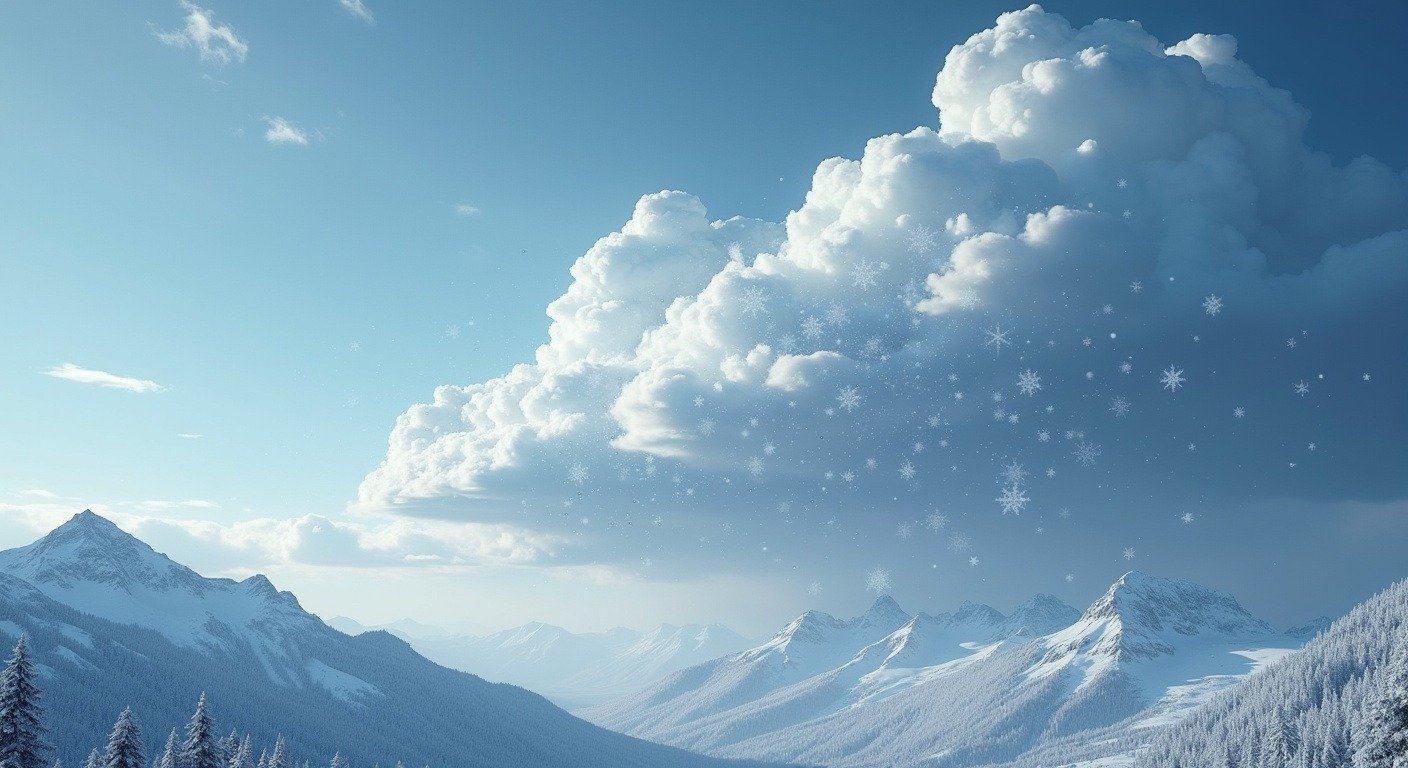
Snow is frozen precipitation that falls from clouds when temperatures in the atmosphere drop below freezing. Unlike rain, which falls as liquid water, snow arrives as ice crystals that stick together into the flakes we recognize. For snow to reach the ground, the entire column of air between the cloud and the surface must be at or below 32 degrees Fahrenheit (0 degrees Celsius). If a warm layer sits anywhere along that path, the snow melts into rain or refreezes into sleet. Different cloud types produce different kinds of winter precipitation, which is why forecasters watch cloud composition closely when predicting snow.
The snow formation process begins high inside a cloud, where water vapor and subfreezing temperatures meet. But cold air alone is not enough. Every snowflake needs a starting point, a tiny particle around which ice can crystallize. These particles, called ice nuclei, are often microscopic dust, pollen, or even bacteria lifted into the atmosphere by wind. Wind carries these particles across continents and up into the storm clouds where snow is born. When water vapor in the cloud touches one of these frozen nuclei, it skips the liquid phase entirely and turns directly into ice, a process called deposition.
The National Weather Service identifies a specific atmospheric layer critical to how snow forms. Known as the dendritic growth zone, this band sits between about 10 and 0 degrees Fahrenheit (minus 12 to minus 18 degrees Celsius). Inside this zone, water vapor attaches most efficiently to ice crystals, creating the elaborate branching shapes most people picture when they imagine a snowflake. Snow can form outside this temperature window, but the most complex, classic snowflakes grow here.
Why Snow Forms of a Crystal
The shape of a snow crystal depends almost entirely on the temperature and humidity inside the cloud where it forms. At 23 degrees Fahrenheit, ice crystals grow into long, thin needles. At 5 degrees Fahrenheit, they become flat hexagonal plates. The familiar six-pointed stellar dendrite, the snowflake of holiday cards and children’s drawings, develops in the dendritic growth zone when humidity is high.
Why do crystals take these specific forms? The answer comes down to how water molecules arrange themselves when they freeze. Water molecules lock into a hexagonal lattice, which is why every snow crystal has six sides at its core. The temperature then determines how fast new molecules attach to each face of the crystal. At some temperatures, growth happens fastest on the flat faces, producing plates. At other temperatures, growth concentrates on the edges and corners, producing needles or the branching arms of dendrites.
Humidity adds another layer of complexity. In drier air, crystals grow slowly and stay simple. In moist air, they grow quickly and develop more elaborate branching. A crystal drifting through different temperature and humidity zones inside a cloud can change its growth pattern mid-flight, which is why no two snowflakes are exactly alike. Each one carries a record of the microclimate it traveled through.
Scientists classify the types of snow into several broad categories. Stellar dendrites are the classic six-armed stars. Plates are flat, thin hexagons. Columns and needles are long, pencil-like crystals with flat or pointed ends. Capped columns look like spools of thread, with plates growing at either end of a column. Spatial dendrites form when individual crystals collide and freeze together, creating irregular clusters. The mix of shapes in any snowfall can tell a meteorologist a great deal about conditions inside the storm cloud.
How Snow Affects People: Travel, Water, Daily Life
Snow shapes human life in ways that go far beyond a canceled school day. Its effects ripple through transportation systems, water supplies, and the economy.
Travel is the most immediate impact. A major winter storm can shut down highways, ground hundreds of flights, and paralyze rail freight across entire regions. The National Oceanic and Atmospheric Administration (NOAA) reports that winter storms cause billions of dollars in economic losses each year when factoring in infrastructure damage, supply chain delays, and lost business. A single severe snowstorm can strand thousands of vehicles on interstate highways, as happened during the January 2022 I-95 shutdown in Virginia, where drivers spent more than 24 hours trapped on the road.
Infrastructure bears the physical weight of snow directly. Wet, heavy snow can collapse roofs not designed for the load, particularly on flat-roofed commercial buildings. Power lines snap under the combined weight of ice and snow, leaving communities without heat or electricity in freezing conditions. The cost of clearing snow from roads and public walkways runs into hundreds of millions of dollars each winter across northern states.
Water supply is the quieter but deeper impact. In the western United States, mountain snowpack acts as a natural reservoir. Snow accumulates through the winter months, then melts slowly in spring and summer, feeding rivers, reservoirs, irrigation systems. According to the U.S. Department of Agriculture’s Natural Resources Conservation Service, snowmelt provides up to 75 percent of the West’s annual water supply. When snowpack is thin, as it was during the 2026 snow drought across the West, farms face tight irrigation limits, reservoirs draw down, and wildfire risk rises with the dry soil left behind.
Farmers who rely on snowmelt to irrigate crops must adjust planting decisions months in advance based on snowpack surveys. Cities from Denver to Los Angeles depend on snow-fed rivers for drinking water. A poor snow year reshapes water policy debates and household water budgets simultaneously.
The economy absorbs these shocks across multiple sectors. The winter recreation industry, from ski resorts to snowmobile outfitters, depends on reliable snowfall for its seasonal revenue. A snow drought in the Sierra Nevada, for example, cost California’s ski industry an estimated $2 billion during the 2014-2015 season. Meanwhile, the costs of snow removal, road salting, and emergency response add up for municipal budgets every winter.
Why Snow Matters and a Shrinking Snowpack
The climate is warming, and snow is one of the first things to change. Across the Northern Hemisphere, snow cover extent has declined measurably over the past five decades. Spring snowmelt now arrives two to three weeks earlier than it did in the mid-20th century across much of the western United States, according to climate researchers. The question of why does it snow is increasingly joined by a harder one: how much longer will it?
This earlier melt creates a timing problem. Instead of releasing water gradually through the hot summer months, snowpack runs off all at once in early spring. Reservoirs cannot always capture the full volume, and by August, the rivers are running low. The natural storage system that snow provides is losing its reliability.
Warmer winters also mean more precipitation falls as rain instead of snow, even at high elevations. This shift compounds the water storage problem while increasing flood risk during winter rain-on-snow events. Communities built around the assumption of a stable snow season, from farming towns in the Central Valley to mountain resorts in the Rockies, are adapting to a new reality. The changing seasons that once delivered reliable winter snow are becoming less predictable with each passing decade.
The question of why does it snow is no longer just about scientific curiosity. It is about knowing what we stand to lose.
What We Can Learn From Snow
Snow teaches a powerful lesson about nature’s hidden connections. A crystal forming in a cloud over a Colorado peak in December becomes the water that irrigates a lettuce field in California in July. A winter without enough snow in the mountains becomes a summer of fire risk and water restrictions in the valley below. Why does it snow is a question with an answer that ripples outward from a single cloud to the drinking water of millions.
Understanding how snow forms and what it does for us makes the stakes of a warming climate more tangible. It turns an abstract concept like snowpack decline into something concrete: fewer ski days, tighter water budgets, higher food prices, and ecosystems pushed past their limits.
The science of snow is also a reminder of nature’s precision. Inside every snowflake is a hexagonal lattice of water molecules, a shape so fundamental that it appears in crystals formed under any freezing condition on Earth. The same physical laws that build a six-pointed dendrite in a storm cloud govern the freezing of a pond or the growth of frost on a windowpane.
A single snowflake may last only seconds on a warm palm, but the process that created it began with water evaporated from an ocean, carried by wind across a continent, lifted into a cloud, and frozen around a speck of dust that might have traveled halfway around the world. Snow is not just weather. It is the water cycle made visible.
One last thought
The forecast moves on. Understanding stays.
What happens in the sky becomes part of how a place is remembered. Keep the meaning, not only the measurement.
Contains information related to marketing campaigns of the user. These are shared with Google AdWords / Google Ads when the Google Ads and Google Analytics accounts are linked together.
90 days
__utma
ID used to identify users and sessions
2 years after last activity
__utmt
Used to monitor number of Google Analytics server requests
10 minutes
__utmb
Used to distinguish new sessions and visits. This cookie is set when the GA.js javascript library is loaded and there is no existing __utmb cookie. The cookie is updated every time data is sent to the Google Analytics server.
30 minutes after last activity
__utmc
Used only with old Urchin versions of Google Analytics and not with GA.js. Was used to distinguish between new sessions and visits at the end of a session.
End of session (browser)
__utmz
Contains information about the traffic source or campaign that directed user to the website. The cookie is set when the GA.js javascript is loaded and updated when data is sent to the Google Anaytics server
6 months after last activity
__utmv
Contains custom information set by the web developer via the _setCustomVar method in Google Analytics. This cookie is updated every time new data is sent to the Google Analytics server.
2 years after last activity
__utmx
Used to determine whether a user is included in an A / B or Multivariate test.
18 months
_ga
ID used to identify users
2 years
_gali
Used by Google Analytics to determine which links on a page are being clicked
30 seconds
_ga_
ID used to identify users
2 years
_gid
ID used to identify users for 24 hours after last activity
24 hours
_gat
Used to monitor number of Google Analytics server requests when using Google Tag Manager