
On a July afternoon in Wichita, Kansas, eight-year-old Mia lay on her back in the grass, pointing at a swollen cumulus cloud drifting overhead. “That one weighs more than a hundred elephants,” her father told her. Mia sat up. “Then why doesn’t it fall on us?”
Her question is the same one scientists have been answering for centuries. And the numbers really are that wild. According to the U.S. Geological Survey, a single average cumulus cloud, the puffy white kind you see on a summer day, holds about 500,000 kilograms of water. That is 1.1 million pounds. It is the weight of roughly 100 adult elephants, suspended a mile above your head. So how do clouds float when they carry more mass than a passenger jet?
The answer changes how you see the sky.
The Paradox of a Million-Pound Cloud
Clouds are not light. They are not hollow. They are made of water, and water is heavy. A cubic meter of liquid water weighs a full metric ton. The cloud above Mia’s head held enough water to fill an Olympic swimming pool. If you could somehow compress all that moisture into a single block of ice and drop it from 5,000 feet, it would crater the ground.
But nobody runs indoors when a cloud passes overhead. Nobody looks up and worries. The paradox of how much does a cloud weigh sits at the center of hissing summer barbecues and quiet back-porch conversations. It is the kind of question a child asks while the adults reach for their phones to look it up. The answer to how do clouds float with that much mass starts with one crucial detail.
The short answer is that clouds are not one solid object. They are a diffuse suspension, a mist of tiny individual water droplets spread across an enormous volume of air. A typical cumulus cloud stretches a kilometer wide, a kilometer deep, and a kilometer tall. There is a reason how clouds form into such distinct shapes. Inside that massive cube, the water is not concentrated. It is spread so thin that each droplet floats independently, surrounded by vast amounts of air.
\n\n\n\n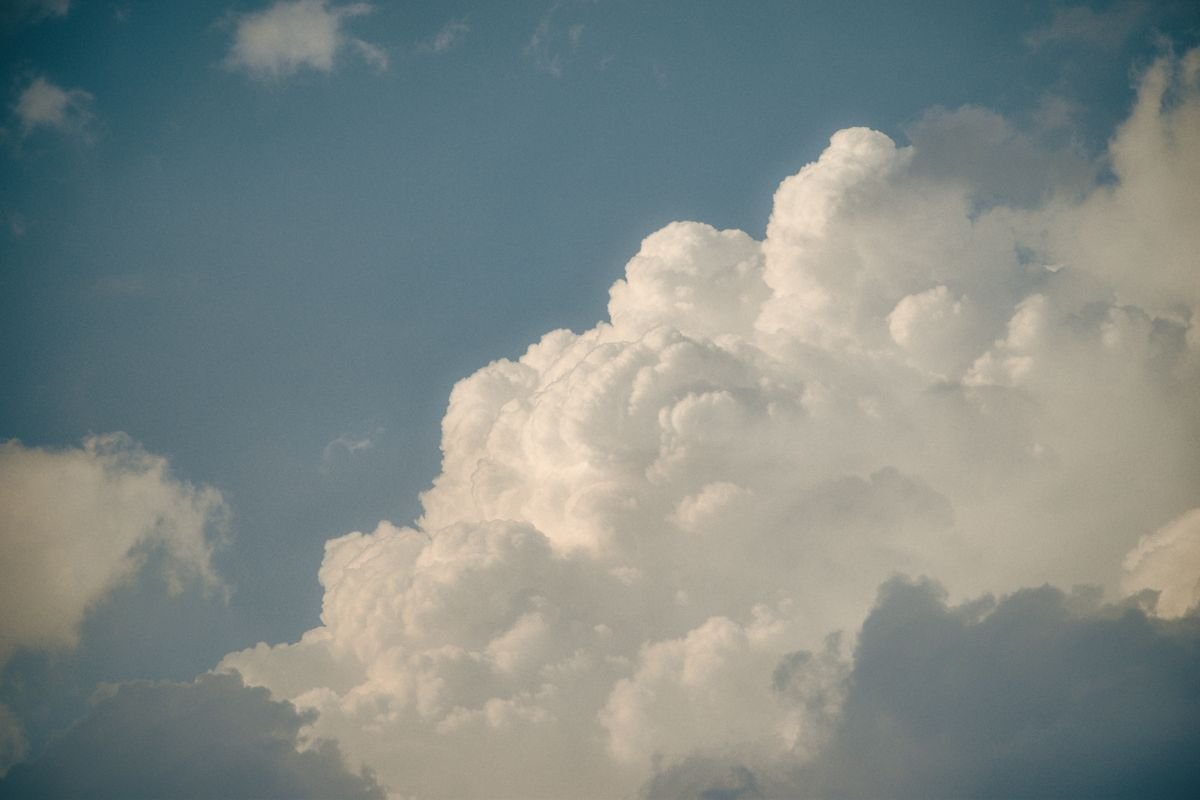
How Do Clouds Float: The Physics of Weightless Water
The key to understanding how do clouds float is droplet size. Each water droplet inside a cloud measures roughly 10 to 20 micrometers across. For context, a human hair is about 75 micrometers wide. You could line up four or five cloud droplets across a single strand of hair and still have room.
Something that small does not fall the way a raindrop falls. When any object moves through air, it reaches a balance between gravity pulling it down and air resistance pushing it up. That balance point is called terminal velocity. A skydiver in freefall reaches a terminal velocity of about 120 miles per hour. A raindrop, maybe 20 miles per hour. A cloud droplet? About one centimeter per second.
At one centimeter per second, it would take a cloud droplet roughly 30 hours to fall from the height of a typical cumulus cloud to the ground. In that time, a gentle rising current of warm air, what meteorologists call an updraft, can easily push the droplet back up. The droplet rises, cools, descends microscopically, gets caught in another updraft, and rises again. It is a continuous slow-motion dance between gravity and moving air.
The National Oceanic and Atmospheric Administration explains that updrafts form when the sun heats the ground, which warms the air directly above it according to NOAA. Warm air is less dense than cool air, so it rises. This rising air flows upward at speeds far faster than a cloud droplet can fall. A typical updraft moves at half a meter to several meters per second. The droplet, falling at just one centimeter per second, never stood a chance.
The Tiny Seeds That Make Clouds Possible
Before a droplet can float, it has to form. And to form, it needs something to cling to. Water vapor in the atmosphere does not spontaneously condense into liquid at typical atmospheric conditions. It needs a surface, a seed. Scientists call these seeds cloud condensation nuclei.
Condensation nuclei are microscopic particles suspended in the atmosphere: sea salt whipped up from ocean waves, dust blown off deserts, smoke from forest fires, pollen from spring meadows. NASA research describes these particles as the invisible scaffolding of every cloud you have ever seen. Without them, the atmosphere would hold its water vapor invisibly, and the sky would be a uniform blue from horizon to horizon.
When warm, moist air rises and cools, water vapor condenses around these nuclei. Each nucleus collects a thin shell of water until it becomes a cloud droplet. Because the nuclei are so abundant, a single cubic centimeter of cloud air can contain hundreds of droplets. None of them are heavy enough on their own to overcome the upward currents that keep the cloud afloat\.
\n\n\n\n
What This MeansWhat This Means for Real People
The physics of floating clouds is not just a curiosity. It is the mechanism that delivers water to every farm, every reservoir, and every kitchen tap on the planet.
Farmers in California’s Central Valley watch cumulus clouds build over the Sierras. They know that those clouds, kept aloft by rising air, are the difference between a harvest and a dust bowl. When droplets finally grow large enough through collisions and merging, the updrafts can no longer hold them. They fall as rain. This is the same mechanism behind how rain forms in every storm system on Earth. The same cloud that weighed 1.1 million pounds and floated for hours suddenly releases its water onto almond orchards and tomato fields.
Pilots navigate around these floating reservoirs every day. A commercial flight passing through a cumulus cloud at 500 miles per hour experiences turbulence because the aircraft is slamming into millions of suspended droplets faster than they can be pushed aside. Airlines schedule routes around thunderstorm clouds not because of the water inside them but because the updrafts powering them can reach hurricane force. Air travel, the economy of overnight shipping, the logistics that put fresh salmon on a plate in Chicago, all depend on understanding how clouds float and where they will be.
For communities along the Gulf Coast, the question of how clouds float has a darker urgency. The warmer the ocean water, the stronger the updrafts that feed tropical storms. When Hurricane Harvey sat over Houston in 2017, it dumped 60 inches of rain because the clouds could not stop forming. Warm Gulf water kept sending moisture upward, condensation kept releasing heat, the heat kept driving stronger updrafts, and the cycle kept spinning. The cloud weight science that explains a puffy summer afternoon also explains why some storms refuse to move on.
A Sky Full of Quiet Miracles
Something shifts once you understand why clouds float. Why clouds float in the sky is not a mystery of magic but a demonstration of physics working at a scale you can barely perceive. You look up and you no longer see shapes in the sky. You see an engineering problem solved by physics so elegant that it works silently every second of every day.
Those clouds are millions of gallons of water, distributed as droplets smaller than dust motes, suspended by currents of warm air that started as sunlight on soil a hundred miles away. They float because they are too small to fall fast, too spread out to fall together, and too caught in a rising tide of atmosphere to ever reach the ground. Until the moment they do. And then they become the rain that fills rivers and grows wheat and lets a child in Kansas lie on her back in the grass, asking the right questions\.
\n\n\n\n