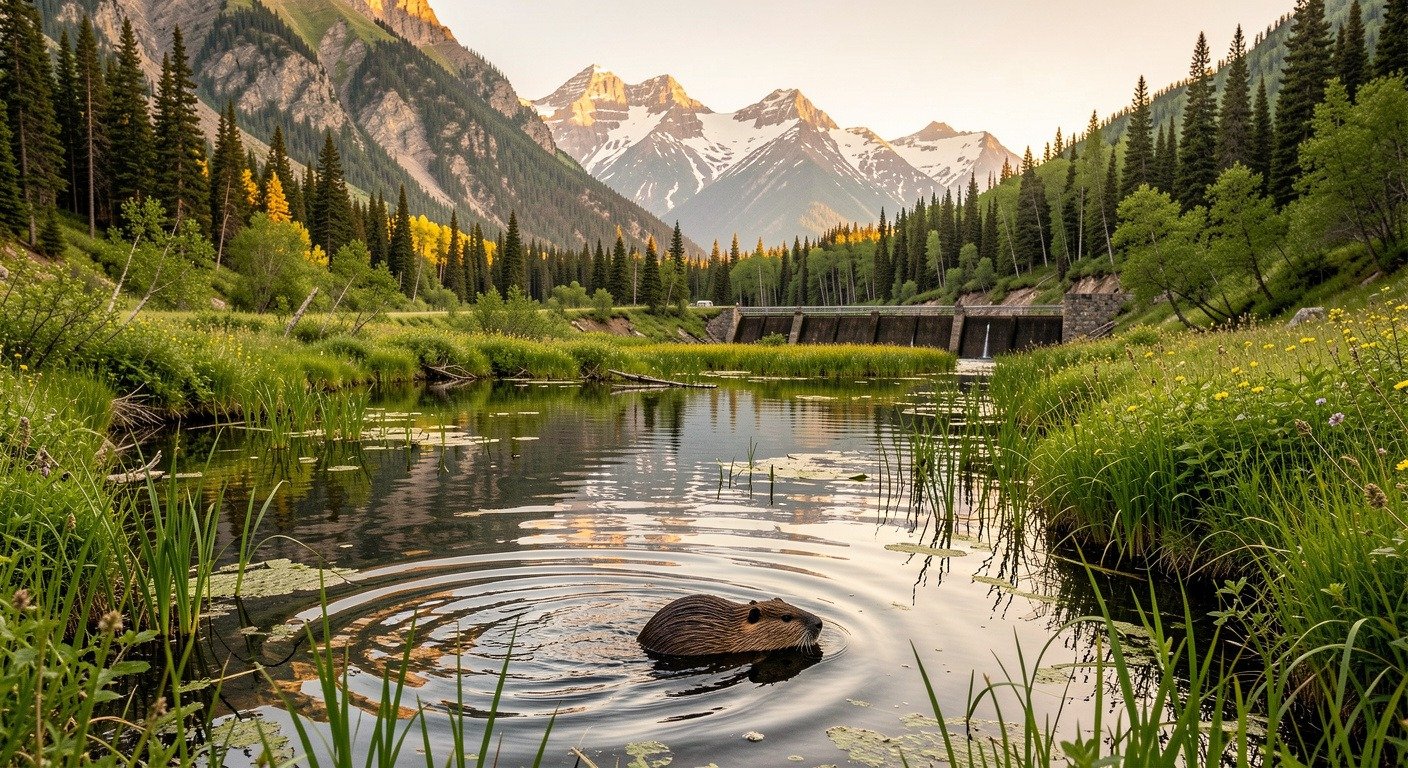
In a quiet valley in Plumas County, California, a family of seven beavers was released into a meadow called Tasmam Koyom in October 2023. It was the first time in roughly 75 years that California had deliberately relocated beavers. Within two years, those beavers had built a 328-foot dam, created a sprawling wetland complex, and increased water coverage on the landscape by more than 22 percent, according to an April 2025 report from the California Department of Fish and Wildlife. By September 2024, the state had relocated 28 beavers across five sites, in an unprecedented collaboration between California Native American tribes and state wildlife managers.
The California program is the most prominent example of a broader shift. Land managers, scientists, and Tribal nations across the West are turning to Castor canadensis, the North American beaver, as a low-cost tool for fighting wildfires and drought. The logic is straightforward: beavers build dams that slow water, spread it across floodplains, and push it underground into aquifers. The wetlands they create stay wet through dry summers and act as natural firebreaks when wildfires sweep through.
Why It Works
The evidence that beaver wetlands resist fire is anchored in peer-reviewed science. In 2020, ecologist Emily Fairfax of the University of Minnesota and co-author Andrew Whittle published a study in Ecological Applications that analyzed satellite imagery of beaver-dammed riparian corridors across the western United States during wildfires. They found that beaver-dammed areas burned roughly three times less than comparable areas without beavers. In many cases, they did not burn at all.
Beavers cut trees and build dams across streams, which creates ponds. The ponds slow the velocity of water, allowing it to spread sideways into the floodplain and percolate down into the soil and groundwater. The beavers then dig canals that distribute that moisture even farther. The result is a broad, saturated greenbelt, what Fairfax describes as a vegetation mosaic, that stays hydrated through the hottest and driest parts of the year. When fire arrives, those corridors function as natural fuel breaks.
The most famous visual of this effect came from the 2018 Sharps Fire in south-central Idaho. After the fire burned roughly 60,000 acres, drone imagery captured a vivid green ribbon of vegetation along beaver-made ponds that stayed lush while the surrounding hillsides were charred black. The image went viral and has become the poster child for what Fairfax calls Smokey the Beaver. Fairfax’s research has documented that 89 percent of the area around beaver ponds and dams qualified as fire refuges, compared with 60 percent of riverscapes without beaver dams.
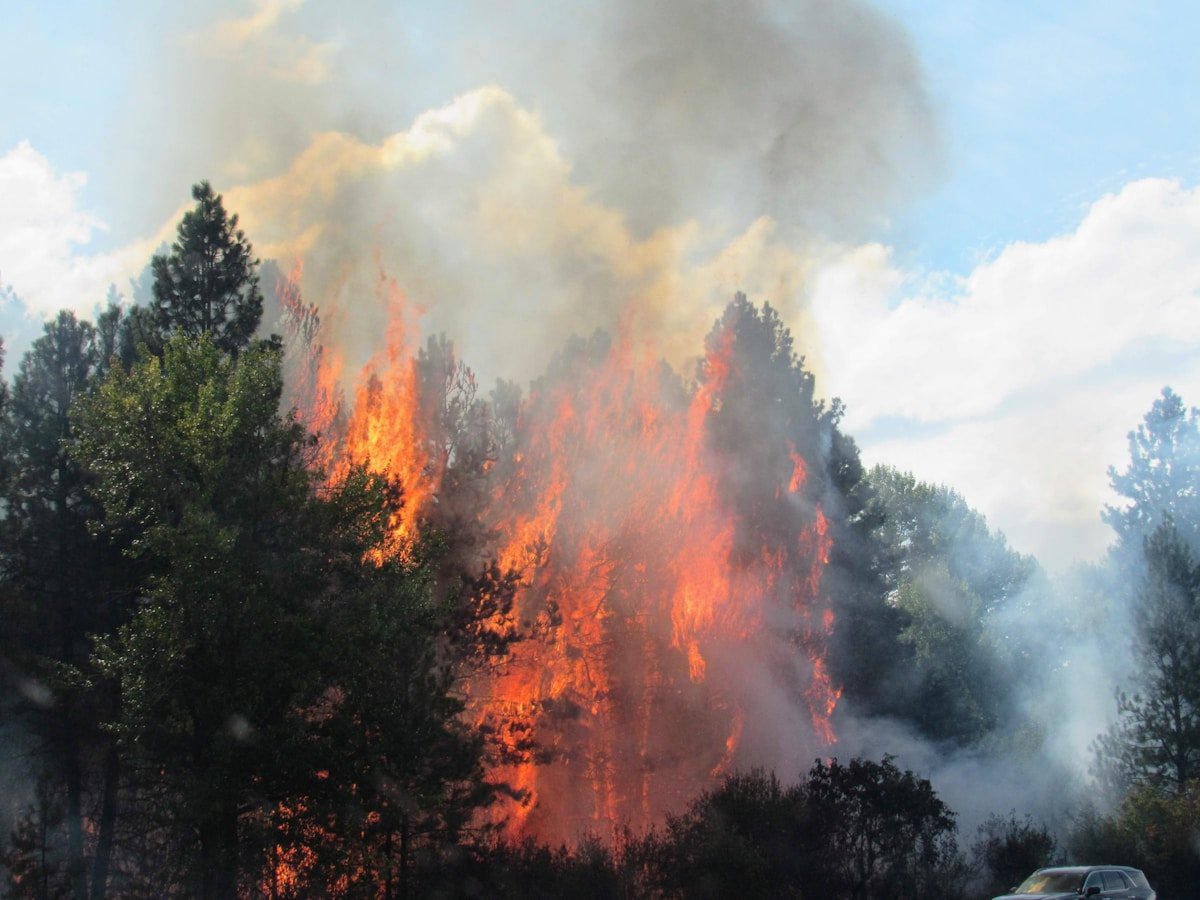
On a landscape scale, the potential is enormous. A 2025 study in Ecological Applications modeled beaver dam-building capacity across California’s Sierra Nevada and found that current capacity, estimated at roughly 440,000 dams, is about 51 percent of historical levels. The study calculated that Sierra beaver ponds could store up to 120 million cubic meters of surface water and create roughly 2,200 square kilometers of fire-resilient landscape in high-risk areas across five priority watersheds: the Upper Yuba, Upper Bear, South Fork American, Upper Mokelumne, and Upper Cosumnes.
To understand how fire seasons are changing across the West, read our article on the 2026 wildfire season, which is already tracking 40 percent above normal.
How It Affects People
Tribal Communities and Cultural Revival
Beaver reintroduction in California is not just an ecological project; it is a restoration of Indigenous land stewardship. The Maidu Summit Consortium leads the work at Tasmam Koyom, land returned to the Mountain Maidu people. The Tule River Tribe, whose reservation in the southern Sierra Nevada hosts another reintroduction site, has pictographs roughly 1,000 years old depicting beavers, an animal their oral traditions recognize as a creator of the watershed. Elder Ben Cunningham described what the project means simply: To have something to work for, be proud of. It is your own.
Landowners and Coexistence
Beavers are not always welcome neighbors. They can flood roads, plug culverts, and fell valuable trees. For generations, the default response was lethal removal. That is changing. A conflict resolution program in Montana’s Clark Fork Basin has shown that nonlethal tools, including pond levelers and culvert fencing, can resolve most conflicts. The program completed 61 projects between 2019 and 2023. California has followed suit, making roughly $2 million in grant funding available for similar measures and formally recognizing beavers as a keystone species.
Firefighters and Downstream Communities
For wildland firefighters, beaver wetlands offer something rare: a place where fire stops or slows on its own. A wet meadow complex can serve as an anchor point for a fire line and a refuge for wildlife fleeing the flames. After a fire passes, beaver ponds trap ash and sediment that would otherwise wash into reservoirs. During Oregon’s 2021 Bootleg Fire, watersheds without beavers turned into black slurries of ash that killed trout populations. Watersheds with intact beaver complexes maintained water quality downstream.
Economics of a Free Workforce
As the North Santiam Watershed Council in Oregon has observed, beavers are ecosystem engineers who will work for free. Human-built beaver dam analogs, structures of wooden posts and woven willow driven into streambeds, cost a fraction of traditional engineered infrastructure. The US Forest Service co-leads Colorado’s largest beaver-based restoration project, where teams constructed 316 mimicry structures in two years. On Colorado’s Trail Creek, the National Forest Foundation built beaver dam analogs that attracted actual beavers who began building dams of their own.
For more on the year-round fire reality reshaping the West, see Fire Season Is Over: Welcome to the Fire Year.
Beavers vs. Wildfire: Key Numbers
| Metric | Value |
|---|---|
| Fire reduction in beaver areas | ~3x less burned |
| Water coverage increase (Tasmam Koyom) | +22% in under 2 years |
| Sierra beaver dam capacity | ~440,000 dams (51% of historical) |
| Potential surface water storage | 120 million cubic meters |
| Historical beaver population | 60–400 million (now ~10% of that) |
The American West is facing compound pressures: hotter droughts, earlier snowmelt, shrinking snowpacks, and fire seasons that now span effectively the entire year. In this context, beaver restoration is increasingly framed as climate adaptation infrastructure, not just wildlife conservation.
The fur trade of the 18th and 19th centuries nearly eliminated beavers from the continent. Pre-trade populations were estimated at 60 to 400 million animals. Today, North American beaver numbers sit at roughly 10 percent of historical levels. That population crash removed millions of dams, drained wetlands, and left western watersheds far less resilient to drought and fire. The Moravek study’s finding that 51 percent of dam capacity remains is both a measure of what was lost and a map of what could be restored. It can be done: the giant panda’s move from endangered to vulnerable shows how a species climbs off the endangered list.

What We Can Learn
The first lesson from the beaver renaissance is that nature-based solutions are not a metaphor. A beaver dam is a physical structure that stores real water, slows real runoff, and creates real firebreaks. The science is quantitative, the satellite imagery is persuasive, and the results at Tasmam Koyom, a 22 percent increase in water coverage in under two years, are measurable.
The second lesson is that coexistence requires a different mindset than control. Beaver advocate Heidi Perryman has warned against idyllic beaver literacy, the idea that relocating a few beavers will fix everything. Beavers do their own work on their own schedule. Ecologist Brock Dolman puts it this way: We are honoring beaver for the work beaver can do, but not turning them into this silver bullet. The programs that work combine beaver reintroduction with human-built analogs and a willingness to let the animals make a mess.
The third lesson is that restoration at scale requires partnerships that did not exist a decade ago. California state agencies working with Tribal nations, the US Forest Service alongside local watershed councils, and researchers sharing satellite data with managers, all of this represents a new model for how conservation gets done. As Emily Fairfax has said, Beavers belong in California, and they should be part of our fire management plan. The question is not whether beavers can help. It is how quickly and how broadly the West is willing to let them.
For further reading, the foundational study by Fairfax and Whittle (2020) in Ecological Applications documents the fire-resilience effect in peer-reviewed detail. The Moravek et al. (2025) Sierra Nevada modeling study quantifies the landscape-scale potential of beaver restoration, and Pacific Rivers maintains an accessible overview of beaver-wildfire science with case studies from across the West.