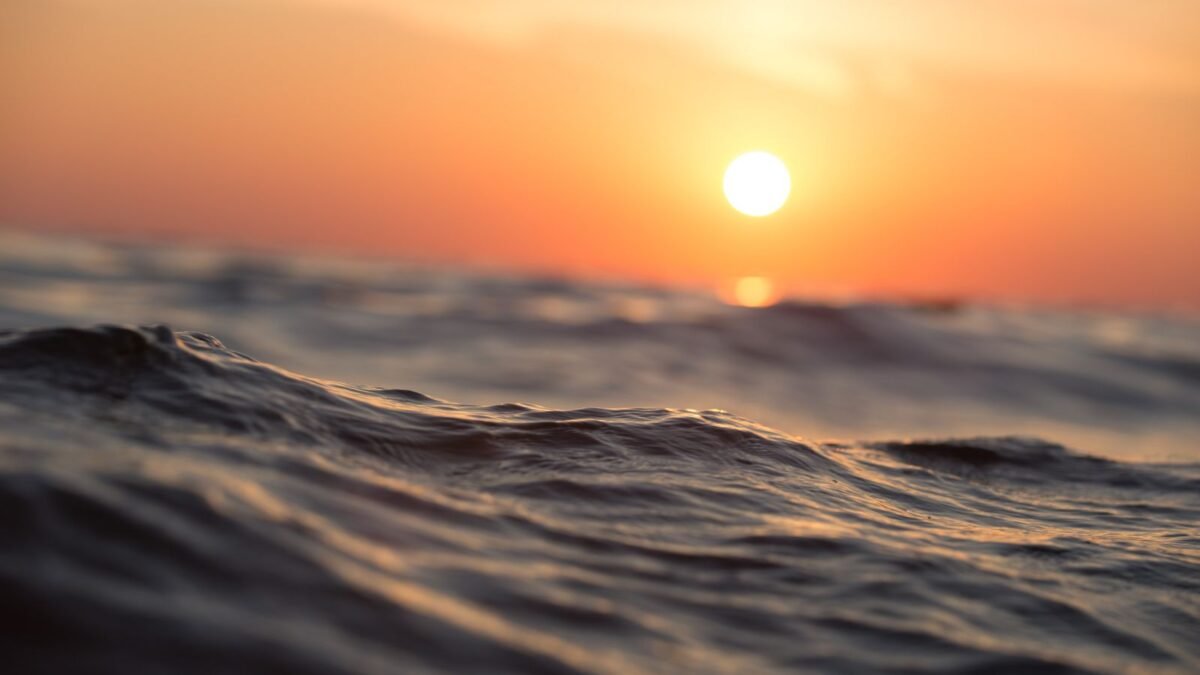
The first time you taste the ocean, you do not expect it. You wade into the surf on a summer afternoon, a wave breaks against your chest, and a splash lands on your lips. Salt. Not a hint of it. Not a whisper. A full, sharp, unmistakable punch of salt. You scrunch your face and ask yourself the question every child asks at the shore: why is the ocean salty?
Kids arrive at this question before they learn to hide their curiosity. A four-year-old at Malibu Beach, salt crusted on her cheeks, turns to her father and demands an answer. The ocean holds enough salt to bury every continent on Earth under a layer 500 feet deep. Yet the rivers that feed the ocean taste fresh. So where does it come from?
Why Is the Ocean Salty? The Story
The answer begins with a raindrop hitting a granite boulder in the Appalachians, four hundred million years ago. That raindrop was not pure water. As it fell, it picked up a whisper of carbon dioxide and became a weak acid. Carbonic acid is gentle enough that you could drink it safely, but given enough time, it dissolves solid rock.
That single raindrop seeped into microscopic cracks in the granite. Over days and centuries, the acid loosened tiny mineral grains: sodium, calcium, magnesium, potassium. These are the building blocks of salt. A trickle of groundwater carried them downhill into a stream. The stream joined a creek. The creek fed a river. And the river, after crossing half a continent, emptied into the Atlantic Ocean.
Every river on Earth carries a silent cargo of dissolved minerals to the sea. The Mississippi alone delivers roughly 130 million tons of dissolved rock to the Gulf of Mexico each year, according to the U.S. Geological Survey. The Amazon, the Ganges, the Nile. Each one is a conveyor belt for salt, running without pause since the continents first formed.
The twist is that you cannot taste the salt in a river. The concentration is vanishingly small. A river like the Colorado carries perhaps 200 milligrams of salt per liter, barely enough for your tongue to register. But the ocean has been collecting that cargo for billions of years without a day off. There is no drain. No river flows out of the ocean. The only way water leaves is through evaporation. Evaporation takes only the freshwater. Every grain of salt stays behind. This is ocean salinity explained in its simplest form: the ocean is a trap with no exit for salt.
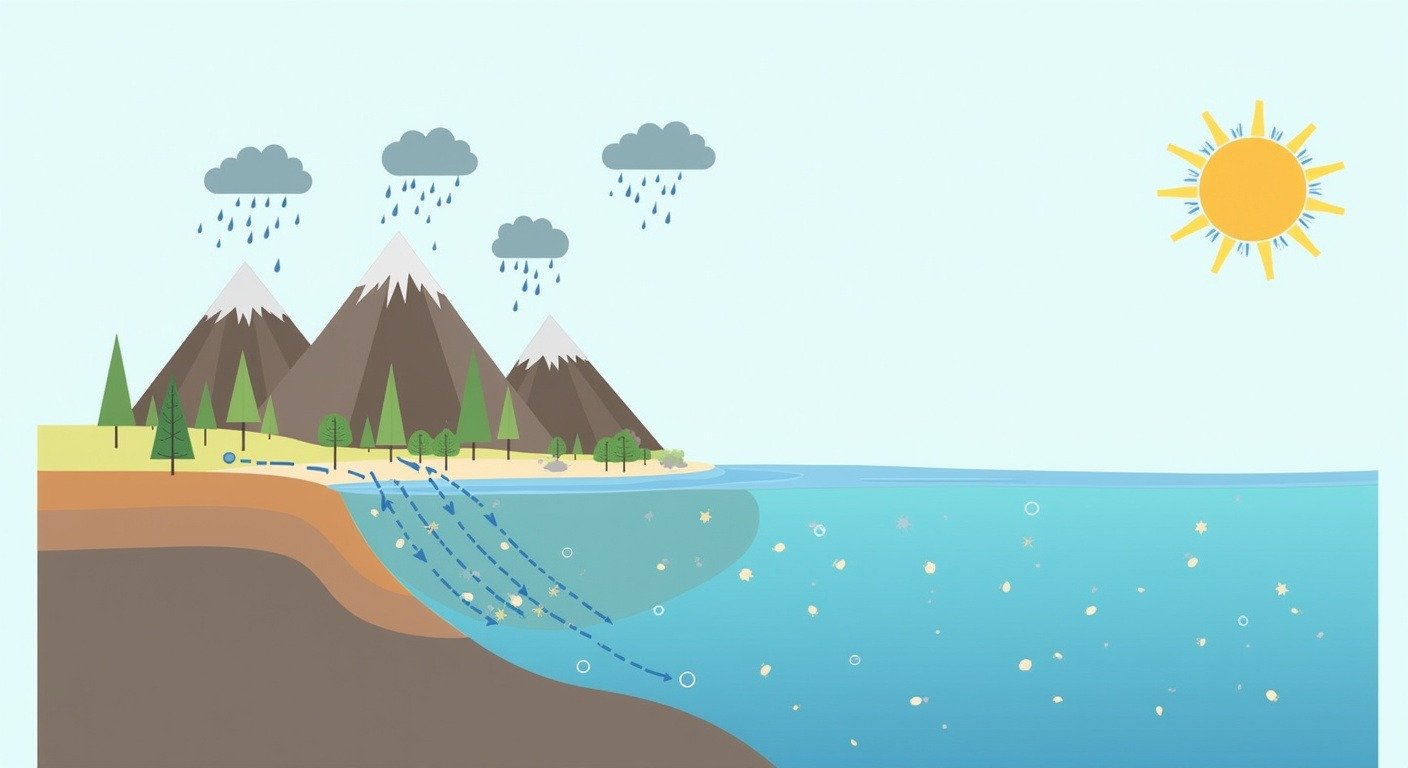
The ocean salt cycle: rain weathers rocks, rivers carry dissolved minerals to the sea, the sun evaporates pure water, and salt stays behind. Four billion years of this cycle created the salty ocean we taste today. Image: NWH / AI-generated
The Science
The main salt in seawater is the same one on your kitchen table: sodium chloride. Its two ingredients arrive from different places.
Sodium comes from rock weathering, the slow chemical dismantling of the continents. Scientists call this process chemical weathering. Acidic rainwater eats into exposed stone, freeing sodium ions that rivers carry to the sea. You can watch it happen in your own garden. The white crust on a boulder after a dry spell is dissolved minerals that water pulled from the rock, then left when the water evaporated. Multiply that boulder by every mountain range on Earth and run it for four billion years. That is your sodium.
Chloride arrives through a different door. Much of it comes from volcanic outgassing deep below the ocean floor. Hydrothermal vents, cracks in the seabed where superheated water jets out at 700 degrees Fahrenheit, leach chloride from the Earth’s mantle and pump it directly into the deep ocean. The NOAA JetStream program describes these vents as chemical factories operating since the oceans first formed. Chloride also enters the atmosphere during volcanic eruptions on land. Rain washes it down. Rivers move it along. The ocean stores it.
The ocean is a one-way system. Water evaporates as pure freshwater, rises, forms clouds, and falls as rain over the continents. This is the water cycle working exactly as it always has. But salt cannot evaporate. When a water molecule lifts off the Pacific, the sodium and chloride ions stay right where they are. Rivers keep feeding the trap. The sun keeps pulling water out. The salt keeps accumulating. The result is ocean salinity of roughly 35 parts per thousand, or 35 grams of salt in every liter of seawater, according to the Science Learning Hub.
The Dead Sea shows what happens when the trap has no outlet. Sitting at the lowest point on Earth, it receives water from the Jordan River but loses water only through evaporation. No river drains it. The result is a salinity of roughly 34 percent, nearly ten times saltier than the ocean. You do not swim in the Dead Sea so much as float on it, propped up by water so dense with salt it feels like warm oil. The dead sea salinity is a preview of what every ocean would become if evaporation outpaced freshwater inflow.
This also explains why are oceans salty but rivers are not. Rivers carry salt, but at concentrations far below what your tongue can detect. The ocean has concentrated that cargo over four billion years while evaporation kept removing only the water.
The Meaning
Ocean salinity powers the largest physical machine on Earth.
Differences in salt concentration, combined with temperature, create density gradients that drive ocean currents. The great global conveyor belt, a system of deep and surface currents wrapping the entire planet, begins when cold, salty water in the North Atlantic becomes dense enough to sink. That sinking pulls warm surface water north from the tropics, distributing heat that keeps London warmer than Labrador despite sitting at the same latitude.
Marine life depends on salinity staying within a narrow range. Fish gills are tuned to a specific salt balance. Oysters in the Chesapeake Bay can only survive in estuaries where salinity falls between 10 and 28 parts per thousand. Too much freshwater runoff after a heavy storm, and entire oyster beds die within days. The fishing communities that depend on those beds feel the loss at the market and at their dinner tables.
For human communities, salinity shapes where people can drink. Desalination plants in Israel, Saudi Arabia, and California strip salt from seawater to produce drinking water for millions of homes. A typical desalination plant uses roughly three kilowatt-hours of electricity per cubic meter of fresh water, about what a household refrigerator burns in six hours. In coastal cities facing drought, the ocean’s salt is both a barrier and a lifeline.
The Resonance
The ocean’s salt has been accumulating for four billion years, yet its concentration has stayed nearly constant for the last billion. This is the quiet miracle. For every ton of salt that rivers deliver, roughly the same amount is removed. Some gets trapped in seafloor sediments. Some gets locked into the shells of microscopic organisms that sink when they die. Some gets absorbed into newly formed rock at tectonic plate boundaries. The inflow and the outflow found balance long before the first human ever tasted seawater.
You can hold the entire story in a single thought. Take a teaspoon of salt from your kitchen. That salt was once part of a mountain in what is now Tibet. Rain dissolved it. A river carried it to the Indian Ocean. A fish absorbed it and used it to regulate its bloodstream. That fish died, sank, and became part of the seafloor. A tectonic plate dragged that seafloor into the mantle, where it melted and re-emerged through a volcanic vent on the other side of the world. Millions of years later, someone mined it, refined it, and put it in a cardboard canister on a supermarket shelf.
The ocean does not forget. Every grain of salt carries four billion years of geology in its crystal lattice. The next time you taste the sea, you are tasting the Appalachians. You are tasting volcanoes that erupted before the first fish grew bones. You are tasting a cycle so patient and so vast that it makes the human lifespan look like a single raindrop hitting granite, here and gone before the rock even notices.
Contains information related to marketing campaigns of the user. These are shared with Google AdWords / Google Ads when the Google Ads and Google Analytics accounts are linked together.
90 days
__utma
ID used to identify users and sessions
2 years after last activity
__utmt
Used to monitor number of Google Analytics server requests
10 minutes
__utmb
Used to distinguish new sessions and visits. This cookie is set when the GA.js javascript library is loaded and there is no existing __utmb cookie. The cookie is updated every time data is sent to the Google Analytics server.
30 minutes after last activity
__utmc
Used only with old Urchin versions of Google Analytics and not with GA.js. Was used to distinguish between new sessions and visits at the end of a session.
End of session (browser)
__utmz
Contains information about the traffic source or campaign that directed user to the website. The cookie is set when the GA.js javascript is loaded and updated when data is sent to the Google Anaytics server
6 months after last activity
__utmv
Contains custom information set by the web developer via the _setCustomVar method in Google Analytics. This cookie is updated every time new data is sent to the Google Analytics server.
2 years after last activity
__utmx
Used to determine whether a user is included in an A / B or Multivariate test.
18 months
_ga
ID used to identify users
2 years
_gali
Used by Google Analytics to determine which links on a page are being clicked
30 seconds
_ga_
ID used to identify users
2 years
_gid
ID used to identify users for 24 hours after last activity
24 hours
_gat
Used to monitor number of Google Analytics server requests when using Google Tag Manager