You probably guessed the Amazon rainforest. Or maybe a Pacific island battered by typhoons. You would be wrong. The wettest place on Earth sits not in a jungle basin or on a tropical atoll. It sits at 1,400 meters above sea level in northeastern India, in a small town where children walk to school under bamboo shields shaped like turtle shells.
The monsoon there is not a season. It is the year.
Mawsynram, a town of roughly 4,000 people in the East Khasi Hills of Meghalaya, receives 11,872 millimeters of rain annually, according to the Guinness Book of World Records. That is 467 inches. Five times what Mumbai gets. More than Seattle receives in a decade. Most of it falls between June and September, when the Bay of Bengal monsoon slams into the Khasi Hills and cannot climb over them fast enough. So it drops everything it is carrying.
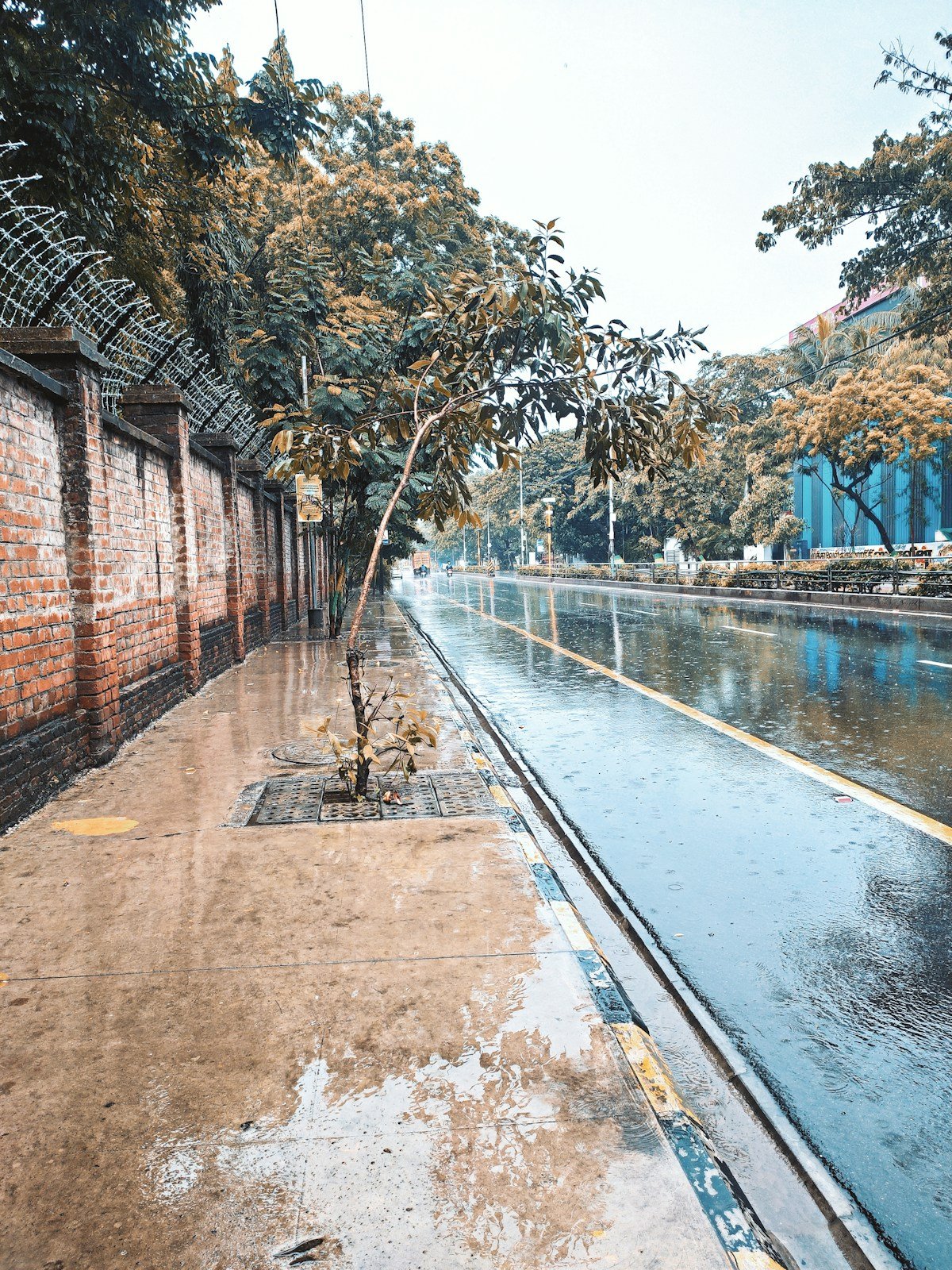
What Makes It the Wettest Place on Earth
The Amazon is not even close. Quibdo, Colombia averages about 8,000 millimeters. Mount Waialeale in Hawaii, once thought to be the record holder, gets roughly 9,500. Neither approaches Mawsynram’s long-term average. The town holds the Guinness World Record. It is the wettest inhabited place on the planet.
The people who live there have not just survived the rain. They have built a culture around it. Much like the communities shaped by the seasonal wind shifts described in our guide to how monsoons work, the rhythm of life here follows the sky.
Fifteen kilometers away sits Cherrapunji, known locally as Sohra. For decades, these two towns traded the title back and forth depending on whose rain gauge filled faster. Cherrapunji still holds the single-year record: 26,461 millimeters from August 1860 to July 1861. That is more than 26 meters of rain. Enough to submerge a two-story building. But Mawsynram wins the long game. Its multi-decade average is higher. The title belongs there.

The Science
The mechanism behind Mawsynram’s rain is called orographic lift. Warm, moisture-laden air from the Bay of Bengal travels north across the Bangladesh plains. When it hits the Khasi Hills, the air has nowhere to go but up. As it rises, it cools. Cool air holds less moisture than warm air. The water vapor condenses into clouds. The clouds release their cargo.
This happens every day for months. According to the India Meteorological Department, a single day can bring over 1,000 millimeters of rain. That is roughly the annual rainfall of London, England. Falling in 24 hours.
The Khasi Hills form a nearly vertical wall against the monsoon flow. The air rises almost 1,400 meters in a very short horizontal distance. That rapid uplift squeezes the moisture out with extraordinary efficiency. The same monsoon that drops a moderate rain on the plains of Bangladesh becomes a deluge by the time it reaches Mawsynram. The town acts as a natural condensation machine: air goes in wet at the bottom and comes out wrung dry at the top.
To understand how this fits into the bigger picture of rainfall worldwide, read our explanation of why rain forms and how the water cycle works.
Why Your Intuition Was Wrong
Most people associate extreme rainfall with tropical heat. The Amazon is hot. So is the Congo Basin. Both are wet. But this town is not hot. Mawsynram is cool and misty. The elevation keeps temperatures moderate year-round. People wear jackets in July. The combination of elevation, proximity to the ocean, and a mountain wall facing the wind is more powerful than raw tropical heat alone.
There is another surprise. The rain is not constant. It comes in bursts. The sky opens, drops an ocean, and then the mist settles in. Locals describe the monsoon not as a rainy season but as a season of cloud. The village lives inside a cloud for four months. Visibility drops to a few meters. Sounds are muffled. The world shrinks to what you can touch.
The Human Element
The Khasi people have lived with this rain for centuries. They developed the knup, a dome-shaped rain shield woven from bamboo and banana leaves, as documented by The Better India. It covers the head and shoulders like a portable roof. Farmers wear them in the fields. Children wear them to school. They leave their hands free. A raincoat would be useless here. The rain comes from every direction, not just from above. The knup creates a bubble of dry air around the upper body. It is practical. It is also beautiful.
Living root bridges are another adaptation. The Khasi train the aerial roots of rubber fig trees across rivers and streams. Over decades, the roots thicken and weave together into living bridges that can support dozens of people. Concrete bridges wash away in the monsoon floods. The root bridges grow stronger with each passing year. Some are over 500 years old.
Mawsynram recently opened a Rain Museum, the first of its kind anywhere. It documents the science of the rainfall. It preserves the tools that made life possible here before modern roads and weather forecasts. And it invites visitors to experience what living in the wettest place on earth actually feels like. Not through photographs. Through being there during the monsoon, listening to rain on a tin roof that has not stopped reverberating since June.
For more on how rainfall patterns are shifting worldwide, see our report on how climate change is rewriting the rules of rain.
So What
The wettest place on earth teaches a simple lesson about extremes. The most dramatic weather on the planet often hides in small places. Not in the Amazon. Not in the South Pacific. In a town of 4,000 people in northeastern India where the monsoon arrives every year like a wall of water. And the local response was not to leave. It was to weave a shield out of bamboo and walk into it.
The next time someone asks you where it rains the most on Earth, you will have the answer. And you will also have the better story: mountains that wring clouds dry. Bridges grown from tree roots. A village that lives inside a cloud for four months every year and calls it home.
Would you visit the wettest place on Earth? If standing under monsoon rain that averages 11 meters a year sounds like an adventure, Meghalaya is waiting. If it sounds like a nightmare, at least now you know where to avoid.
Get The Nature Brief
One calm, useful nature and weather briefing every week. No panic. No jargon. Just clear stories that help you understand the planet.
Join Free \u2192