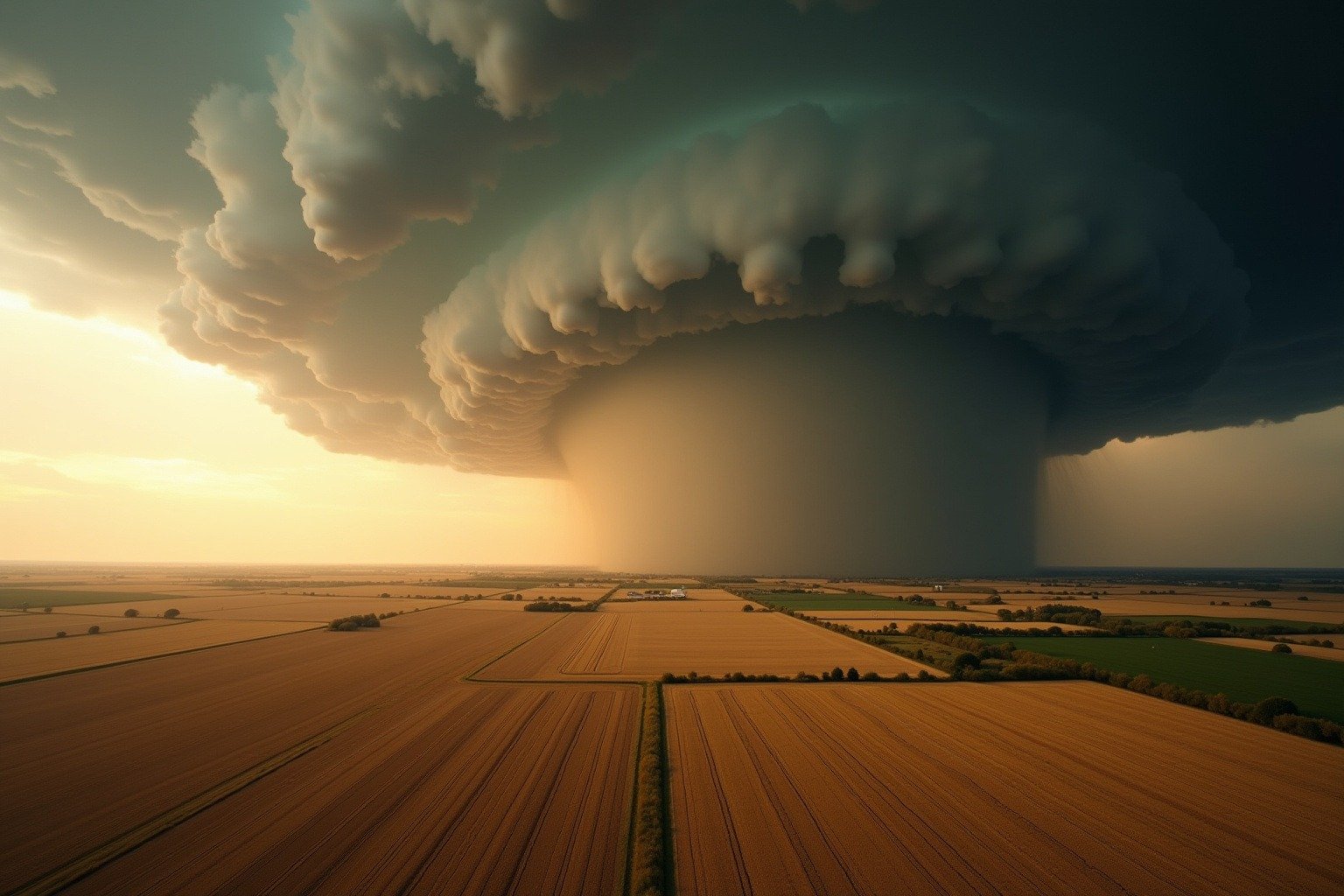
A thunderstorm in July should not be dropping ice. But it does, and some of those ice balls are the size of baseballs, falling at highway speeds. Understanding how hail forms is the first step to knowing when danger is overhead.
The contradiction is what makes hail so unnerving. The air temperature at ground level is 90 degrees Fahrenheit. The sun was out ten minutes ago. And now chunks of ice are smashing through car windshields, shredding crops, and piling up on roads like a winter storm that forgot what season it belongs to. Hail causes roughly $10 billion in damage every year in the United States alone, more than tornadoes and hurricanes combined according to research from Dr. John Allen and colleagues. Understanding how hail forms is not just weather curiosity. It is how you know when to get inside.
Hail is ice that grows inside thunderstorms in summer. A powerful updraft of rising air catches raindrops, freezes them, and cycles them through the storm again and again while supercooled water droplets freeze onto the surface layer by layer. When the stone becomes too heavy for the updraft to lift, it falls. The stronger the updraft, the bigger the hail.
- Hail forms when thunderstorm updrafts carry raindrops into freezing air, building ice layers around a central seed until the stone falls under its own weight.
- The largest US hailstone on record fell in Vivian, South Dakota, in 2010: 8 inches across, nearly 2 pounds, falling at over 100 miles per hour.
- Hail causes roughly $10 billion in damage annually in the United States, more than tornadoes and hurricanes combined.
- Hail Alley (Nebraska, Colorado, Wyoming) averages 7 to 9 hail days per year. Climate change is making hailstorms more damaging in more regions.
What Is Hail?
Hail is solid ice that falls from thunderstorms. Unlike sleet or freezing rain, which happen in winter when the whole column of air is cold, hail happens in the middle of summer. It requires a thunderstorm, and specifically, it requires the kind of thunderstorm with a powerful, sustained updraft: the rising column of air that feeds the storm.
The National Severe Storms Laboratory defines hail as a form of precipitation consisting of solid ice that forms inside thunderstorm updrafts. The key word is inside. Hailstones are not frozen raindrops that fell through cold air on the way down. They are built, layer by layer, inside the storm itself, while suspended thousands of feet above your head.
A thunderstorm becomes severe when it produces hail at least one inch in diameter, roughly the size of a quarter. Below that, it is just a thunderstorm with small hail. Above that threshold, the National Weather Service issues a Severe Thunderstorm Warning, and the ice falling from that storm can crack skulls. For more on the storms that produce hail, see our guide to how thunderstorms form.
How Hail Forms: The Updraft Engine
The process starts with a raindrop. Not at the ground, but high inside a cumulonimbus cloud. The thunderstorm’s updraft catches the droplet and shoots it upward into a region of the atmosphere that is below freezing. The droplet freezes into a tiny pellet of ice.
That is the seed. What happens next is what makes the difference between a pea-sized pebble of ice and a grapefruit-sized stone that can punch through a roof. This is the core of hail formation, and it depends entirely on the thunderstorm’s updraft.
So why does hail form in some thunderstorms but not others? The answer is updraft strength. A typical thunderstorm updraft can suspend small ice pellets. Only a supercell thunderstorm, with its rotating, sustained updraft, can keep a golf-ball-sized stone aloft long enough for it to accumulate dozens of ice layers. That is how hail forms at the scale that does real damage.
Professional meteorologists call this process accretion. The simple version: a hailstone is like a pearl, built in concentric layers around a central seed, except the layers are ice and the oyster is a thunderstorm traveling at 50 miles per hour.
If the water freezes instantly when it hits the stone, air bubbles get trapped inside and the layer is cloudy white. If it freezes slowly, the air escapes and the layer is clear like glass. Cut a large hailstone in half and you can count the rings, each one marking another trip through the storm.

How Big Can Hail Get, and How Fast Does It Fall?
The size of a hailstone depends entirely on the strength of the updraft. The hail size chart below, adapted from National Weather Service data, shows the relationship:
| Hail Size | Diameter | Updraft Needed | Fall Speed |
|---|---|---|---|
| Pea | 0.25 in | ~24 mph | 9-25 mph |
| Quarter (severe) | 1.00 in | ~50 mph | 25-40 mph |
| Golf Ball | 1.75 in | ~64 mph | 25-40 mph |
| Baseball | 2.75 in | ~80 mph | 44-72 mph |
| Softball | 4.00 in | ~100 mph | 44-72 mph |
| Grapefruit | 4.50 in | ~110 mph | over 100 mph |
Source: NOAA National Severe Storms Laboratory and National Weather Service
The largest hailstone ever recovered in the United States fell in Vivian, South Dakota, on June 23, 2010. It was 8 inches across, had an 18.62-inch circumference, and weighed nearly two pounds. It was not a perfect sphere. Large hailstones rarely are. They tumble as they fall, developing irregular shapes.
Their irregular shapes make terminal velocity hard to predict. But the NOAA National Severe Storms Laboratory estimates that stones exceeding four inches in diameter can reach speeds over 100 miles per hour.
Where Hail Happens Most
The central United States is the global capital of hailstorms. The area where Nebraska, Colorado, and Wyoming meet has earned the name Hail Alley and averages seven to nine hail days per year. These storms feed on the same supercell thunderstorms that power tornadoes, which we covered in our tornado science explainer. Other hail-prone regions include northern India, eastern China, Russia, and northern Italy.
But hail is not limited to the Plains, and recent seasons have been unusually active. In 2024, storms with damaging hail occurred on 133 days across the United States, well above the 20-year average. A year later, insurers counted $61 billion in global losses from severe convective storms — the thunderstorm hazards that include hail, damaging winds, and tornadoes — the third-highest annual total ever recorded, according to Aon’s 2026 Climate and Catastrophe Insight. Florida has the most thunderstorms of any state but relatively little large hail, because its storms lack the powerful, sustained updrafts that supercells on the Plains can generate.
Hail falls in paths called hail swaths that can stretch 10 miles wide and 100 miles long. A single supercell thunderstorm can drop a continuous trail of hail across an entire county, and the piles left behind have, on occasion, required snowplows to clear.
What Hail Does to People, Property, and Crops
The economics of hail are staggering. Hailstorms cause more property damage in the United States each year than tornadoes and hurricanes combined, roughly $10 billion annually according to the Insurance Journal and a 2026 Nature study. Aon’s 2026 Climate and Catastrophe Insight put global insured severe thunderstorm losses for 2025 at $61 billion, the third-highest annual total on record. The costliest single hailstorm in American history struck St. Louis in April 2001, causing $1.9 billion in insured losses.
Cars are the most common casualty. A single hailstorm can total thousands of vehicles in a dealership lot in minutes. Roofs, siding, and windows are next. Farmers watch an entire season erased in ten minutes when hail shreds corn and soybean crops. Livestock in open pasture can be killed by large stones.
People caught outdoors during a severe hailstorm face serious risk. More than 400 people were injured at a single outdoor event when softball-sized hail fell on a crowd. Wind-driven hail, pushed sideways by storm winds, makes this even more dangerous. It can shatter side windows and send glass through interior walls. This is why hail safety rules emphasize getting away from windows, not just getting indoors.
Climate change may be making the problem worse. A 2026 study published in Nature found that a warming atmosphere is creating conditions favorable for larger hail in more regions. This follows the broader pattern we covered in our climate change explainer: warmer air holds more moisture, which fuels stronger thunderstorms. Stronger updrafts can suspend larger hailstones. The Insurance Journal reported that hail damage claims have been rising faster than overall severe weather claims.
How to Stay Safe During a Hailstorm
The NWS safety rules for hail are simple and they are absolute:
- Get inside. A sturdy building is the only reliable shelter. A car is better than nothing. Open fields, under trees, and highway overpasses are not.
- Stay away from windows. Wind-driven hail can shatter glass. Move to an interior room on the lowest floor.
- If you are driving, pull over. Angle your car so the hail hits the front windshield (which is reinforced) rather than the side windows. Cover your eyes.
- After the storm, check for damage. Hail dents on a roof can lead to leaks that worsen over weeks. Document everything for insurance.
The forecast tools have improved dramatically. The NWS Storm Prediction Center issues hail outlooks days in advance. When a Severe Thunderstorm Warning includes the words “destructive” or mentions hail larger than golf balls, take it seriously. That storm can reshape a neighborhood in the time it takes to finish a cup of coffee.
Join Free →