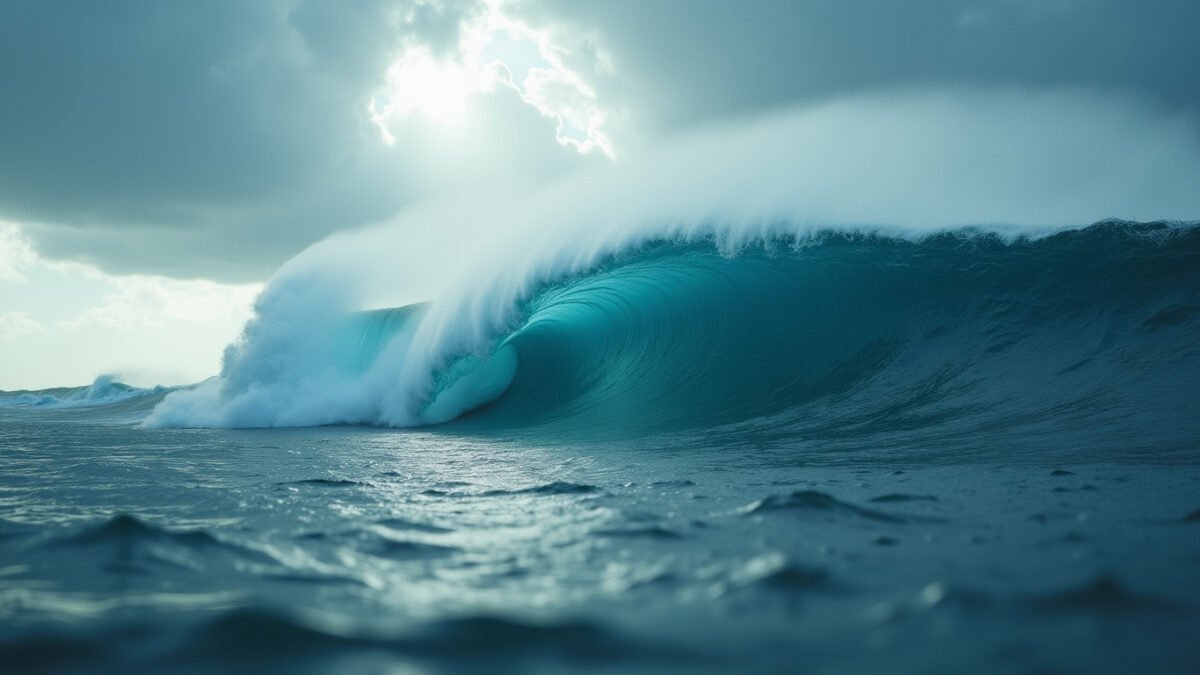
A wall of water races toward the shore at the speed of a jetliner, silent and nearly invisible in the open ocean. For coastal communities around the world, understanding how do tsunamis form is not just science: it is a matter of survival.
What Is a Tsunami
A tsunami is a series of enormous ocean waves caused by the sudden displacement of large volumes of water. Unlike the wind-driven waves that surfers ride at the beach, which only move the surface layer of the ocean, a tsunami involves the entire water column from the seafloor to the surface.
Regular ocean waves travel at perhaps 10 to 30 miles per hour and break predictably on the shore. Tsunamis move through deep water at speeds of 500 to 600 miles per hour, roughly as fast as a commercial jet. The deeper the water, the faster the wave travels, according to NOAA’s JetStream education pages.
In the deep ocean, a tsunami wave may rise only one to three feet high, barely noticeable by ships passing overhead. The danger becomes real only when the wave approaches shallow coastal water and the seafloor compresses its energy upward.
How Do Tsunamis Form
Understanding how do tsunamis form begins with what lies beneath the ocean floor. More than 80 percent of all tsunamis are triggered by underwater earthquakes at tectonic plate boundaries, especially in subduction zones where one plate slides beneath another.
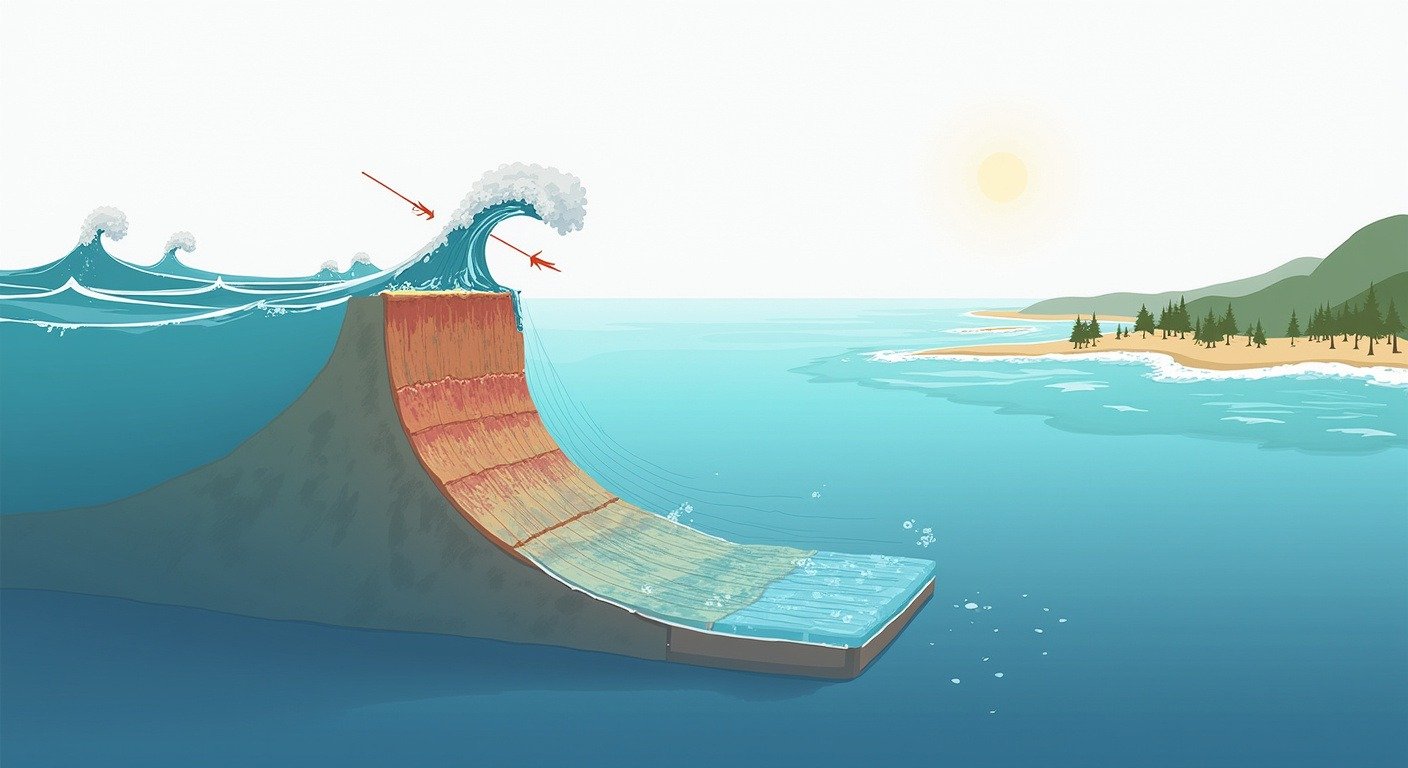
When an earthquake suddenly lifts or drops the seafloor, it displaces the entire water column above it. This displacement, called vertical seafloor deformation by seismologists, pushes a massive volume of water upward. The displaced water then collapses under gravity and radiates outward in all directions as a series of waves.
If you want the formation of a tsunami step by step, here is the sequence:
- The trigger. An earthquake at a subduction zone suddenly lifts or drops a large section of the seafloor.
- The displacement. That movement shoves the entire water column above it upward, heaving an enormous volume of water out of place.
- The wave train. The displaced water collapses under gravity and radiates outward in all directions as a series of long, fast-moving waves.
- The arrival. When those waves reach shallow water near a coastline, they slow down, bunch together, and rise — sometimes to the height of a building.
This is what causes a tsunami in its most common form: the abrupt, violent movement of the ocean floor itself.
The 2004 Indian Ocean tsunami illustrates this process on a catastrophic scale. A magnitude 9.1 earthquake off the coast of Sumatra lifted a section of seafloor roughly the length of California. The resulting waves reached heights of 100 feet in some locations and killed or left missing 227,898 people across 14 countries, according to NOAA’s National Centers for Environmental Information — the deadliest tsunami in recorded history.
Not all tsunamis are earthquake-driven. Underwater landslides can displace water when sediments collapse along continental shelves. Volcanic eruptions, like the recent volcanic activity in Indonesia, can generate tsunamis when explosive blasts or flank collapses push water outward.
In rare cases, meteotsunamis form when rapid changes in atmospheric pressure from severe weather systems generate wave trains that resemble seismic tsunamis.
What Happens as a Tsunami Approaches Land
In deep water, a tsunami is easy to miss. Its waves are rarely more than three feet high, and with wavelengths of hundreds of miles, the entire train can pass beneath a ship without anyone on board noticing. Everything changes when the seafloor rises to meet it. The process is called shoaling, and it is how a wave that is invisible at sea becomes a wall of water at the beach.
As a tsunami enters shallow water, the front of the wave drags against the rising seafloor and the whole train slows down — from jetliner speeds of over 500 miles per hour to roughly 20 or 30 miles per hour near the coast, according to the National Weather Service. That is still faster than a person can run. But the energy does not disappear: the waves behind catch up, wavelengths shrink, and the water piles upward. Most tsunamis come ashore at less than 10 feet high. In extreme cases, they have exceeded 100 feet.
Then there is the strange part: the ocean often leaves before the wave arrives. This sudden retreat — called drawdown — can expose the seafloor, reefs, and fish “like a very low, low tide,” as the National Weather Service describes it. It is one of nature’s clearest warnings, and it has also been one of its deadliest traps. On December 26, 2004, people on coastlines around the Indian Ocean walked onto newly exposed seabed, drawn by stranded fish. Minutes later, the water returned.
A tsunami is never a single wave. It is a train of waves that floods, drains, and re-floods the coast for hours. The time between waves can range from five minutes to two hours, and the first wave is not always the biggest. The second or third wave is often the most destructive — one more reason that leaving the coast after the first wave passes, and staying away until authorities give the all-clear, saves lives.
The 2004 Indian Ocean tsunami showed how fast this sequence unfolds. The magnitude 9.1 earthquake struck off northern Sumatra at 7:58 a.m. local time, and the tsunami reached the coast within 20 minutes. Near Banda Aceh, waves along parts of the Sumatran coast were reported to be 30 meters — about 100 feet — high, according to the U.S. Geological Survey. The waves then crossed the Bay of Bengal, striking Sri Lanka and India about two hours later and reaching the coast of Africa within seven hours. By the time the ocean settled, 227,898 people were dead or missing across 14 countries.
The 2011 Tohoku event in Japan compressed the same lesson into half an hour. The magnitude 9.1 earthquake struck offshore on March 11, and the tsunami arrived at the coast within 30 minutes, overtopping seawalls and flooding a 2,000-kilometer (1,242-mile) stretch of the Pacific coast. The largest waves measured almost 40 meters (130 feet) in Iwate Prefecture. More than 18,000 people died, and NOAA’s National Centers for Environmental Information reports that 98 percent of the damage came from the waves, not the shaking.
How Tsunamis Affect People
The human cost of tsunamis unfolds across multiple dimensions of life. Coastal communities bear the first and most devastating impact. Entire neighborhoods are erased within minutes as walls of water sweep through streets, destroying homes and leaving families with nothing but the clothes on their backs.
Infrastructure collapse follows the initial wave strike. Roads, bridges, power lines, water treatment plants, and communication networks are destroyed simultaneously, making rescue efforts nearly impossible in the critical first hours. The 2011 Japan tsunami demonstrated this with chilling clarity: a magnitude 9.1 earthquake sent waves almost 130 feet high crashing into the coast, killing more than 18,000 people and triggering the Fukushima nuclear disaster.
Economies also take years to recover. Fishing fleets are destroyed, tourist destinations are wiped off the map, and the cost of rebuilding infrastructure runs into billions of dollars.
The psychological toll on survivors lasts even longer. Communities that have experienced a tsunami report elevated rates of anxiety, post-traumatic stress, and a deep-seated fear of the ocean that persists for decades.
Tsunami Warning Signs and Preparedness
Recognizing the natural tsunami warning signs can mean the difference between life and death. The first and most important sign is a strong earthquake felt near the coast. If the ground shakes so intensely that standing becomes difficult, a tsunami may follow within minutes.
A second critical sign is a sudden and unusual drop in sea level that exposes the seafloor. This phenomenon, called drawback, occurs when the ocean recedes dramatically before the first wave arrives. People who recognize this sign and move to high ground immediately have survived tsunamis that killed those who stayed to investigate the exposed reef.
The third warning sign is a loud roaring sound from the ocean, often described as resembling a jet engine or a freight train. Any one of these three signals demands immediate evacuation to high ground. Do not wait for an official warning: a tsunami generated by a nearby earthquake can reach the coast in under 10 minutes.
Monitoring systems have improved dramatically since 2004. NOAA operates tsunami warning centers, including the Pacific Tsunami Warning Center and the National Tsunami Warning Center, that use DART buoys to detect pressure changes on the seafloor. These buoys transmit real-time data that helps forecasters issue warnings before waves reach populated coastlines. The USGS Earthquake Hazards Program tracks the earthquakes that trigger most tsunamis. The Pacific Ocean, circled by the seismically active Ring of Fire, sees the most tsunamis worldwide, but the Indian Ocean and Mediterranean regions also face significant risk.
The science behind how do tsunamis form has given coastal nations the tools to build early warning networks that did not exist a generation ago. Understanding how tsunamis form — like understanding how hurricanes form and how flash floods work — is part of a broader effort to protect communities from the ocean’s most dangerous behavior.
But technology alone is not enough. Knowing the natural warning signs and moving to high ground when they appear remains the single most effective path to survival.
What We Can Learn
Tsunamis cannot be prevented, but their death toll can be dramatically reduced. The three natural warning signs, a strong coastal earthquake, a sudden sea level drop, and a loud ocean roar, are free, instant, and available to everyone regardless of technology or infrastructure.
Coastal communities in tsunami-prone regions now run regular evacuation drills, build vertical evacuation structures, and educate residents about the signs their grandparents once knew by instinct. These simple, low-cost measures have already saved thousands of lives in Japan, Chile, and Indonesia. Every minute spent learning the warning signs today could buy the minutes needed to reach high ground tomorrow.
The ocean gives clear signals before it strikes. The question is whether we choose to listen.