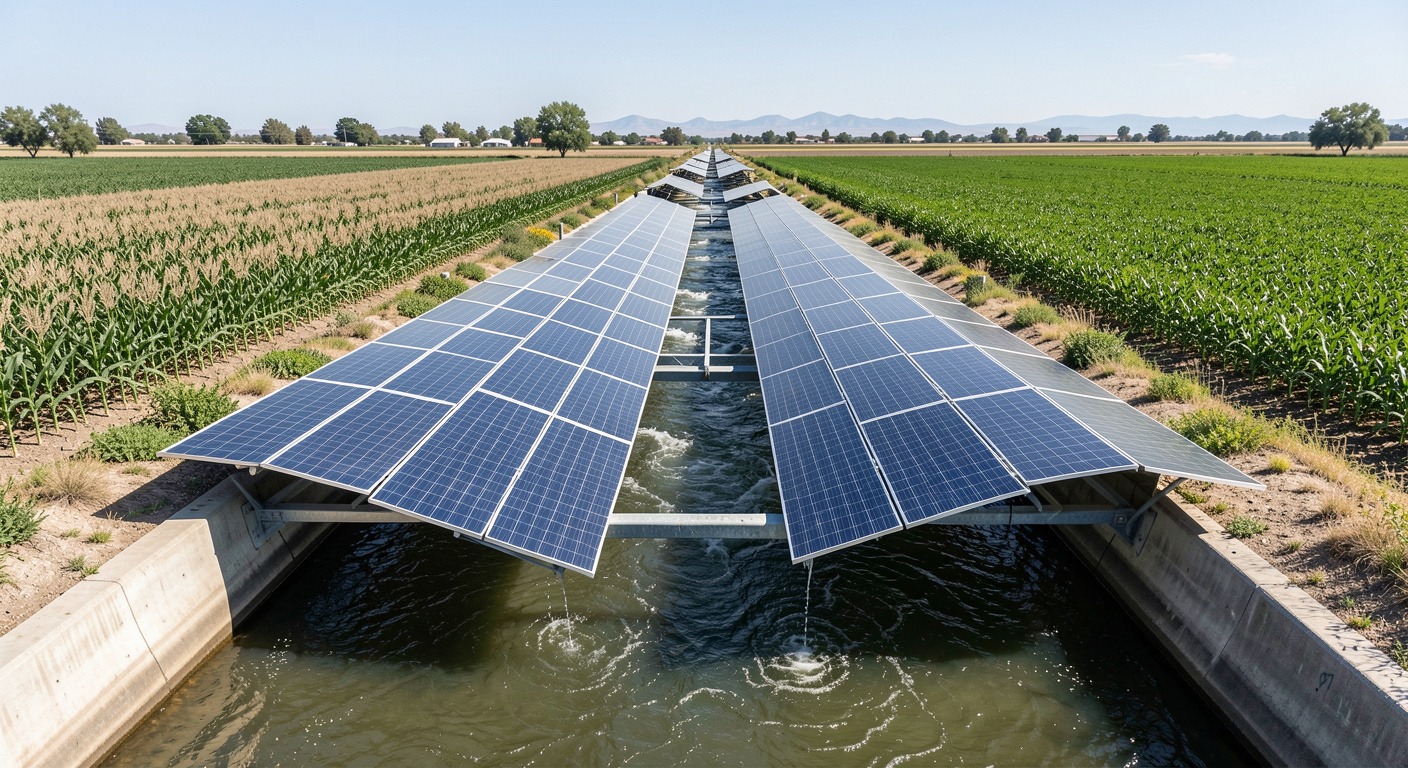
California is covering its irrigation canals with solar panels, a two-for-one solution that generates clean electricity while saving billions of gallons of water from evaporation. The Turlock pilot project, the first of its kind in the United States, could reshape how the arid West thinks about infrastructure.
What It Is
Along a stretch of irrigation canal in California’s Central Valley near Turlock, steel trusses span the waterway, supporting rows of solar panels that form a continuous canopy over the flowing water. The concept is simple: put solar panels over canals to generate electricity while shade keeps the water from evaporating. The implications reach across the state’s water and energy systems.
California has roughly 4,000 miles of open irrigation canals, a network that delivers water to about 40 million people and irrigates 5.5 million acres of farmland. Every mile of exposed water surface loses moisture to the sun. “Solar canals,” also called canal-top solar, cover those waterways with photovoltaic panels and solve two problems at once. The panels produce clean energy. The shade conserves water. And the water below cools the panels, improving their efficiency.
The pilot in the Turlock Irrigation District, conducted with researchers from the University of California, Merced, is the first of its kind in the United States. It draws inspiration from a larger installation in Gujarat, India, where solar panels have covered canals for more than a decade. If scaled across California’s network, the approach could save billions of gallons of water annually while generating enough electricity to power hundreds of thousands of homes.
Why It Works
The science rests on two straightforward principles. First, shade reduces evaporation by intercepting solar energy before it hits the water surface. Second, photovoltaic panels perform more efficiently when they stay cool, and the water flowing through a canal provides natural cooling that can boost panel output by an estimated 3 to 5 percent. The panels shade the water; the water cools the panels. Each makes the other more productive.
The scale of the opportunity is what makes solar canals compelling. A 2021 study by researchers at UC Merced and UC Santa Cruz, published in Nature Sustainability, calculated that covering all of California’s canals with solar panels could save approximately 63 billion gallons of water annually from evaporation. That is enough water to meet the residential needs of more than 2 million people. The same study estimated the panels could generate roughly 13 gigawatts of renewable energy capacity, equivalent to about one-sixth of the state’s current installed solar.
For more on water systems being reimagined across the American West, read our article on beavers fighting wildfires and drought.
How It Affects People
Water Security for Farmers and Communities
For farmers in the Central Valley, water is everything. The region produces roughly one-quarter of the nation’s food, and its orchards, vineyards, and row crops depend on irrigation delivered through the canal network. Reducing evaporation losses means more water reaches the fields and less pressure falls on groundwater pumping, a crisis that has caused land subsidence across the Central Valley. For the 40 million people who rely on California’s water systems, the benefit is equally direct. Urban water agencies from Los Angeles to San Francisco depend on the same canals. Conserving water upstream eases pressure on the entire system.
Clean Energy and Unexpected Wildlife Benefits
The electricity generated by canal-top solar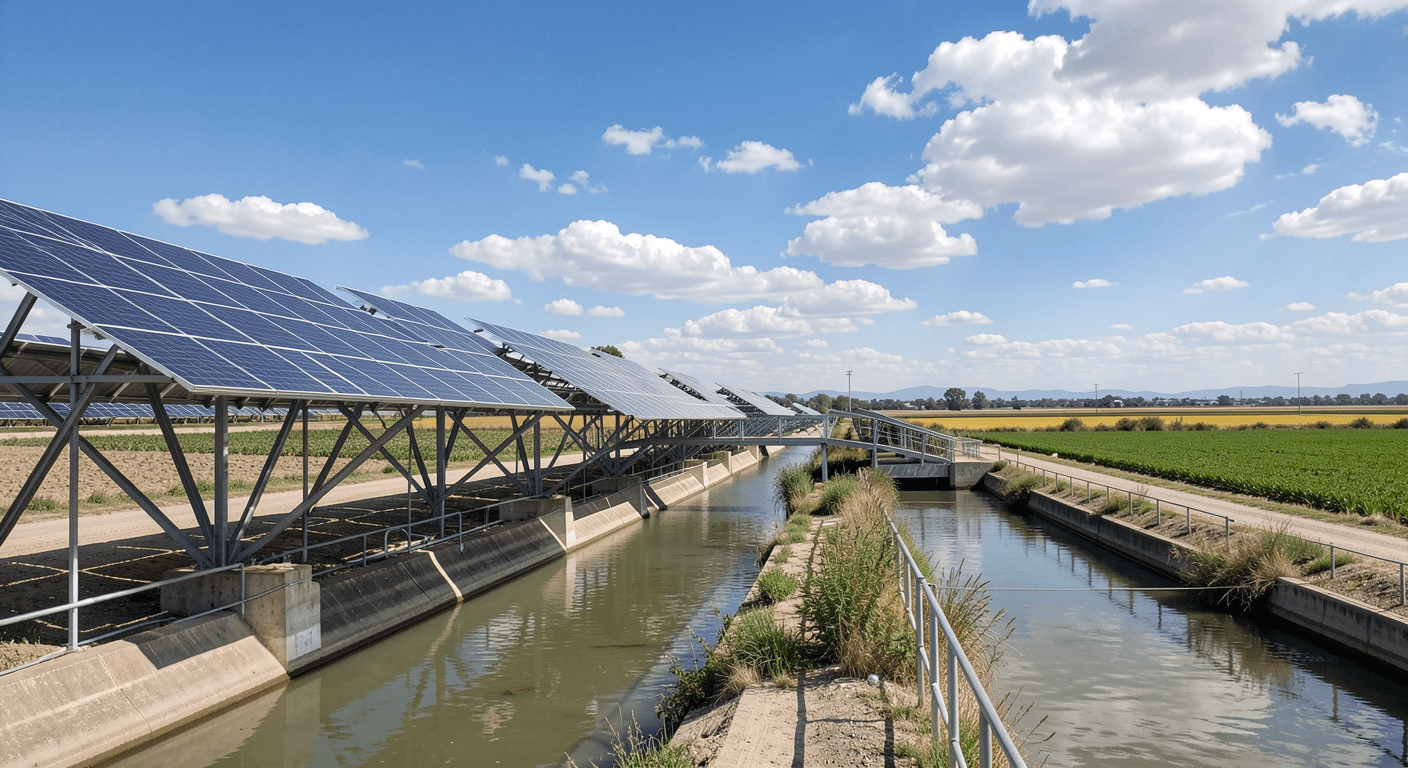
The electricity generated by canal-top solar flows into the grid that powers pumps and communities along the canal routes, reducing transmission losses. In a state racing toward a carbon-free grid by 2045, every megawatt-hour displaces fossil fuel generation.
One surprising finding from the UC Merced research involves fish. Irrigation canals are often too warm for native species like salmon and steelhead during summer months. By shading the canals, the solar panels lower water temperatures, potentially expanding usable habitat for threatened fish. What began as a water conservation project may produce a meaningful ecological side benefit.
Solar farms require land, and land in California is expensive and contested. Ground-mounted installations can compete with agriculture, conservation, and housing for the same acres. Canal-top solar avoids that conflict entirely. The panels sit above water already flowing through an existing corridor. No additional land is consumed, an advantage in a state where land-use battles have slowed renewable energy deployment.
For a broader look at climate-driven water extremes reshaping infrastructure, see our coverage of the Midwest flooding crisis.
California Solar Canals: Key Numbers
| Metric | Value |
|---|---|
| California canal network | ~4,000 miles |
| Water saved (if fully covered) | 63 billion gallons/year |
| Energy potential | ~13 gigawatts |
| Panel efficiency boost | 3–5% (water cooling) |
| First U.S. pilot | Turlock Irrigation District, CA |
California is in a race against a changing climate. The state’s water system was designed in the 20th century for a climate that no longer exists. Snowpack in the Sierra Nevada, California’s largest natural reservoir, is shrinking and melting earlier. Hotter temperatures increase evaporation. Droughts are becoming longer and more frequent. At the same time, the state has committed to one of the most ambitious clean energy transitions in the world.
Solar canals sit at the intersection of these two pressures, addressing water scarcity and clean energy generation as a single integrated problem. The UC Merced pilot is small, a proof of concept, but it arrives at a moment when California is searching for solutions that deliver multiple benefits from the same dollar. If the pilot succeeds, it could unlock federal investment for a larger buildout across the arid West.
“Covering California’s canals with solar panels could save 63 billion gallons of water and generate 13 gigawatts of clean energy. Two problems, one elegant solution.”
What We Can Learn
- Solutions hide in plain sight. India has covered canals with solar since 2012. It took a decade for the U.S. to try it. The barriers were institutional, not technical.
- Water and energy are one system. The same shade that conserves water also cools panels for fish habitat. Solving for one without the other misses the point.
- Scale takes time. The Turlock pilot covers a fraction of one canal. Scaling to thousands of miles needs years of engineering, but every canal covered is progress.
India has been covering canals with solar panels since 2012, but it took a decade for the concept to cross into the American West. The barriers were not technical but institutional: who pays, who owns the power, who takes the risk of being first. The Turlock project answers those questions for a U.S. context.
For most of the modern era, water policy and energy policy have been treated as separate domains. Solar canals force a convergence. The same structure that conserves water also generates electricity. The same shading that boosts panel efficiency also cools water for fish. Solving for one variable without the other misses the point.
The third lesson concerns scale. The UC Merced pilot covers a small fraction of one canal. Scaling to thousands of miles will require years of engineering and negotiation. The 63 billion gallon figure is a theoretical maximum, not a near-term promise. But every canal covered is water saved and clean energy generated. The pilot marks the beginning of a new way of thinking about infrastructure California already has.
For further reading, the foundational study by McKuin et al. (2021) in Nature Sustainability provides modeling behind the 63 billion gallon and 13 gigawatt estimates. The UC Merced project page tracks research from the Turlock pilot, and the U.S. Department of Energy maintains a technical overview of canal-top solar potential.