Half the people on Earth owe their water, their food, and their way of life to how monsoons work, a seasonal wind shift that most of us never think about until it fails to arrive.
Every summer, a continent-sized engine fires up over South Asia. The land bakes under the sun, air rises, and a vacuum forms at the surface. Ocean air, heavy with moisture, rushes in to fill the gap. This is a monsoon: a planetary-scale seasonal wind reversal that delivers life-sustaining rain to billions of people. When the monsoon arrives on time, crops grow, reservoirs fill, and heat breaks. When it arrives late, stays weak, or dumps too much too fast, the consequences ripple through food systems, economies, and emergency rooms across half the globe.
A monsoon is a seasonal wind reversal driven by one simple fact: land heats up faster than water. In summer, hot air rises over continents, drawing moisture-laden ocean air inland. That incoming air lifts, cools, and releases its water as rain. The same physics that creates a beach breeze, scaled to cover an entire continent.
- A monsoon is a seasonal reversal of wind direction, not a storm or just a rainy season.
- The mechanism: land heats faster than ocean in summer, creating low pressure that pulls in moist ocean air.
- Five major monsoon systems affect more than half the world’s population across Asia, Africa, Australia, and the Americas.
- Climate change is making monsoons more erratic: longer dry spells punctuated by more intense rainfall bursts.
What a Monsoon Actually Is
What is a monsoon? It is a seasonal reversal of the prevailing wind direction, driven by temperature differences between land and ocean. The word comes from the Arabic mausim, meaning “season.” For centuries, traders sailing the Arabian Sea noted that winds blew steadily from the northeast in winter, then swung around to the southwest in summer, carrying torrential rains to the Indian subcontinent.
The mechanism is simpler than most people realize. The monsoon wind direction reverses seasonally: in summer, warm air rises over land, pulling moisture-laden ocean air inland. The air above the land warms, expands, and rises, creating a zone of low pressure at the surface.
Cooler, moisture-laden air from the ocean flows inland to replace it. This incoming air rises as it hits the heated landmass, cools at higher altitudes, and the water vapor condenses into clouds and rain. In winter, the pattern reverses: the land cools faster than the ocean, high pressure builds over the continent, and dry winds blow outward toward the sea.
The monsoon cycle has repeated for millennia: summer rains, winter drought, driven by the land-sea temperature contrast.. A monsoon is simply that process scaled up to cover an entire continent.
The word “monsoon” comes from the Arabic mausim, meaning “season.” More than 1.5 billion people depend on monsoon rains for drinking water, agriculture, and hydroelectric power. The Indian monsoon alone delivers 70 to 80 percent of the country’s annual rainfall.
How It Affects People
Monsoons affect human life more directly than almost any other weather pattern on Earth. Understanding how monsoons work is not academic, it is practical knowledge for more than 1.5 billion people from Mumbai to Manila to Mexico City who rely on monsoon rains for drinking water, agriculture, and hydroelectric power. The impacts fall into several categories.
Food and Farming. The Indian monsoon explained simply: it delivers roughly 70 to 80 percent of the country’s annual rainfall. A good monsoon season means full grain silos and stable food prices. A weak monsoon means crop failures, food inflation, and in severe cases, famine. In 2026, India’s monsoon rainfall ran 43 percent below average through June, a deficit that threatened the rice, cotton, and sugarcane harvests across the subcontinent.
Flooding and Infrastructure. The same monsoon rainfall that sustains crops can destroy communities. Monsoon flooding routinely displaces millions across South and Southeast Asia. In July 2026, the eastern arm of the monsoon pushed the Brahmaputra over its banks in Assam, displacing 700,000 people. , including the July 2026 Southeast Asia floods, a seasonal threat that monsoon science helps predict days in advance.. In August 2022, record monsoon rains in Pakistan submerged one-third of the country, affecting 33 million people and causing more than 30 billion dollars in damage. Climate change is making these extremes worse: a warmer atmosphere holds more moisture, so when the monsoon does arrive, the rain falls harder and faster than drainage systems can handle.
Health and Disease. Monsoon season brings a surge in waterborne diseases. Standing floodwater becomes breeding ground for mosquitoes carrying dengue and malaria. Diarrheal diseases spike in communities without clean water access. Heat and humidity stress hospitals that are often already overwhelmed.
Economy and Livelihoods. India’s economy still moves with the monsoon. A good season depresses food inflation, boosts rural demand, and fills hydroelectric reservoirs. A poor season sends food prices climbing and strains government budgets with disaster relief. In 2023, economists estimated that a 5 percent monsoon deficit could shave 0.3 to 0.5 percentage points off India’s GDP growth.
Why It Happens: The Monsoon Science Explained
The science behind monsoons builds on four core ideas.
The Land-Sea Temperature Contrast. This is the main driver. Land and water heat at different rates. In summer, the Asian landmass, from India to China, warms to temperatures well above the neighboring Indian Ocean and Pacific. Hot air rises, creating low pressure. Ocean air, cooler and denser, rushes toward the low. This land sea temperature contrast sets up the summer monsoon circulation. The question of how does a monsoon form always returns to this fundamental imbalance.
The Intertropical Convergence Zone. The ITCZ is a band of low pressure that circles Earth near the equator, where trade winds from the two hemispheres meet and air rises. As the sun migrates northward in Northern Hemisphere summer, the ITCZ shifts north with it. Over Africa and Asia, this northward shift pulls moisture-laden air from the oceans deep into the continents, intensifying the monsoon.
The Role of Mountains. The Himalayas and the Tibetan Plateau act as a massive heat source in summer. The plateau, at an average elevation above 4,000 meters, heats the air above it more intensely than the surrounding lower land. This reinforces the low-pressure system that draws in monsoon winds. The Himalayas also serve as a physical barrier: moist air from the Indian Ocean hits the mountains, is forced upward, cools, and drops its moisture as rain on the southern slopes. This is why the Himalayan foothills are among the wettest places on Earth.
The Coriolis Effect. Earth’s rotation deflects moving air. In the Northern Hemisphere, this deflection is to the right. Air flowing from the southern Indian Ocean toward the Asian low is deflected eastward, turning what would be a simple inbound rush of air into the characteristic southwest monsoon wind that defines the season.
The World’s Major Monsoon Systems
Monsoons are not exclusive to India. They operate wherever large landmasses sit adjacent to warm oceans in the subtropics.
South Asian Monsoon (Indian Summer Monsoon). The most dramatic and economically significant monsoon system on Earth. Runs from June through September. Delivers 70 to 80 percent of India’s annual rainfall. Driven by the extreme heating of the Tibetan Plateau and the Indian subcontinent, combined with moisture drawn from the warm Indian Ocean. The monsoon’s arrival in Kerala, typically in early June, is one of the most watched weather events on the planet. When the monsoon weakens, as it did in 2026, hundreds of millions of people feel the consequences.
East Asian Monsoon. Affects China, Japan, Korea, and Southeast Asia. Runs from May through August. Brings heavy rains to eastern China and Japan, with a characteristic “Meiyu” or “plum rain” front that can stall for weeks, dumping enormous quantities of water on the same region. The 2020 East Asian monsoon produced the wettest summer in China since 1961, forcing the evacuation of millions.
West African Monsoon. Drives rainfall from the Gulf of Guinea into the Sahel region. Runs from June through September. Driven by the northward migration of the ITCZ and the intense heating of the Sahara Desert. The West African monsoon is the lifeblood of agriculture from Senegal to Sudan. When it is weak, as it was during the devastating Sahel droughts of the 1970s and 1980s, famine follows.
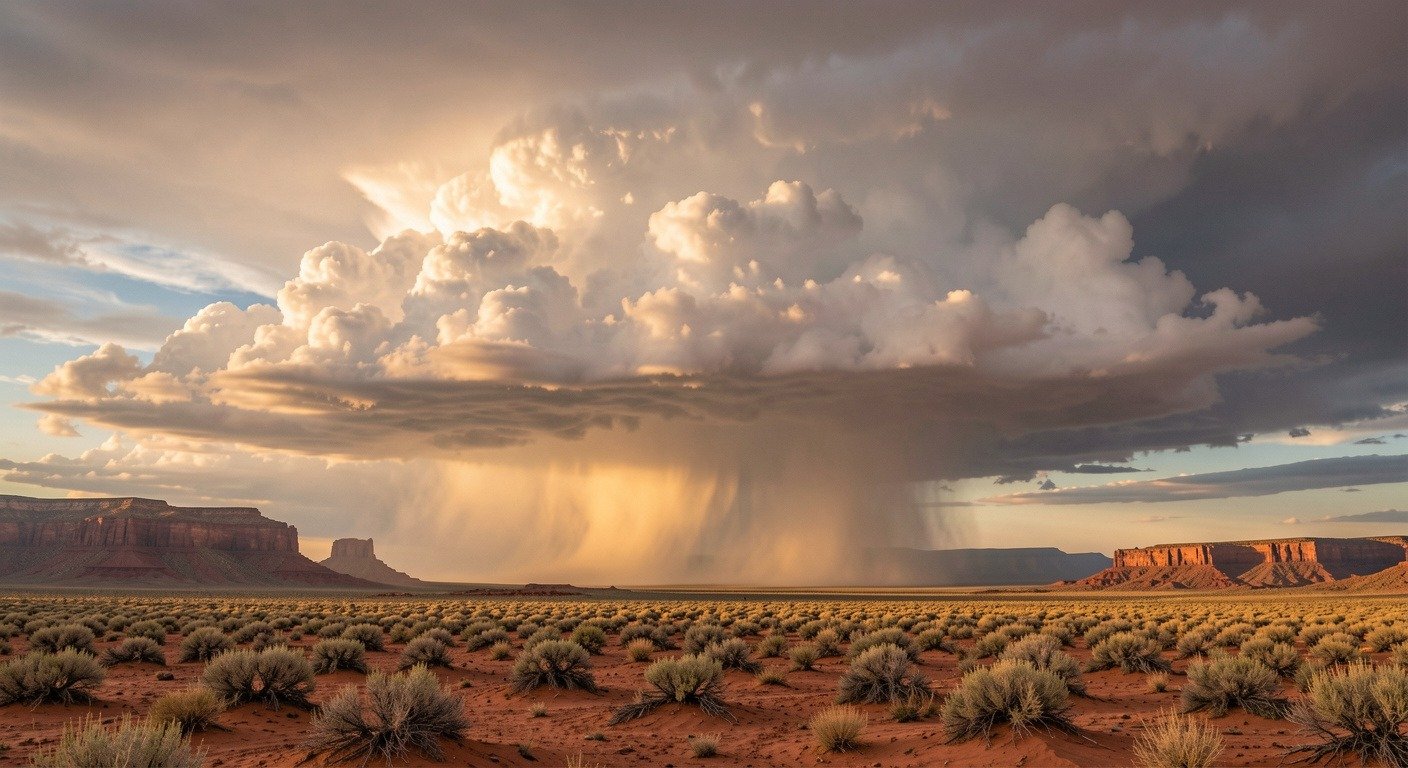
North American Monsoon. Affects the southwestern United States and northwestern Mexico. Runs from June 15 through September 30. This is why Arizona and New Mexico get much of their annual rainfall during a few intense summer months, often in the form of dramatic afternoon thunderstorms. The North American monsoon can produce flash floods, dust storms called haboobs, and welcome relief from summer heat.
Australian Monsoon. Affects northern Australia and parts of Indonesia. Runs from December through March, during the Southern Hemisphere summer. Brings heavy rains to Darwin and the surrounding region, sometimes producing tropical cyclones.
Why It Matters Now
Climate change is making monsoon rainfall more erratic in ways scientists are still working to understand. Three trends are becoming clear.
First, the monsoon’s rain distribution is shifting. The total amount of seasonal rain may not change much, but longer dry spells are now punctuated by shorter, more intense bursts of rainfall. A week’s worth of rain may fall in a day or two, overwhelming drainage and triggering flash floods.
Second, a warmer atmosphere holds more moisture. For every degree Celsius of warming, the air can hold roughly 7 percent more water vapor, a fundamental principle of atmospheric physics called the Clausius-Clapeyron relationship. This means that when conditions are right for rain, the downpours are heavier than they were a generation ago, a pattern climate scientists have tracked across every continent.
Third, the drivers of the monsoon themselves are shifting. The Indian Ocean is warming faster than the landmass in some regions, altering the land sea temperature contrast that powers the monsoon. Aerosol pollution, which reflects sunlight and cools the surface, may also be weakening monsoon circulation over South Asia.
Scientists at the Indian Institute of Tropical Meteorology have documented a weakening trend in monsoon low-level winds since the 1950s, even as extreme rainfall events have increased. The 2026 El Nino adds another layer of uncertainty: El Nino events are historically associated with weaker Indian monsoons, and NOAA confirmed in June 2026 that El Nino conditions had arrived with a 63 percent chance of becoming historically strong.
What We Can Learn
Understanding the monsoon is not just an academic exercise. It is practical knowledge for more than half the world’s population.
For communities: Early warning systems save lives. India’s monsoon forecasting has improved dramatically since the 1990s, giving farmers and governments weeks of lead time to prepare for dry spells or floods. Bangladesh has cut cyclone-related deaths by more than 90 percent since the 1970s through a combination of early warnings, cyclone shelters, and community education.
For individuals: Knowing the monsoon’s rhythm helps with travel planning, crop planting, and home preparation. If you live in or visit a monsoon region, pay attention to the seasonal forecast, not just the daily weather app. A strong monsoon prediction in April affects decisions made in May and June.
For the rest of us: The monsoon connects to global food prices. When the Indian summer monsoon fails, global rice, sugar, and cotton markets feel it within months. The monsoon is a reminder that weather in one part of the world affects dinner tables everywhere.
- NOAA Climate.gov: The North American Monsoon
- NWS Tucson: Monsoon Information Page
- NASA Scientific Visualization Studio: The Science of Monsoons
- Penn State METEO 3: Monsoons as Giant Sea/Land Breezes
- Britannica: Monsoon | Meteorology, Climate & Effects
- Wikipedia: Monsoon
Frequently Asked Questions About Monsoons
Is a monsoon the same as a rainy season?
No. A monsoon is a seasonal reversal of wind direction that brings moisture from the ocean to land. A rainy season is simply the period when most rainfall occurs. The monsoon causes the rainy season in many parts of the world, but not all rainy seasons are monsoons. The key difference is the wind reversal, not just the rain.
How long does monsoon season last?
The South Asian monsoon typically runs from June through September. The East Asian monsoon runs from May through August. The North American monsoon runs from June 15 through September 30. Duration varies by region but generally lasts 3 to 4 months during the summer.
Does climate change affect monsoons?
Yes, climate change is making monsoons more erratic. Total seasonal rainfall may not change much, but the distribution is shifting: longer dry spells punctuated by shorter, more intense bursts of rain. A warmer atmosphere holds roughly 7 percent more water vapor per degree Celsius of warming, which means when rain does fall, the downpours are heavier than they were a generation ago.
Can a monsoon cause flooding?
Yes. Monsoon flooding routinely displaces millions across South and Southeast Asia. The same rainfall that sustains crops can destroy communities when it falls too fast. In August 2022, record monsoon rains in Pakistan submerged one-third of the country, affecting 33 million people and causing more than 30 billion dollars in damage.
Does the United States have monsoons?
Yes. The North American monsoon affects the southwestern United States and northwestern Mexico from June through September. This is why Arizona and New Mexico receive much of their annual rainfall during a few intense summer months, often as dramatic afternoon thunderstorms. It also produces dust storms called haboobs.