
Table of Contents
The Hidden Life Beneath the Cracks
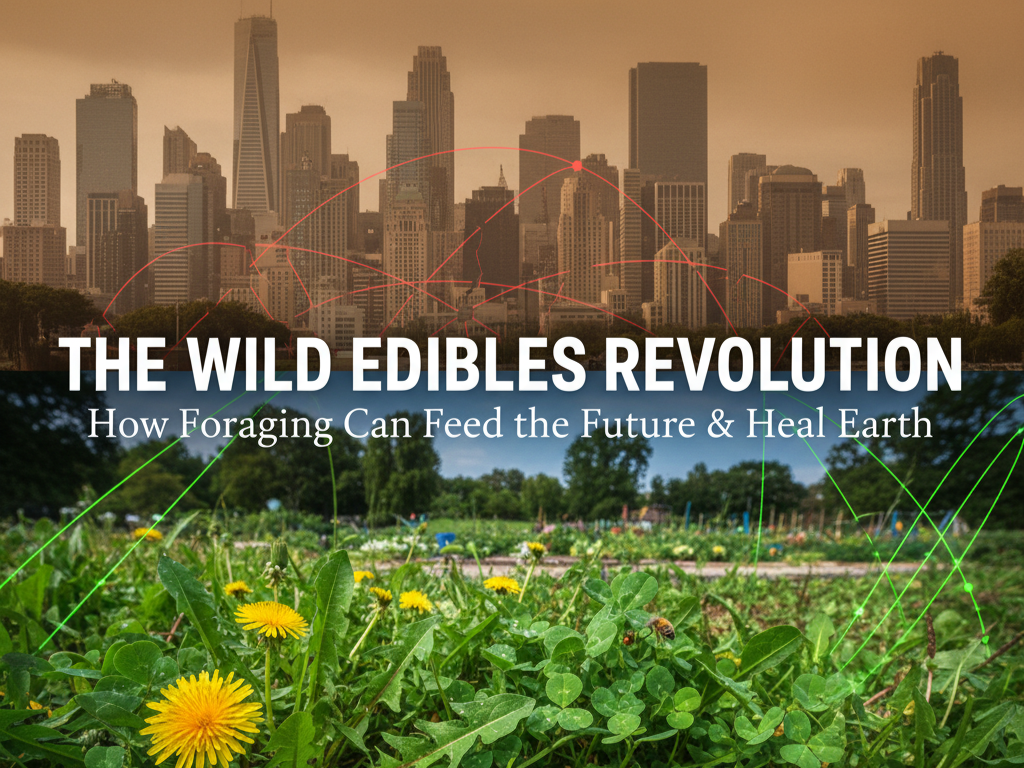
You call it a weed.
A tenacious, tiny green thing, pushing its way through the asphalt, ignoring the concrete, and thriving in the absolute worst conditions our cities can offer. You walk past it every day, perhaps dismissing it as a nuisance—a stubborn blot on engineered civilization.
But what if that resilient green life, the dandelion, the wild mustard, the persistent clover, wasn’t a nuisance? What if it was, in fact, the food of the future?
It’s a realization that shifts your perspective instantly: While billions starve and our global food system grows more fragile, an untapped, redundant pantry is growing untended, hidden in plain sight. This isn’t a theory. This is a global, perennial food web that asks for nothing : no irrigation, no pesticides, no central industrial oversight .. to flourish.
These pioneer plants have bypassed our elaborate infrastructure, established freedom in the cracks, and built an ultra-resilient insurance policy right beneath our noses. The weed is not a problem to be sprayed away; it is the key to a local, sustainable, and democratized food future. We simply need to look down, change our definition of food, and recognize the revolutionary potential in the abundance that refuses to be tamed.

This is the untold story of the Wild Edibles revolution, and how Urban Foraging for nature’s original foods could be the key to building a more sustainable food system for the future.
Origins: The Diet That Built Humanity
Before the farm, there was the forest.
For 99% of our history, humans were not just surviving; they were thriving on wild diversity. Our relationship with the planet was direct and reciprocal: we were participants in the ecosystem, not just consumers. Hunter-gatherers and early agricultural societies maintained vast, sophisticated, and decentralized libraries of knowledge about the land, utilizing hundreds and in some regions, thousands of different species for nutrition, medicine, fiber, and tools.
This was not subsistence; it was affluence through biodiversity. Think of it: Long before standardized wheat fields, indigenous communities relied on the powerful, rugged genetics of wild grains, tubers, and leafy greens. They knew exactly which patch of soil provided the most robust nettle, which riverbank yielded the finest cattail root, and the precise moment a berry achieved peak medicinal potency. This was food that required no central farming, no chemical pesticides, and no elaborate irrigation system. It was the ultimate resilient food web, a cultural and biological insurance policy written into the very landscape.
We were, in essence, biologically programmed to consume this incredible diversity. Our gut biomes and our immune systems evolved alongside this varied diet. This comprehensive, local knowledge was what sustained our ancestors through drought, famine, and environmental change. It was a time when the world was our garden, and the loss of one species was simply met by the discovery or utilization of another. Reconnecting with wild edibles isn’t a trendy hobby; it’s a powerful and grounding return to our fundamental human blueprint a return to a diet that actually built us.
The question is not, “Can we eat these plants?” but, “Why did we ever stop?”
We are genetically wired to consume this diversity. Reconnecting with wild edibles isn’t a trendy hobby; it’s a powerful and grounding return to our human blueprint.

Collapse: The Fragility of Modern Agriculture
The shift was a bargain we are now regretting.
Modern industrial agriculture prioritized scale and yield, locking us into an alarming over-dependence. Today, just 12 plant species provide approximately 75% of the world’s food supply.This extreme lack of biodiversity is a monumental risk, acting like a single point of failure in a massive, global system.
| Global Food Risk | Wild Edibles Resilience |
| Monoculture creates vulnerability to one single pest or disease. | Genetic diversity means a loss in one area doesn’t wipe out the food system. |
| Soil Degradation makes land useless without chemical input. | Pioneer species naturally rebuild soil health for free. |
| Climate Change creates drought and extreme heat, shattering crop yields. | Wild plants are already adapted to local environmental extremes. |
The hard truth is that the traditional system is becoming less reliable every year. We need a backup plan. And that plan is growing, right now, outside the window.

Revolution: The Wild Edibles Movement Rises
The narrative is changing. What was once seen as ‘famine food’ or ‘peasant knowledge’ is now being embraced by scientists, tech startups, and Michelin-starred chefs. The revolution is already happening.
1. The Culinary Renaissance
Chefs like René Redzepi of Noma built their legacy by elevating the wild. They proved that the complexity and unique terroir of foraged ingredients, from forest moss to sea buckthorn, are capable of creating the highest form of cuisine. This prestige has instantly legitimized the practice globally.
2. Tech Meets the Trail
The greatest hurdle, fear of misidentification, is being tackled by AI. Apps like PlantNet and iNaturalist turn your smartphone into a virtual field guide, using image recognition to identify plants quickly and safely. This democratization of knowledge is rapidly accelerating the number of confident new foragers.
3. Wild Genetics for Climate Resilience
The true power lies in the lab. Scientists are actively studying the deep, rugged genetics of wild plant relatives (the “weeds”) to find traits: like drought resistance, heat tolerance, or pest immunity, that can be bred into our struggling cash crops. The key to the future of wheat may be found in its uncultivated cousin.

Responsibility: The Essential Code of the Forager
The benefits are transformative, but the risks are real. This isn’t a free-for-all. Responsible foraging requires education and respect for the land. Trust is built by acknowledging the risk.
The Three Critical Challenges:
- Toxic Lookalikes: Many benign plants have lethal twins (e.g., Elderberry vs. Water Hemlock). Never consume a plant unless you are 100% certain of its identity, using multiple sources.
- Urban Contamination: In cities, the soil can harbor heavy metals (lead) or chemical residues. Always research the land’s history and only harvest from clean, safe areas far from roadsides and industrial sites.
- Ethical Limits: The Forager’s Code demands respect. Take only what you need, leaving at least two-thirds of any patch intact. This ensures the plant can regenerate and wildlife can feed.

Future Vision: The Rewilding of the Human Diet
The full vision extends far beyond our dinner plates.
Imagine a city where every green space, parks, riverbanks, and rooftops, is viewed as productive, edible green infrastructure. This vision isn’t about replacing farms; it’s about embedding food resilience into our built environment, mitigating the urban heat island effect, and creating pockets of self-sufficiency.
This is the ultimate climate solution: using nature’s own hardiness to safeguard our future. Maybe the most important lesson isn’t what we can harvest, but the act of simply noticing the life around us.
The future of food isn’t grown in sterile fields: it’s waiting in the cracks.
Continue Exploring NatureWeatherHub:
- Climate Solutions – Explore more nature-based tech to tackle climate change. (Work-in-Progress)
- Eco-Friendly Travel – Discover sustainable destinations shaped by local ecology.(Work-in-Progress)
- The Soil Story – Learn why soil health is the ultimate key to global food security.(Work-in-Progress)

