
Fungi Kingdom : The True Rulers
What if I told you the true rulers of Earth aren’t plants, animals, or even bacteria, but a mysterious, often overlooked kingdom? They live mostly underground, yet their networks span continents. They are genetically closer to you than to a tree. And right now, these organisms hold the key to solving the world’s most critical problems: climate change, toxic pollution, and the looming agricultural waste crisis.
Forget the charming little toadstool you see popping up after a rainstorm. That mushroom is just the “fruiting body,” a temporary structure. The real magic lies beneath, in the vast, sentient membrane known as mycelium ,a fungal network so enormous that the single largest living organism ever found is a honey mushroom fungus in Oregon, covering 8.8 square kilometers.
This is the story of the Fungi Kingdom, the ultimate recyclers of life, and why we desperately need to stop neglecting them.
Table of Contents
Part 1: The Engine of Life’s Recycling
Fungi are classified as one of the major eukaryotic kingdoms, distinct from plants and animals. They are heterotrophs, meaning they cannot photosynthesize; instead, they acquire food by secreting potent digestive enzymes into their environment and then absorbing the resulting dissolved organic molecules.
This fundamental process is the decomposition imperative. Fungi are the destination that delivers nutrients to whatever comes next. They are the essential major decomposers and nutrient recyclers in nature, often described as the door between the living and the dead.
The Sacred Balance of Life and Death
Fungi are the catalysts for transformation, birthing life from death. They break down complex organic compounds like carbohydrates and proteins into simpler components, releasing energy and materials. This recycling process is vital for the entire ecosystem. Without the combined work of fungi and bacteria, all the essential inorganic nutrients from dead organisms would become permanently unavailable. Life as we know it would cease to exist. Fungi carry out this crucial task globally in almost all terrestrial and many aquatic ecosystems, playing a critical role in biogeochemical cycles and food webs.
Part 2: The Secret Weapon: Lignin Masters
Fungi’s unique power stems from their biochemical sophistication and their evolutionary capacity to dismantle the toughest structural components of plant biomass.
The Lignin Challenge
The single greatest challenge in decomposition is lignin. Lignin is the second most abundant polymer on Earth and is a highly resistant, complex structure that gives plant cell walls their rigidity. It is inherently resistant to almost all enzymatic attack.
But there is a hero built specifically for this challenge: White-rot fungi (WRF).
WRF are recognized as the primary lignin degraders, forming the only group of microorganisms generally capable of achieving its complete mineralization—converting complex lignin fully into carbon dioxide and water. They accomplish this feat using a specialized, non-specific enzymatic system.
The Fungal Enzyme Toolkit
Fungi perform decomposition by secreting potent extracellular oxidoreductases that act far beyond the hyphal tip. For white-rot fungi, the key machinery includes a suite of lignin-degrading enzymes (LDEs):
- Laccases (Lac): These oxidize phenolic units and can initiate the depolymerization of hydrophobic plastics.
- Lignin Peroxidase (LiP): This enzyme breaks down lignin structure using hydrogen peroxide ($\text{H}_2\text{O}_2$).
- Manganese-dependent Peroxidase (MnP): This also utilizes $\text{H}_2\text{O}_2$ to generate reactive oxygen species (ROS).
Species like the Oyster mushroom (Pleurotus) and Trametes versicolor are commercially relevant WRF known for these powerful capabilities. Their non-specific mechanism of action—the enzymes attack molecules randomly—is what makes them so effective against chemically diverse man-made pollutants.

Part 3: The Environmental Superpower: Mycoremediation
The incredible ability of fungi to chemically dismantle lignin is an evolutionary advantage that scientists are now leveraging to combat modern pollution. The complex, stable carbon structures in lignin are chemically similar to many stable, man-made pollutants, or xenobiotics.
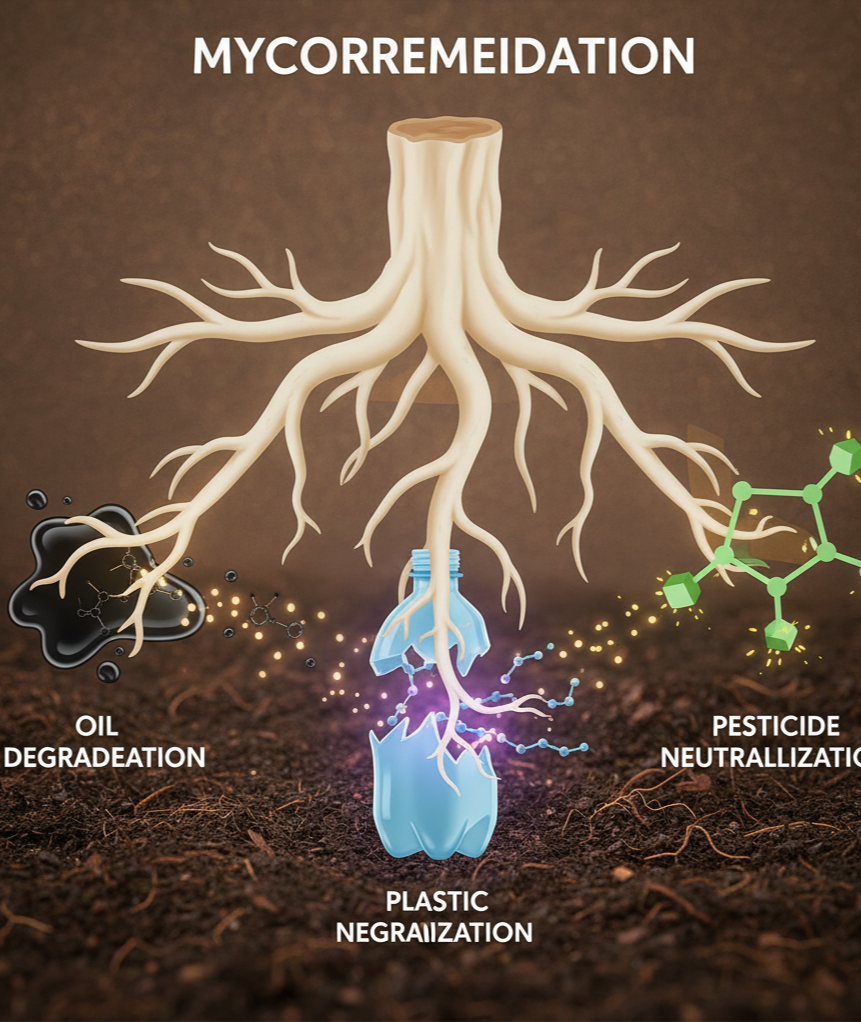
This biological mastery forms the foundation of mycoremediation: the advanced, cost-efficient, and environmentally benign form of bioremediation that uses fungi or their compounds to heal environmental damage.
Fighting the Petroleum Crisis
Mycoremediation has demonstrated robust efficacy against soils contaminated with heavy hydrocarbons and Polycyclic Aromatic Hydrocarbons (PAHs), offering promise for oil spill cleanup and refining waste.
- Case Study Success: In one large-scale study, the white-rot mushroom Pleurotus ostreatus degraded approximately 99% of Total Petroleum Hydrocarbons (TPHs) in diesel-contaminated soils over eight weeks.
- Mechanism: When petroleum hydrocarbons contact fungal hyphae, the fungal enzymes initiate degradation through oxidation, leading to aromatic ring openings, cleavage of hydrocarbon chains, and ultimately decarboxylation into $\text{CO}_2$ and simpler fragments.
The Battle Against Plastics
The fight against plastic, a modern scourge clogging landfills and oceans, is also being outsourced to fungi.
- Plastic-Eating Discoveries: Researchers have discovered fungi like Pestalotiopsis in the Amazon that not only consume plastic but can thrive in the oxygen-starved environments typical of landfills.
- Polymer Breakdown: Fungi like Aspergillus tubingensis have been observed successfully degrading complex plastics like polyurethane ($\text{PUR}$) in a matter of weeks. This requires a specialized enzymatic attack combining oxidative LDEs (like laccases) to initiate surface breakdown and hydrolases to cleave the polymer chains.
Challenges in the Field
Despite these promising outcomes, mycoremediation faces challenges in scaling up from the lab to the field. It is inherently slower than traditional chemical techniques and fungi are highly sensitive to their environment, requiring specific temperatures and humidity. Incorporating the ideal environmental, edaphic, and climatic factors of a real-life contaminated site is essential for large-scale field applications.
Part 4: The Invisible Climate Solution: Carbon Cycling
Beyond pollution cleanup, the fungal kingdom is fundamentally indispensable to global ecosystems due to its critical role in the global carbon cycle. Approximately 75% of all land carbon is stored in the soil, and fungi are the key managers of this vast reservoir.
The Underground Carbon Pump
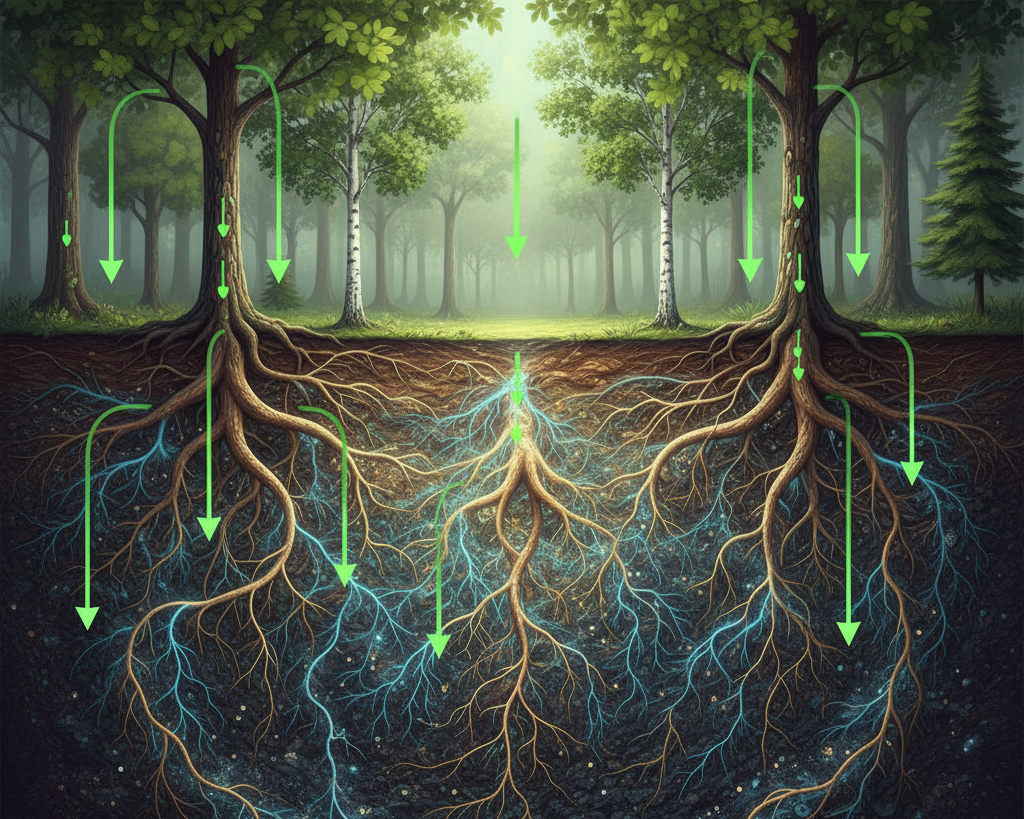
A recent landmark study highlighted the immense, yet overlooked, role of mycorrhizal fungi in carbon storage. These fungi, which form mutualistic symbiotic partnerships with about 90% of plants, use carbon to build massive underground networks of fine filaments known as hyphae.
The astonishing finding is that over 13 billion metric tons of CO2 from terrestrial plants are transferred to mycorrhizal fungi each year. This carbon allocation is equivalent to approximately 36% of global fossil fuel emissions. Mycorrhizal fungi are essential ecosystem engineers, pumping this carbon deep into the soil food web where it can be locked away, forming what’s often called the “Wood-Wide Web.”
Fungi and Sustainable Agriculture
In agriculture, fungi play an equally critical role in efficiency and sustainability. Arbuscular mycorrhizal fungi (AMF) form partnerships with plants, allowing them to access nutrients like inorganic phosphate and nitrate that roots cannot reach alone. This exchange enhances nutrient uptake, which in turn can reduce the environmental impact of excess synthetic fertilizers and improve overall soil quality and Soil Organic Carbon (SOC) accumulation.
Part 5: Fungi Feeding Humanity: Waste and the Circular Economy
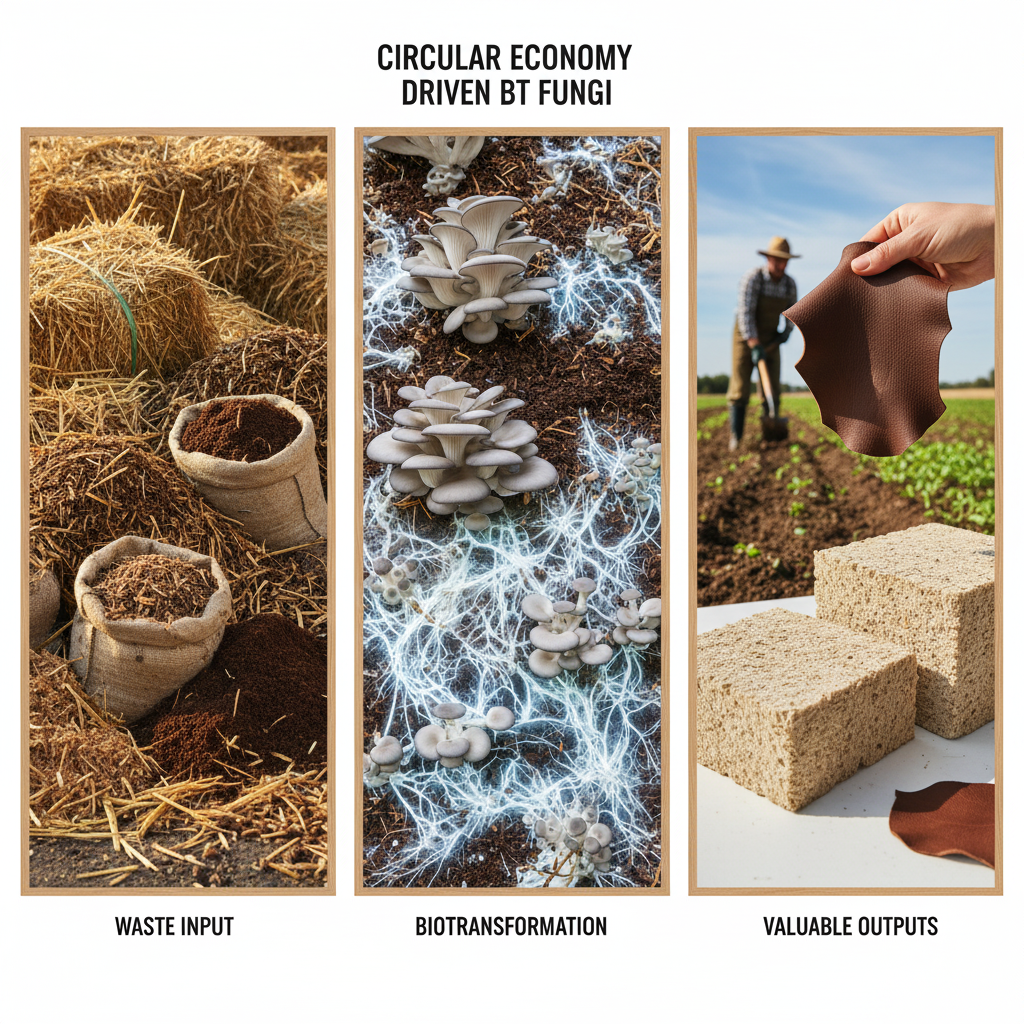
The fungal life cycle offers profound economic and sustainability advantages. Fungi don’t just solve problems; they turn waste into wealth, acting as a crucial component of the circular economy.
Cultivation on Waste
Mushroom cultivation is widely regarded as the most ecofriendly method for managing agricultural wastes. These wastes are rich in lignocellulosic components (like straw, sawdust, and coffee pulp), which fungi thrive on.
Edible mushroom species, particularly Pleurotus (Oyster mushroom), are farmed globally to convert otherwise useless agricultural waste into valuable food and medicinal products, offering a strategy to combat malnutrition and environmental pollution caused by waste disposal.
The Spent Mushroom Substrate (SMS) Revolution
Perhaps the most compelling argument for the fungal circular economy lies in the byproduct of cultivation—the Spent Mushroom Substrate (SMS).
Even after producing mushrooms, this residual waste is nutrient-reduced and can be used as high-quality biofertilizer and manure for agricultural fields. Leveraging SMS in mycoremediation minimizes material costs, transforming the economic equation: traditional remediation is a cost center, whereas mycoremediation using edible fungi generates high-value byproducts, including mushrooms, enzymes, and biofertilizer.
Mycelium as the Material of the Future
Fungi are also being used to create materials that replace environmentally damaging synthetic products. This process is often called “programmable biology.”
- Fashion and Building: Mycelium has been grown into sustainable, durable leather alternatives used by major fashion and sporting brands. It is also used as an alternative building material, such as organic, fire-resistant boards, grown and molded into nearly any shape in a matter of weeks.
- Food Source: Mycelium biomass can even be grown quickly into slabs to serve as healthy, protein-rich meat substitutes.
Conclusion: The Call to Action
The Fungi kingdom encompasses an enormous diversity of taxa. Fungi sicken us, and fungi sustain us. Their roles are complex, ranging from critical decomposers of agricultural wastes and environmental pollutants, to sequestering carbon equivalent to over a third of global fossil fuel emissions.
Our understanding is still incomplete, with over 90% of fungi estimated to remain unknown.
Their importance is starting to gain international recognition. The International Union for Conservation of Nature (IUCN) recently called for the phrase “fauna and flora” to be replaced with “fauna, flora, and funga,” demanding due recognition of fungi as major components of biodiversity in policy.
We must recognize the fungi not just as passive components of the environment, but as active, essential engineers. We must defend the process of decay, allow things to rot, and support the scientific and commercial endeavors that leverage their profound, mysterious power. The future of environmental health, climate stability, and sustainable resource management rests on the invisible empire beneath our feet.
Related post – Seaweed: The Ocean’s Climate Superfood , The Wild Edibles Revolution: How Foraging Can Feed the Future and Heal the Earth


