Quick Summary
- Lightning forms inside thunderstorms when ice crystals and graupel (soft hail) collide, separating electric charges within the cloud.
- A stepped leader descends from the cloud in invisible jumps; when it connects with an upward streamer from the ground, the visible return stroke fires at 60,000 miles per second.
- About 20 million cloud-to-ground flashes strike the US each year, and lightning heats the air to 50,000 degrees Fahrenheit, five times hotter than the sun’s surface.
- Positive lightning (+CG), though rare, is the most dangerous type. It can strike 25 miles from the storm and carry 300,000 amperes.
- Follow the 30-30 rule: seek shelter when flash-to-thunder is 30 seconds or less, and stay inside 30 minutes after the last thunder.
By NatureWeatherHub Team · Updated July 13, 2026 · Reading Time: 6 Minutes
In This Guide
The Most Electric Place on Earth
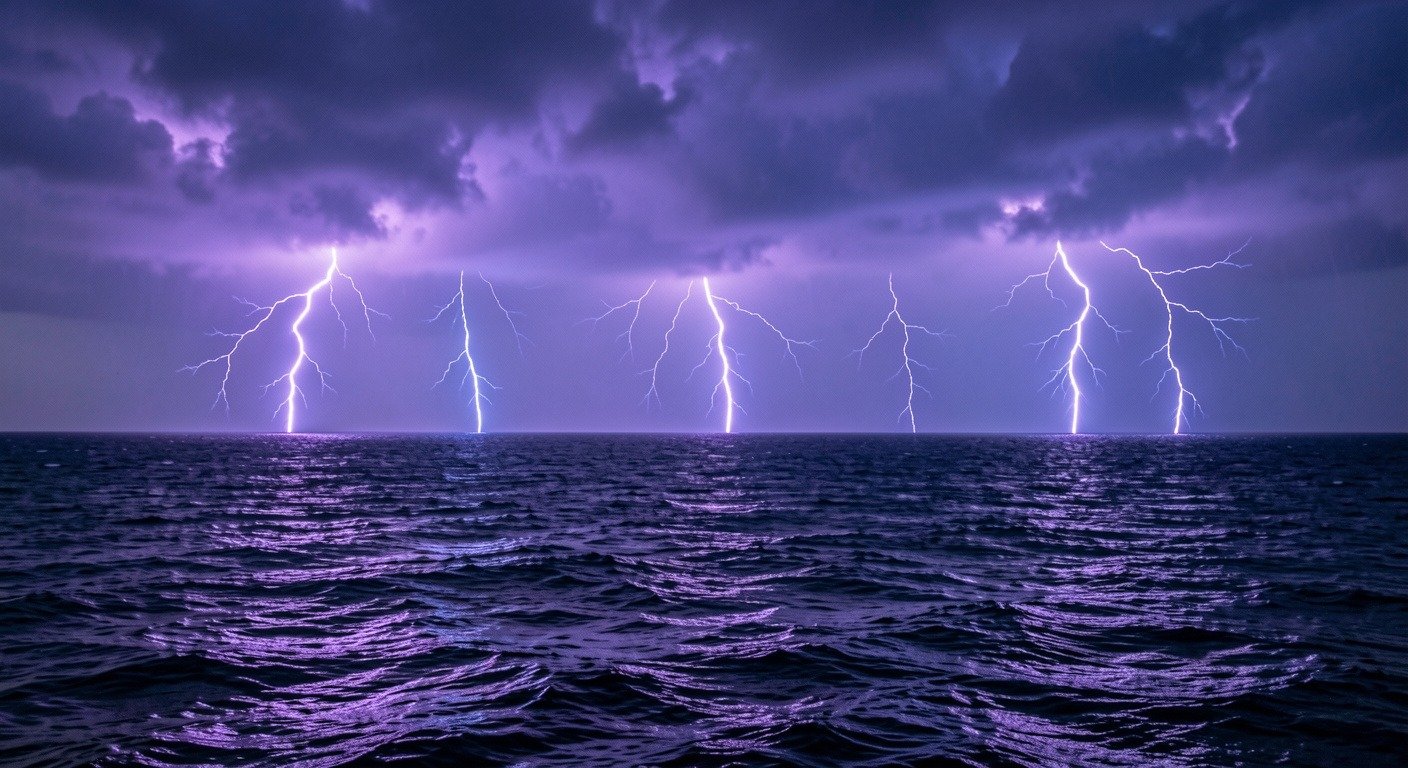
Lake Maracaibo in Venezuela is the most electric place on Earth. For roughly 300 nights a year, thunderstorms pound this massive lake, producing the Catatumbo lightning phenomenon: a near-continuous light show that sailors once used as a natural lighthouse (NASA/University research via Geology.com).
Every second, about 40 lightning flashes crackle somewhere on Earth. That is more than 3 million flashes a day, with about 2,000 thunderstorms in progress at any moment (NSSL Thunderstorm Basics; NOAA JetStream, 2023). We live on an electrified planet.
At its simplest, lightning is a giant spark of static electricity, the same thing you feel when you touch a doorknob after walking across carpet, scaled up by a factor of roughly a billion. Understanding how that spark forms, the different types of lightning, and how to stay safe when the sky flashes is what this article is about.
How Lightning Forms
Lightning begins inside a thunderstorm, where conditions are violent enough to tear electricity from thin air.
Inside a developing thunderstorm, strong updrafts carry tiny ice crystals upward while larger, heavier ice pellets called graupel fall through the cloud. When graupel and ice crystals collide, they trade electric charges, just like rubbing a balloon on your hair (NSSL Severe Weather 101: Lightning Basics). The graupel gains a negative charge and settles toward the bottom of the cloud. The ice crystals gain a positive charge and ride updrafts to the cloud top (NOAA JetStream: How Lightning is Created, 2023).
This separation builds an enormous electric field. The negatively charged cloud base repels electrons in the ground below, inducing a positive charge at the surface. When the voltage difference reaches 100 million to 1 billion volts (NSSL Lightning FAQ), the air breaks down, even though it is normally a good insulator.
A stepped leader emerges from the cloud base: an invisible, negatively charged channel that descends in roughly 50-yard jumps, branching as it goes, faster than the human eye can detect (NSSL Lightning Types). As the leader nears the ground, positively charged upward streamers rise from tall objects like trees, buildings, and even people standing in open fields.
When leader and streamer connect, the circuit is complete. A brilliant return stroke races back up the channel at about 60,000 miles per second (NSSL Lightning Types). This is the flash you actually see, and it travels upward, not downward. The entire process, from leader to return stroke, takes less than a hundredth of a second.
The Many Faces of Lightning
Not all lightning is the same. The flash you picture is just one of several distinct types of lightning.
Cloud-to-ground lightning (-CG) is the classic bolt: a negatively charged stroke that connects the cloud base to the ground. It accounts for most strikes that hit people and property. In the United States alone, about 20 million cloud-to-ground flashes strike each year, hitting at least 30 million points on the ground since many flashes have multiple attachment points (NSSL Lightning FAQ).
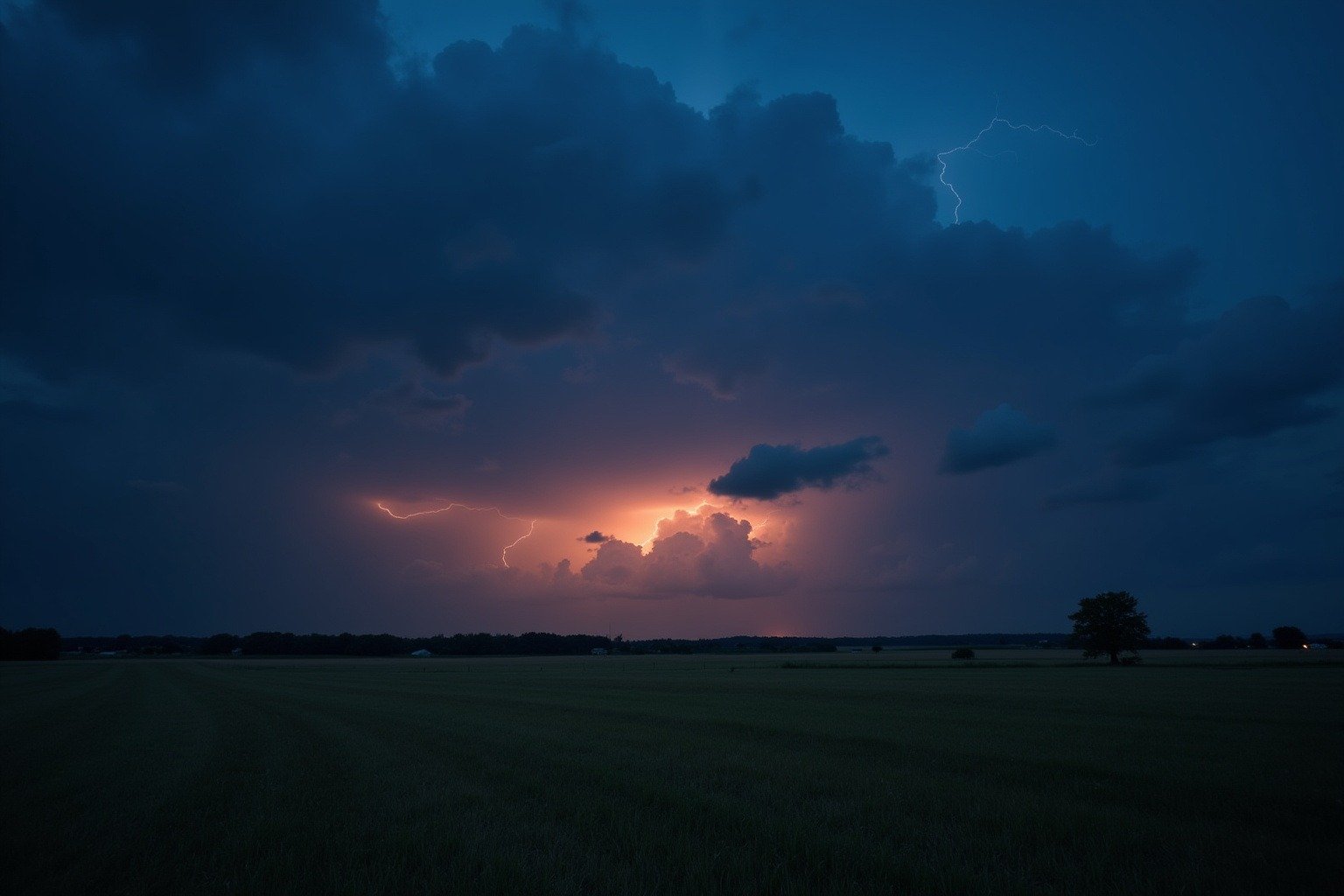
Intra-cloud lightning (IC) never touches the ground. It jumps between oppositely charged regions within the cloud, illuminating the sky in sheets of light. About 75 to 80 percent of all lightning stays within the cloud (NOAA JetStream: How Lightning is Created, 2023). You have seen it countless times: the silent, flickering glow deep inside a distant thunderhead.
Positive lightning (+CG) is the dangerous outlier. Making up less than 5 percent of all strikes, it originates from the positively charged storm top rather than the negatively charged base (NOAA JetStream: Positive and Negative Side, 2023). Understanding positive vs negative lightning matters for safety: a positive strike can carry up to 300,000 amperes, 10 times the current of a negative strike, and can travel 25 miles or more from the storm before hitting the ground. This is the bolt from the blue: a strike that lands under clear sky, miles from any visible storm.
Above the clouds, lightning creates stranger phenomena. Sprites are red, jellyfish-shaped flashes 30 to 55 miles above thunderstorms. Blue jets shoot upward from cloud tops into the stratosphere. Scientists only confirmed these Transient Luminous Events (TLEs) in 1989 (NSSL Lightning Types).
Why Thunder Rumbles
If lightning is the spark, thunder science reveals the explosion.
When a return stroke fires, it heats the lightning channel to about 50,000 degrees Fahrenheit. That lightning temperature is roughly five times hotter than the Sun’s surface (NOAA JetStream: Sound of Thunder, 2023). This heating happens in microseconds. Air cannot expand that fast, so it explodes outward as a shock wave.
Within about 10 yards, the shock wave becomes a sound wave: the thunder you hear (NWS Lightning Science). But how does thunder work to produce a rumble instead of a single crack? The lightning channel can be miles long, with different segments at different distances from your ears. Sound from the farthest segment arrives later, stretching a single bang into a rolling rumble. Temperature inversions, hills, and buildings further warp the sound.
Thunder also reveals distance. Count seconds between flash and thunder. Every 5 seconds equals roughly 1 mile. A 15-second count means the strike was 3 miles away. Thunder is audible up to 10 miles from the strike (NWS Lightning Science).
Staying Safe When the Sky Flashes
The most important lightning safety rules start with one phrase: When thunder roars, go indoors (NWS Lightning Safety).
The 30-30 rule backs this up. If the time between flash and thunder is 30 seconds or less, the storm is within 6 miles and lightning can strike your location. Seek shelter immediately in a substantial building or hard-topped vehicle. Wait at least 30 minutes after the last thunder before going back outside (NWS Lightning Safety Tips and Resources).
Once indoors, stay away from anything that conducts electricity: corded phones, plumbing fixtures, windows, and concrete walls with metal reinforcement. A hard-topped metal vehicle is safe not because of the rubber tires (a myth) but because the metal body conducts current around you and into the ground, a principle called the Faraday cage effect (NWS Lightning Myths).
Several lightning myths and facts are worth knowing because believing the wrong ones can be deadly:
- Myth: A lightning victim is electrified and unsafe to touch. Fact: The human body does not store electricity. Victims need immediate CPR. You will not be shocked by touching them (NWS Lightning Myths).
- Myth: Crouching down makes you safer outdoors. Fact: Crouching provides no meaningful protection. The only safe option is to get indoors. If you are caught outside, avoid being the tallest object. Stay away from isolated trees. Sheltering under a tree is the second leading cause of lightning casualties (NWS Lightning Myths).
- Myth: Metal attracts lightning. Fact: Lightning is not attracted to metal. It is attracted to height, isolation, and the path of least resistance to ground. A metal fence is dangerous because it conducts current over long distances, not because it attracts strikes (NWS Lightning Myths).
Lightning kills approximately 20 Americans per year (2016-2025 average), and men account for 82 percent of those deaths (NWS Lightning Fatalities, updated June 30, 2026). In 2026, two people have already been killed: a man walking to his vehicle in Wisconsin, and a man kayaking in Florida. The outsized percentage of male victims is about behavior, not biology. Fishing, beach trips, camping, construction work, and sports are the activities most associated with lightning deaths (NWS Lightning Safety).
Your odds of being struck in any given year are about 1 in 1.2 million (NSSL Lightning FAQ). Over an 80-year lifetime, that rises to about 1 in 15,300. Those are low odds, but they drop dramatically the moment you decide to finish the fishing trip instead of heading inside when thunder rumbles.
Frequently Asked Questions
Can lightning strike the same place twice?
Yes, and it happens often. Tall structures like the Empire State Building are struck dozens of times per year. Lightning follows the path of least resistance, and once something is hit, it often remains the most conductive route in the area.
Is it safe to shower during a thunderstorm?
No. Lightning can travel through metal plumbing. The CDC advises avoiding all water-related activities during a thunderstorm, including showering, bathing, washing dishes, and even washing your hands.
Can lightning strike when there is no rain?
Yes. The bolt from the blue, a positive lightning strike, can travel 25 miles or more from its parent thunderstorm and strike under clear or partly cloudy skies. Always check the forecast and be aware of distant storms.
Sources
This article references data from:
- NOAA National Severe Storms Laboratory (NSSL): Severe Weather 101 – Lightning Basics
- NOAA JetStream Online School: How Lightning is Created
- National Weather Service: Lightning Safety Tips and Resources
- National Weather Service: Lightning Myths and Facts
- NSSL: Lightning FAQ