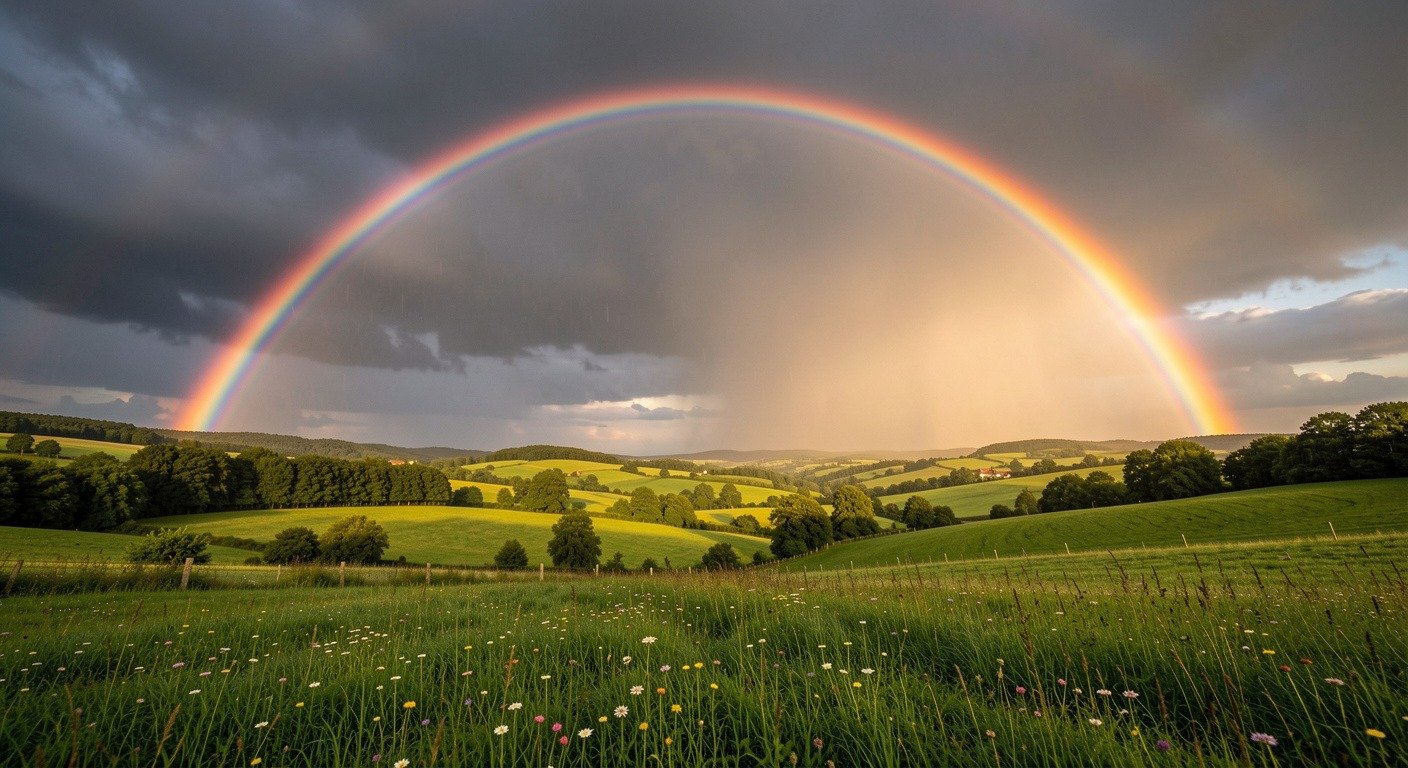
You step outside after a summer storm and there it is, a perfect arc of color stretched across the sky. This is how rainbows form: light, water, and geometry doing something fleeting and precise.
- Rainbows form when sunlight refracts, reflects, and disperses inside falling water droplets at a precise 42-degree angle.
- The colors always appear in the same order: red, orange, yellow, green, blue, indigo, violet (ROY G BIV).
- Double rainbows are produced by a second internal reflection at 51 degrees, with reversed colors and a dark band called Alexander’s Band between them.
- Every rainbow is a full circle. The ground cuts off the bottom half, which is why we see an arc from the ground.
- Rare types include fogbows, moonbows, and supernumerary rainbows, each formed by different droplet sizes and light conditions.
A rainbow is not an object at all. It has no fixed location. Walk toward it and it recedes.
Every rainbow is a full circle. The ground cuts off the bottom half, so we see only the arc. From an airplane, you can watch the complete ring of color hanging in the sky.
There is no end, therefore no pot of gold. This is optics, not folklore.
What a Rainbow Actually Is
A rainbow is sunlight split into its component colors by water droplets suspended in the air. The colors always appear in the same order: red on the outside, then orange, yellow, green, blue, indigo, and violet on the inside. Schoolchildren learn the sequence as ROY G BIV, a name that has outlasted every debate about whether indigo deserves its own slot between blue and violet.
Each droplet acts like a tiny prism, and the process takes three steps. Sunlight enters the droplet and slows down, bending as it crosses from air into water. This is refraction.
The light then reflects off the back inside surface of the droplet. Finally, it exits, bending again as it moves back into air. The full journey happens in a fraction of a second inside millions of droplets at once.
White sunlight contains every color in the visible spectrum. When the light bends, each color bends by a slightly different amount, a process called dispersion. Violet light, with the shortest wavelength, bends the most. Red light, with the longest wavelength, bends the least. This color-splitting is a cousin of the scattering that turns the sky blue: both are sunlight sorted by wavelength.
That is why red sits on the outside of the arc and violet on the inside, with every other color stacked between them in precise order. The same optics that explain how thunderstorms form also govern how rainbows form, just with water droplets instead of rising air parcels doing the organizing.
How Rainbows Form: Refraction, Reflection, and the 42-Degree Rule
The curved shape is not random. Light exits a water droplet at a fixed angle of roughly 42 degrees relative to the incoming sunlight. According to NOAA, every droplet that sends red light to your eye sits at exactly 42 degrees from the point directly opposite the sun. Droplets that send violet light sit at about 40 degrees.
The result is a circle of color, with each band at its own precise angle. A rainbow is always exactly opposite the sun. To see one, you need the sun behind you and rain in front of you.
The sun must also be below 42 degrees above the horizon, which is why these rainbow facts point to one reliable window: early morning or late afternoon. A midday sun sits too high for the geometry to work.
Each person sees their own rainbow, and this is not a metaphor. The angles are calculated from your eyes specifically. Someone standing twenty feet away is looking at light from different droplets, bent at the same angles but arriving from a slightly different position. No two people ever see the same rainbow.
A rainbow is not a thing. It is a relationship between the sun, the rain, and where you are standing.
The Joy of the Hunt and the Rare Rainbow Types
Rainbows do something to people. They are universally understood. A child in Mumbai, a farmer in Kansas, and a tourist in Iceland all stop to look up at the same physics.
Photographers who chase rainbows for a living know the craft behind the luck. A polarizing filter deepens the colors against a dark storm sky. Underexposing by half a stop keeps the bright bands from washing out. The window is short: most rainbows last between five and fifteen minutes before the rain moves on or the sun shifts position.
A double rainbow appears when light reflects twice inside each droplet. The second reflection sends light out at roughly 51 degrees instead of 42, producing a fainter outer arc with reversed colors. The dark band between the two arcs is called Alexander’s Band, named after a Greek philosopher who described it in the second century CE.
Other rainbow types are rarer still. A fogbow appears in fog rather than rain, with droplets so tiny that the colors wash out into a ghostly white arc. A moonbow, formed by moonlight instead of sunlight, looks pale gray to the naked eye but shows full color in long-exposure photographs.
Cumberland Falls in Kentucky is one of the few places on Earth where moonbows appear predictably.
Supernumerary rainbows show faint pastel bands just inside the primary arc, caused by wave interference between light paths inside droplets. At sunrise or sunset, when blue and green wavelengths are scattered away by the atmosphere, what remains is a monochrome red rainbow: all the same physics, stripped down to a single color. These rare rainbow types belong to a family of optical phenomena that includes halos, sundogs, and coronas, each with its own geometry of light and water droplets. Fogbows are another member of the same family.
Why Rainbow Science Still Matters
Understanding how rainbows form took centuries of patient observation. Aristotle wrote about them in the fourth century BCE but could not explain the mechanics. Rene Descartes published the 42-degree angle calculation in 1637, using geometry to show exactly how light bounces inside a sphere of water.
Isaac Newton closed the loop in 1672 by demonstrating that white light is a mixture of all visible colors and that a prism separates them in a predictable way. Together, these three men built the foundation of modern optics, and the rainbow was their test case.
That same rainbow science informs everything from fiber optic cables to the way lenses bend light inside a smartphone camera. The rainbow is a classroom that fits inside a raindrop.
There is a quieter reason the subject matters now. In a world where so much is mediated through screens, a rainbow demands that you go outside and look up. It cannot be streamed or downloaded in a way that captures what it actually looks like. It reminds people that the physical world is still capable of producing something that stops them in place, even if they know exactly how it works.
What We Can Learn
Knowing the physics does not dull the experience. It deepens it. When you understand that red sits exactly 42 degrees from the antisolar point and that every person around you is watching a different rainbow from different droplets, the thing becomes more remarkable, not less.
The practical takeaway is simple. After a storm, when the sun breaks through behind you and rain is still falling ahead, turn around. Look opposite the sun.
If the angle is right, the full circle is there, even if you can only see the top half. No camera will ever record what your own eyes see in that moment because the rainbow is not a fixed object in the sky. It is light, water, and your position in the world, arranged into color for a few minutes and then gone.
The rainbow you see is yours alone. Nobody else in the world is standing in exactly the right place.
The next time rain and sun arrive together, take the moment. The physics will do its work whether you understand it or not. But knowing the rainbow science behind the spectacle, the 42 degrees, the reversed colors of the double bow, the way each droplet becomes a prism, turns a pretty sky into something you see differently forever.